
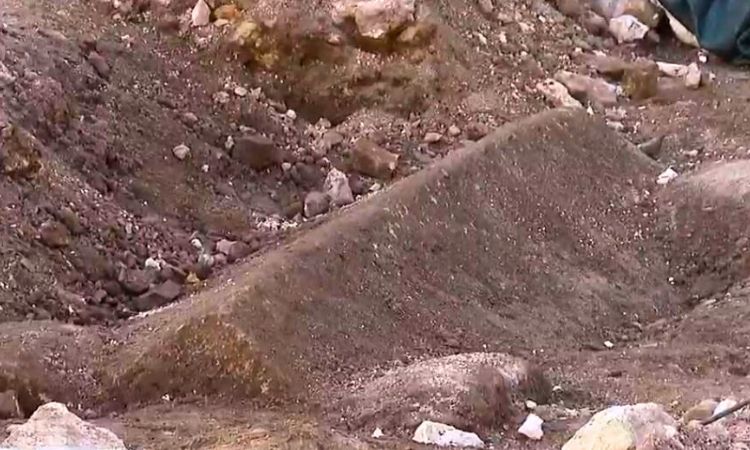
After five years of silence and inactivity a yet another mass grave has been dug up in Croatia. A mass grave found several days ago, in Taboriste near the town of Petrinja, was made public on Thursday March 15. Remains of 8 people, Croatian civilians, have been dug out near Petrinja’s rubbish dump site.
Utter horror. Utter atrocity.
The air in Taboriste is heavy, the scene sickening to intolerable levels, Vecernji List article says.
Predrag Matic Fred, minister of Croatian War Veterans visited the mass grave site at Taboriste.
“This is a hard story, one of the hardest in this job. We are standing at the 43rd mass grave in this region, and the work the professional teams, led by Grujic (Ivan Grujic, war veterans deputy minister) , is a humanitarian and civilization matter. Although Croatia is already recognized as a professional in this work, as we have more than 80% positive results in victim identification, we won’t rest until the last victim is found. We owe that to the victims and members of their families, whose lives during the past years have been anything but normal. We’re still searching for 1768 persons.”
In autumn 1991, the Petrinja area was captured by Serb forces and the Yugoslav National Army, which expelled the Croats from their homes, killing many of them. Until today, 45 mass graves had been found in the area around Petrinje. In August 1995, the Croatian army retook the territory in operation Storm, and most of the Serbs fled the territory.
The mass grave in Taboriste is the 145th mass grave found in Croatia since the end of the war of independence in 1995.
4,683 people have been exhumed from both individual and mass graves, of which 3,262 people have been identified.
Having visited the Taboriste mass grave site, Croatian Army Lieutenant Colonel Ivica Pandza Orkan said: “After this discovery we expect that someone will answer for these crimes. 1600 people were murdered in this area, 14 children among these victims. Dario Juric was two and a half and his brother Tomislav four years old.”
Away from this mass grave site in Taboriste there are still around 15,000 missing persons from Croatia, who “disappeared from the face of the earth” during the war.
It is frustrating and angering that Croatian President Ivo Josipovic, when referring to relations with Serbia, does not demand more forcefully Serbia’s cooperation in assisting with the location and identification of graves left in Croatia by thousands of Serbs who fled Croatia in 1995 and ended up in Serbia. A better cooperation from Serbia would mean a quicker resolution and closure on the matter of missing persons – and above all justice. Getting the information from Serbs on yet uncovered mass graves would also benefit the Croatian evidence against Serbia in the court case of genocide Croatia lodged against Serbia in the International Court of Justice (ICJ).
On March 16 he told the weekly NIN: “relations between Serbia and Croatia were better now than they had been a few years ago, and the likely political consequences to their mutual genocide lawsuits had been exaggerated”.
“The public, and therefore the political scene, in both countries is very sensitive when it comes to this issue. At the same time, the effects of the lawsuits might be overestimated as far as what is believed the suits can achieve … “
Josipovic said numerous open issues remained. “These are serious problems, but with what we have accomplished in our relations so far, we have created a good foundation to start talking very openly about these problems, and to finally start solving them, one by one,” he said.
Diverting the issue of fully resolving the question and facts of genocide committed by Serbs during the 1990’s war to political gains or losses, and considering the withdrawal of Croatia’s claim against Serbia at ICJ will only benefit Serbia and not Croatia. Josipovic should not be nebulising, speaking vaguely about Serb war crimes in Croatia, almost turning them into dust-specks that can be easily bypassed or blown away with political rhetoric, referring to many as “problems” or “serious problems”.
He, and the Croatian government, should be naming clearly and precisely these crimes; advocating strongly without holding back for Serbia to come clean and hand over all the records it holds of unsolved war crimes. Otherwise how will full justice be served, how will the aggressor be justly punished and answer for its crimes. In the EU circles Croatia should employ unwavering pressure to be placed upon Serbia to reveal the destiny of murdered thousands of people still missing from 1991/92. Otherwise, the desired goal of good relations between the people of Croatia and Serbia will most likely never be achieved. And, Serbia will slip quietly into EU membership without having to account for its part in the full range of genocidal operations against Croatian people.
One cannot but feel that the Croatian President and Government are walking on eggshells when it comes to addressing war crimes committed by Serbs in Croatia. Almost as if they don’t want to make any waves that would obstruct the building of amicable relations between Croatia and Serbia that European Union expects. For crying out loud – there should be no walking on eggshells when it comes to the pursuit of justice for the victims. Ina Vukic, Prof. (Zgb); B.A., M.A.Ps. (Syd)




 Croatia, the War, and the Future
Leave a comment