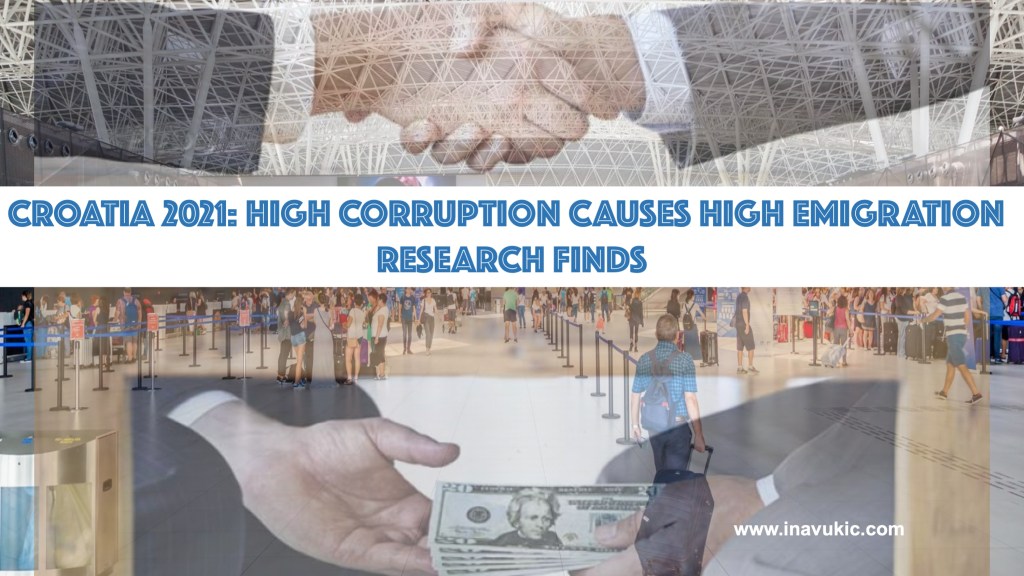

Corruption has countless manifestations. Prominent examples include bribery, embezzlement, misappropriation of public funds, nepotism, non-existence of equal opportunities in employment and public tenders and procurement, influence peddling, insider trading, extortion, and abuse of the public purse to name only a few.
Even bare logic alone tells us that nothing honest can come out of a dishonest process.
And so, nothing anti-corruption can come out of members of Zagreb Holdings management board placed in those positions via a corrupt process headed by the newly elected Mayor, green-left nutjob named Tomislav Tomasevic, even if such appointments are reportedly temporary or until a public recruitment process is undertaken. Tomasevic is giving his people, those he appointed directly to those positions, an advantage in their future competition for those positions – not an equal opportunity exercise by a long shot.
The new model of governing Zagreb announced as electoral promise (to rid Zagreb of corruption) by the We can! movement (green-left) Tomislav Tomasevic explicitly stated that members of the management board of Zagreb Holding (and other city companies) would be selected in a public competition and procedure to give everyone an opportunity to compete for the job. As soon as he became the Mayor of Zagreb, he broke that electoral promise and appointed people into those jobs without a publicly advertised recruitment process. Tomasevic says that he needed to do that because he found the state of the city’s finances and business in a shocking state and had to act quickly and appoint his people directly to the positions! It is obvious that he did that because he practices corrupt and biased measures that were and are associated with the former Yugoslavia regime and its generation of mass corruption. Tomasevic, is after all, a politician with a nasty communist mindset. Instead of getting rid of the Zagreb Holding Board incumbent Board members overnight he could have retained them while a public call for applications process was afoot.
Knowing whether corruption leads to higher emigration rates is important because most labour emigration is from developing to developed countries. If corruption leads highly skilled and highly educated workers to leave developing countries, it can result in a shortage of skilled labour and slower economic growth. In turn, this leads to higher unemployment, lowering the returns to human capital and encouraging further emigration. Corruption also shifts public spending from health and education to sectors with less transparency in spending, disadvantaging lower-skilled workers and encouraging them to emigrate.
Migration and corruption are among the defining issues of socioeconomic development across the world. Migration provides a lifeline and offers safety to millions, while corruption remains one of the most pernicious obstacles to economic and social development. Fighting corruption and managing migration have become major preoccupations of governments across countries at all stages of development. However, one yet needs to see real and sincere efforts being made by the government of Croatia to fight against both since the late 1990’s when the war of Serb aggression actually ended fully.
If corruption and nepotism are perceived to undermine meritocracy, it is a plausible reaction to turn towards opportunities elsewhere, especially among the highly skilled. This direct effect on individual migration decisions comes in addition to the negative indirect impacts of corruption on the economy or on security. Widespread corruption can hamper economic development and undermine the rule of law. The resulting poverty and insecurity can in turn stimulate the wish to leave.
Croatia has, with new research findings, joined the countries of the world where migration and corruption have been proven to have a causal relationship.
New research findings’ report („Research on Corruption in Croatia – Measuring Corruption“) and recent book (Gastarbeiter Millennials/Milennial Guest Workers) by Dr Tado Juric, political scientist and historian at the Catholic University of Croatia in Zagreb, point to Croatia as a country where corruption is on the rise as is the number of people leaving the country, emigrating.
Political corruption is growing in Croatia, which means placing its people in positions that govern society. What ‘hurts’ a little man is when someone with the same education as him in society passes, if he has connections and membership cards, while he or his children stagnate and regress, said Dr Juric last week for the Croatian Television show “Studio 4”.
The emigration of Croatian citizens, in addition to the dire consequences for the pension, education and health care system, also leads to an increase in corruption in Croatia. Statistics show that more than 370,000 Croatian citizens (a whopping 6-8% of total population!) have emigrated from Croatia during the past decade in search for a better life, employment and fairer life, while some 125,000 have come to Croatia, not all citizens. The sum of these entry and exit figures is a drastic decline in population leaving little hope for economic prosperity and autonomous well-being without injections from the Croatian diaspora that now numbers more Croatian people than Croatia itself. But that injection is likely to shrink significantly the longer the corruption is allowed to thrive.
The more people leave Croatia the more are the corrupt enboldened to continue with corruption as those who leave are among those that care the most, who are concerned the most, and who protest the most, wanting changes. Once they leave the country the number of people left that push for changes reduces. The results of Juric’s new paper and book link the reported increases in corruption and emigration – and explain how emigration is both the result of past corruption and the fuel for further corruption.
“Namely, if the critics leave, it becomes easier for the criticised,” Juric writes, adding that corruption is deeply rooted in Croatian society and has become a form of parallel system that undermines the economy.
“Increased emigration reduces the possibility of pressure from citizens on political elites, because it is those who leave who would be most capable of initiating change and they are the most motivated for change.”
With fewer people to hold power accountable, there’s more corruption. And when corruption runs rampant inside a country, those uninvolved want to leave to find honest work. Juric calls this the “departure of the dissatisfied.”
When Juric compared corruption and migration trends from 2012 to 2020, i.e. the number of emigrated Croats to Germany, where the majority of Croatian citizens emigrate, and Croatia’s positioning on the world scale of the corruption index, it turns out that corruption is more pronounced the higher the emigration. In 2019 and 2020, Croatia was ranked 63rd out of 180 countries, while before the peak of the emigration wave it was ranked 50th.
Corruption has done even more damage to Croatian national identity, sense of community and solidarity and Croatian culture in general than the damage it has done to the economy, which is unquestionably enormous. The main negative impact of corruption has affected human capital and political stability in the country. In Croatian society, corruption has become a kind of privilege of the elites, and the so-called major corruption, political corruption and clientelism and the so-called civil corruption.
“So called. elite corruption has also enabled a special phenomenon in society that can be called ‘elite revolt’. Elites are the ones who use the media space to protest against the media, citizens, institutions on a daily basis… which accustoms citizens to the practice that they should not express dissatisfaction with politicians, but politicians with them,” Juric points out.
He added that corruption is proven to be less present in developed economies, while in transition economies it is extremely developed that the smaller the population, the greater the corruption. The latest study on corruption research conducted on a sample of small, medium and large companies in Croatia (a sample of 178 companies, equally from each county) showed that companies believe that corruption has been growing in the last five years and that 65.3% of them 32.4% of companies believe that there are no significant changes, reports Croatian media.
The desire to emigrate is, and was, often driven by a lack of faith in local opportunities. Knowing this and having experienced this from its own fleeing and later emigration, as the borders of former communist Yugoslavia opened during the 1960’s, the Croatian diaspora had during the early 1990’s war of independence, Croatian Homeland War, stepped in and helped enormously the fight for democracy. The Croatian diaspora wanted the people and future generations of Croatia to have the same or similar local opportunities in life within Croatia as its children had in the “West”. To achieve this, eradication of corruption or its minimisation was seen as necessary for Croatia to survive into a well-developed country and democracy. Regretfully, corruption in many forms of manifestation still largely defines Croatia and its emigration is alarmingly high. Perhaps the new players, elected officials and councillors as local Municipal Councils that include relatively large numbers of relatively young people from relatively young political movements and parties will set a trend to Croatia’s recovery from corruption that will spill into national political platforms? However, if the majority of these relatively young people and new players now involved with local governments carry the heritage of communist Yugoslavia, because they grew up in communist families, no real progress can be expected; corruption is likely to “reign”. It will be interesting to follow, say the next couple of years, how many local corrupt thugs are exposed and brought to justice. Ina Vukic





 Croatia, the War, and the Future
Leave a comment