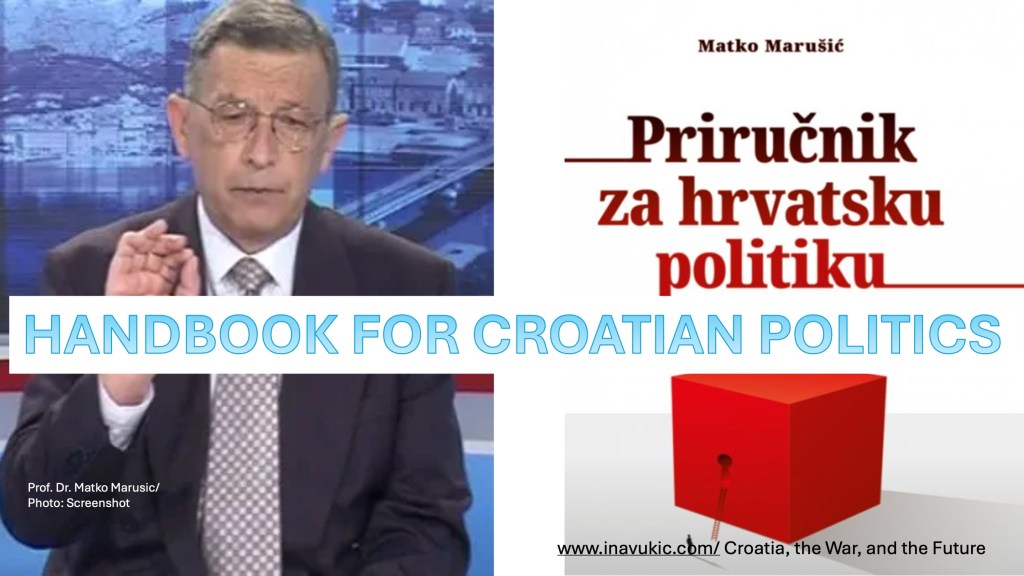

With regards to his latest book “Handbook for Croatian Politics” (Priručnik za Hrvatsku Politiku) Croatia’s world-renowned academic, professor emeritus Matko Marusic from the city of Split said: “I am very interested in politics because I believe that it has a significant impact on our lives, perhaps most on the lives of those who say: ‘I am not interested in politics’. But I have noticed that people talk a lot about politics, most of the time fiercely and with conviction, without knowing the basic facts that lie behind the topic they are talking about. So, I got tired of saying: ‘But you forgot this…’, ‘You didn’t take into account that…’, ‘Don’t you know that…’ so I decided to write a handbook of basic knowledge that one should have in order to engage in political discussions. I don’t know if the ‘Handbook’ will fulfill the function I intended for it, but I don’t know better than that. However, I was the first one to find the book useful because I learned a lot while putting it together.”
Prof. dr. Matko Marusic published this new book late last year and it represents to the view of many, including myself, a very significant piece of work that spans over 600 pages. It is a book that is easy to read despite its large size. The reader will find a great deal of useful information in this book. With all this and more the book is sold online by Knjižara Ljevak for 32 euro, which is a most reasonable and considerate price given the wealth of knowledge it brings to the reader. Given that new parliamentary elections in Croatia have just been announced, to held late April to mid-May 2024 (date to be announced by Croatia’s President in the coming couple of weeks), introducing here the content of this book will hopefully motivate many voters to vote on election day. The voter turnout at elections in Croatia has been quite poor for the past two decades and therefore, whichever government or whatever seat in parliament is thus filled are not convincingly representing most people. Minority governments have been a trend because of that and this needs to change.
It is a fact that Croatia has been under a constant political crisis during the past couple of decades particularly laced with overwhelming scandals of corruption and nepotism. It appeared as if voting at elections made no difference, that situation will not improve for the better. Hence, many failed to vote at elections, forgetting that voting at elections does and can move mountains for the people and bring change. Croatians need only to remember the Independence Referendum of May 1991 in which almost 94% of eligible voters to secede from communist Yugoslavia.
This handbook has 24 chapters divided into four categories: “Croatian political history”, “Croatian neighbours”, “Independent Republic of Croatia” and “What should we do, then?”. The extensive index contains about 1000 terms at the end and is divided into five parts: 1. Battles, wars, rebellions, and revolutions, 2. Documents, 3. Names, 4. Organisations, movements, bodies, and military units and 5. Crimes. This makes it easier to search for information. In addition, the text refers the reader to the pages that should be viewed when reading a particular topic. This book is a major piece of work by anyone’s standards, interesting and useful, and offers a huge number of unknown or relatively unknown data as well as those that have been forgotten or distorted, all of which are very important for Croatian history, politics, sociology, and economy.
For example, on Croatian political history the reader comes across interesting, little-known or perhaps forgotten facts or data such as:
- Unlike most medieval states and although it did not have full independence, Croatia was governed from 1273 to 1918 by the Croatian Parliament.
- Dalmatia was handed over to Italy by the Yugoslav (Serbian) government in the Treaty of Rapala in 1920, and Ante Pavelic had to confirm it in the Treaty of Rome in 1941.
- Punisa Racic, who in 1928, during the session of the National Assembly in Belgrade, killed Stjepan and Pavle Radic and Đura Basaricek, and seriously wounded Ivan Granđa and Dr. Ivan Pernar, was sentenced to prison, which he served in a hotel, with his own servants.
- Jewish municipalities, at least partially, operated in the territory of the NDH (World War Two Independent State of Croatia), and the Jewish Municipality in Zagreb operated until the very end of the war and its archive material has been preserved. The Croatian people massively and intensively protected the Jews. Miroslav Salom Freiberger, the Zagreb treasurer, was a great friend of Cardinal Alojzij Stepinac; they worked together to save the Jews and both refused to leave their peoples and go to safety, and both perished.
- In 1943, the Zagreb football clubs organised a “user” competition, from which all proceeds went to Hajduk from Split.
- Tito personally ordered the killing of the Croats at Bleiburg.
- When the Croatian Spring of 1971/72 was broken. More than two thousand Croats were arrested and sentenced, and more than 100,000 people were thrown out of their jobs, dismissed, removed, or socially degraded. As many as 50 journalists were sentenced to prison terms, and 172 journalists and publicists were “blacklisted”. Matica Hrvatska (non-government organisation promoting Croatian national and cultural identity since 1842) was shut down and its work was banned, and many of its members were imprisoned.
- Communist Yugoslavia declared bankruptcy in 1982.
In the part of the book that deals with the destruction of the Croatian State from within, Marušić talks, among other things, about “de-Tudjmanisation”, which aimed to criminalise the Homeland War and through fabricated and false accusations of war crimes against leading Croatian generals at the international criminal court in The Hague, and about public promotion incidents aimed at stigmatisation of Croats as Ustashas and criminals. That part of the book also talks about Yugoslavianism, UDBA, persistent Greater Serbia policy, attacks on Croatian education, unfavorable portrayals of the state of affairs in the country, and more. That chapter is extensive because it refutes the views of the main attackers of the Croatian State.
As part of this book the author has also delved into a SWOT analysis of Croatia in which he sees the following elements to weigh up in the analysis:
- Croatian STRENGTHS are: belonging to the West; patriotism; faith; geopolitical position and beauty of the country.
- WEAKNESSES: mentality of socialist idleness and weak work ethic; corruption; slow recovery of higher education; fragile economy; demography; internal social discord.
- OPPORTUNITIES: preserved environment; EU and NATO membership; and international reputation and cooperation (which Croatia has never had before).
- THREATS: Croatia should and can solve internal problems on its own, and the EU is helping it a lot.
An down-to-earth perspective on politics, political history, political intrigues and indicdents that shape a nation indeed; it’s today and tomorrow.
However, the true and tested reality remains and that is that Croatia cannot address effectively its internal and external threats without the massive help from its voters at elections. In reality, the EU is a cauldron of multitudes of differing political sides and pulls which can either be a threat or a benefit to a single member country like Croatia and I believe that Croatian voters are the single most important force that can make Croatia better for all, not just some.
Hence, I hope Croatian voters in particular will arm themselves with this book, or sections of it, or even with the very idea of doing their utmost in making sure their vote counts and head to the polling stations on election day 2024. Ina Vukic




 Croatia, the War, and the Future
Leave a comment