Lack of memory, or worse, selective memory, continues to obstruct progress of a fully democratic society in Croatia and is increasingly common in Europe. Both realities are infuriating, to say the least, to the concept of human equality and decency. Furthermore, selective memory, which victims of historical horrors deserve remembrance and honouring, and which are to be forgotten and trivialised is enforced by various memory laws. Hence, in Croatia, still, the victims of communist crimes, people who fought for the independence of Croatia during World War Two and their plights, instead of remembrance receive condemnation by much of the official state which, regretfully, leans too far to the left of the political spectrum to be able without a significant mind-switch to treat all victims of murder equally, regardless of who committed the murders. Communist crimes’ executioners, the partisans – are still kept on the pedestal of high honour which, when looking from the perspective of some two thousand mass graves discovered during the past 35 years, they do not deserve.
This is a disturbing consequence of the lack of decommunisation in Croatia after the collapse of Yugoslavia and the survival of communist elites – elites that have legitimised themselves by manipulating the past.
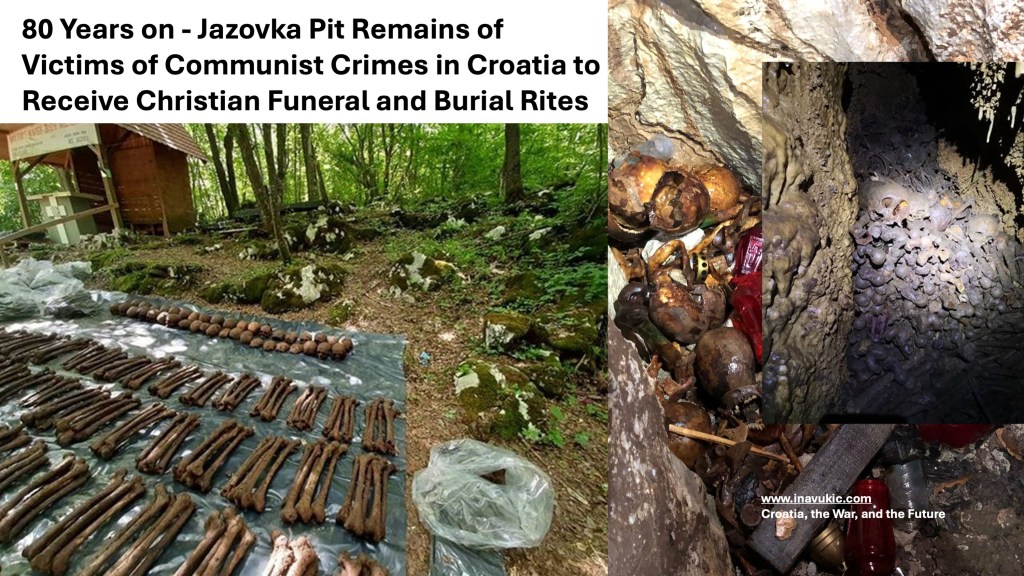
It is thus most encouraging for justice for all victims to have received the news that a Holy Mass following with Catholic funeral and burial rites to follow of 341 out of the 814 Croats massacred by communist partisans in 1941, dumped into the Jazovka Pit, will take place Saturday, August 23, 2025, which is the European Day of Remembrance for Victims of Totalitarian and Authoritarian Regimes – Nazism, Fascism and Communism, also known as Black Ribbon Day!
LOCATION OF HOLY MASS: Parish of St. Mary Magdalene – Oštrc, near the Jazovka Pit – Sosice and also the Greek Catholic Parish of St. Peter and Paul – Sosice
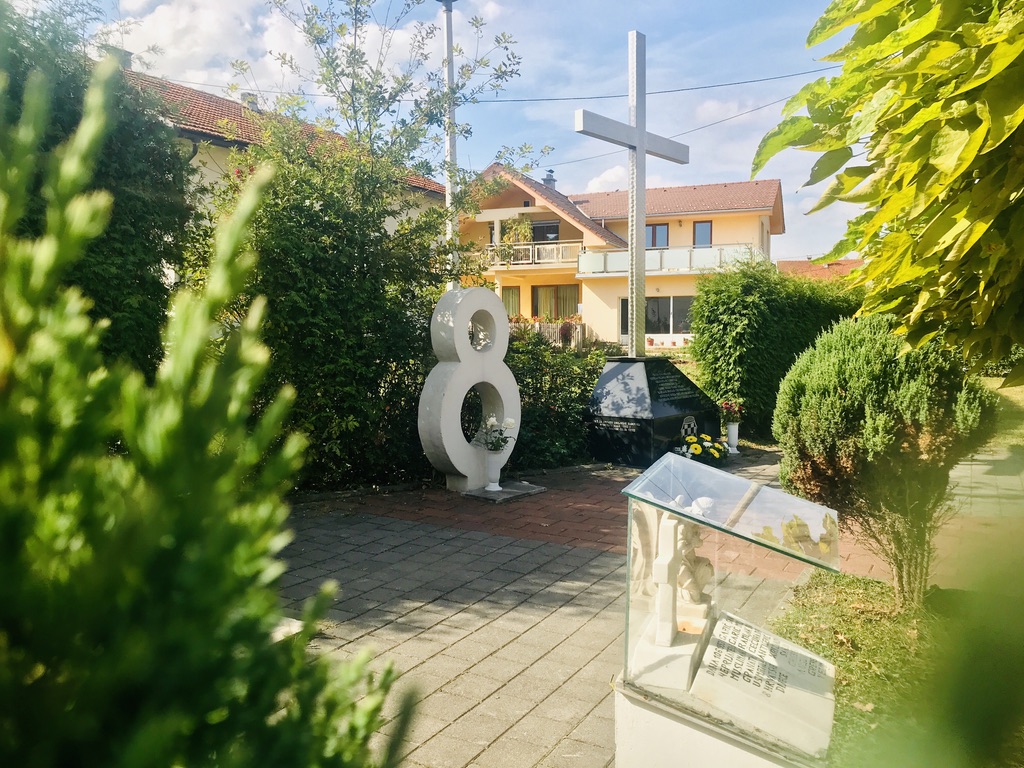
The beginning of the Holy Mass at the Jazovka Pit at 10:00 a.m., led by Msgr. Drazen Kutlesa, Archbishop and Metropolitan of Zagreb and President of the Croatian Bishops’ Conference in collaboration with numerous bishops and priests, nuns and faithful people of God. Immediately after the Holy Mass ends the procession will descend towards the road to the ossuary (grave) where there will be a burial and a Catholic funeral rite for all the victims and all the remains (bones) that are returned to the tomb, the bones will be placed in small coffins. All those who will not be able to come will have the opportunity to follow these events live via Croatian Radio and Television!
Jazovka Pit is just a very small example in the scheme and the carrying out of communist crimes in Croatia. On 15 May 1945 communist partisans took numerous wounded Croatian soldiers, known as Home Guards, from Zagreb’s hospitals and brought them to the psychiatric hospital in Vrapce, a suburb on the outer perimetre of the capital, run by the Sisters of Charity. Once there, all the prisoners of war were strangled or butchered in the basement of the hospital. After killing them, the partisans loaded the corpses into trucks and transported them to Jazovka, a pit in the ground of the dense Zumberak Mountains area. Three nuns who witnessed the massacre were also massacred soon after by the partisans who wanted to cover up their horrific tracks. The three nuns were thrown into the Jazovka Pit together with the corpses of many Croatian soldiers, doctors and civilians. The corpses not taken to Jazovka were taken to other pits and mass graves filled with the remains of communist crimes victims.
While local people retained the memory of these horrific events of mass murders by the partisans, the communist government of Yugoslavia suppressed any records or information about them. Just as it did for over a thousand mass graves of Croats they slaughtered. In 1990, during Croatia’s increased push for independence from Yugoslavia and political turmoil that ensued after the fall of socialism/communism, the Jazovka pit was discovered. At a depth of around 40 metres (131 ft), the remains of more 800 skeletons were found but the exhumation of the victims’ remains would not take place until July 2020, when the Croatian Veterans Ministry began work and determined that there were at least 814 skeletons in that pit. The first victims were Croatian soldiers captured in January 1943 and executed by the partisans. In 1945, the partisans used the pit for victims from Zagreb hospitals: wounded prisoners, civilians, doctors, nurses, and Catholic nuns. Most were dead when they were thrown into the pit, but others were thrown in alive to die in terrible agony.
To ensure that these events are not forgotten again, as they were during the existence of communist Yugoslavia, and to honour the victims, a pilgrimage to Jazovka Pit takes place every 22nd of June. However, June 22nd is also a public holiday in Croatia (‘Anti-Fascist Struggle Day’) in remembrance of WWII and post-WWII communist partisans, i.e. the group to whom those who murdered thousands of people in Jazovka and in many other places belonged. On 22 June 1941 the first Croatian communist partisan unit was supposedly formed around a group of communists from Sisak who took up arms to ‘fight fascism.’ This story of the Sisak anti-fascists is an invention of Croatian national-communist historiography in the 1960s—an invention that succeeded and became a state holiday even after the establishment of independent Croatia in the 1990s. In the Yugoslav communist period, the official start of the anti-fascist partisan struggle was celebrated on 29 June, the date on which the Yugoslav Communist Party began the uprising in Serbia in 1941.
Hence, two deeply opposite commemorations are held in Croatia on June 22nd: one in Sisak, in honour of the communist partisans, the butchers of Croatian patriots, and one in the vicinity of Jazovka Pit, for communist partisans’ victims. For Croatia, the country that spilled rivers of its own blood for freedom from communist Yugoslavia during the 1990’s, this political reality is surely the greatest stumbling block and barrier for full democracy and for the realisation into life of values set for the country by its independence war. It is, therefore, reassuring to learn that the Jazovka Pit victims will, this year, receive a special place on the very day when Europe marks remembrance of victims of totalitarian regimes. At least on that day the lies and coverup of crimes maintained by apologetics of communism will lose on strength and validity. Ina Vukic




 Croatia, the War, and the Future
Leave a comment