
Supported in UN Voting for Two State Solution to Palestine/Israel Question

When Ursula von der Leyen, president of the European Commission, impeccably dressed in a tailored army-green jacket started delivering her 2025 state of the union address last Wednesday 10 September smiles, handshakes, butterfly kisses to and from some politicians were only a warm prelude to a stark, sharp statement in her speech in which she said:
“Europe is in a fight. A fight for a continent that is whole and at peace. For a free and independent Europe. A fight for our values and our democracies. A fight for our liberty and our ability to determine our destiny for ourselves. Make no mistake – this is a fight for our future… Europe must fight. For its place in a world in which many major powers are either ambivalent or openly hostile to Europe…A world of imperial ambitions and imperial wars. A world in which dependencies are ruthlessly weaponised. And it is for all of these reasons that a new Europe must emerge…This must be Europe’s Independence Moment. I believe this is our Union’s mission. To be able to take care of our own defence and security. To take control over the technologies and energies that will fuel our economies. To decide what kind of society and democracy we want to live in. To be open to the world and choose partnerships with allies – old and new. Ultimately, it is about having the freedom and the power to determine our own destiny. And we know we can do it…”
Her speech was quite unsettling in its warnings and moving in its details. For example, she told the story of an eleven-year-old Ukrainian boy, Sasha, who had been abducted by Russian soldiers, but who had been rescued and sat in the audience with his mother as she delivered her speech. She announced that she would host a “Summit of the International Coalition for the Return of Ukrainian Children.”
There was much more in the speech, but the bottom line was that Europe had to take responsibility for its own security in the face of an increasingly aggressive and determined Russia, led by Vladimir Putin. Notably, she mentioned the United States only a few times, and almost exclusively in relation to trade tensions. She did not mention US President Donald Trump at all, other than an oblique reference to his meeting on August 15 with Putin: “There was much more in the speech, but the bottom line was that Europe had to take responsibility for its own security in the face of an increasingly aggressive and determined Russia, led by Vladimir Putin. Notably, she mentioned the United States only a few times, and almost exclusively in relation to trade tensions. She did not mention US President Donald Trump at all, other than an oblique reference to his meeting on August 15 with Putin: “…This war needs to end with a just and lasting peace for Ukraine. Because Ukraine’s freedom is Europe’s freedom. The images in Alaska were not easy to digest.”
“What is happening in Gaza has shaken the conscience of the world. People killed while begging for food. Mothers holding lifeless babies. These images are simply catastrophic. So, I want to start with a very clear message: Man-made famine can never be a weapon of war. For the sake of the children, for the sake of humanity – this must stop. This is also part of a more systematic shift in the last months that is simply unacceptable. We have seen the financial suffocation of the Palestinian Authority. The plans for a settlement project in the so-called E1 area which would essentially cut off the occupied West Bank from East Jerusalem. The actions and statements by the most extremist ministers of the Israeli government which incite violence. All of this points to a clear attempt to undermine the two-state solution. To undermine the vision of a viable Palestinian state and we must not let that happen…”
What caught my attention and struck me rather stunned was that while she referred to World War Two and the fall of the Berlin War in 1989 any mention of the United States as an ally or security partner was left out in her speech. It remains to be seen precisely what role the United States will play in the European emergence that von der Leyen envisions as she says, “This must be Europe’s independence moment.”
While von der Leyen marched on with her speech with the confidence of a warrior who has full support among the ranks on that enormous semi-circle debating chamber in Strasbourg it didn’t take long after she finished her hour-long speech to hear responses to her speech that were as tough as her speech. “We are losing Europeans; we’re not taking them with us. We’re weak when they want protection,” Valérie Hayer, leader of the centrist Renew group. “The summer was very painful,” said Greens co-chair Bas Eickhout. “Europe has entered a world of power, yet we are still playing chess in a boxing match.” He told the leader of the EPP group Manfred Weber: “If you want unity, work with us, not with the screaming side of parliament,” referring to the far right. Which would seem to strongly suggest the EU is still swimming in global waters without a united rudder.
Indeed, only days before her speech Mario Draghi, the former Italian prime minister, said events had “swept away any illusion that economics alone could ensure geopolitical power”. Europe, he said, was “ill-equipped in a world where geo-economics, security and the stability of supply sources, rather than efficiency” shape international trade relations. He said the EU had to “adapt to the existential demands of its time”.
During von der Leyen’s speech, applause was heard, as well as loud negative cheers and whistles that tried to interrupt her. She warned them several times to stop. After the speech, some of the presidents of the largest European parliamentary groups and other speakers criticized her for being weak. “Where is Europe, where is Europe in Gaza?”, “You are destroying Europe” and “Go home” were some of the calls made to the President of the European Commission.
The reality in the European Union seems unfortunately much different than what its president is trying to portray. People are primarily concerned about their own security and competitiveness. Over a year ago voters at EU Parliament elections decided for changes that were to be radical and that the will of the people must be considered for changes to succeed. Since then, the world has changed, and geopolitics demand new resolve. Perhaps, it will be a firm hand similar a the one that is palpable in von der Leyen’s speech that will keep the EU together. This way it looks as though it is slipping away through the fingers of most capable and prudent politicians and member states of which Croatia is one.
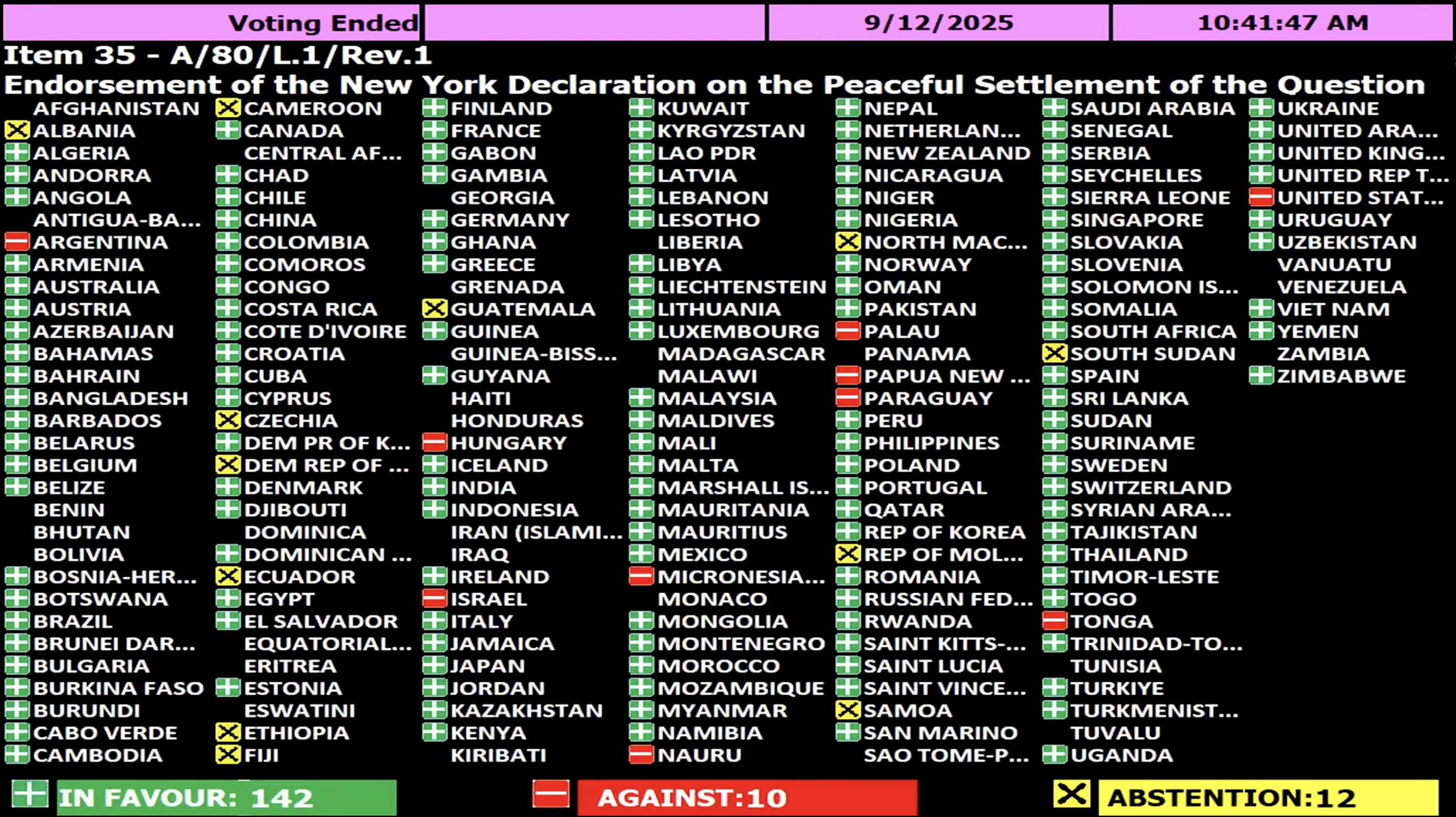
If one judges by the results of voting in the UN General Assembly on 12 September 2025 on the resolution endorsing the New York Declaration on the Peaceful Settlement of the Question of Palestine and the Implementation of the Two-State Solution, then at least some of the key EU directions set by Ursula von der Leyen in her said state of the union speech are under a “go-ahead” green light. Voting results for Palestine were: In favour 142, Against 10, Abstain, 12. Hungary appears to be the only EU member state that voted against the resolution even though the Russian Federation, with whom Hungary sides when it comes to the war in Ukraine, has voted for the resolution. It is of note here to say USA and Israel voted also against the resolution. Regretfully, the tapestry appears set for ongoing political discord and upheaval and continued insecurity for the ordinary person across the world. Ina Vukic



 Croatia, the War, and the Future
Leave a comment