
BLEIBURG – THE BLOODY SPRING IN SOUTH CARINTHIA 1945 AND THE TRAGEDY OF THE CROATIANS
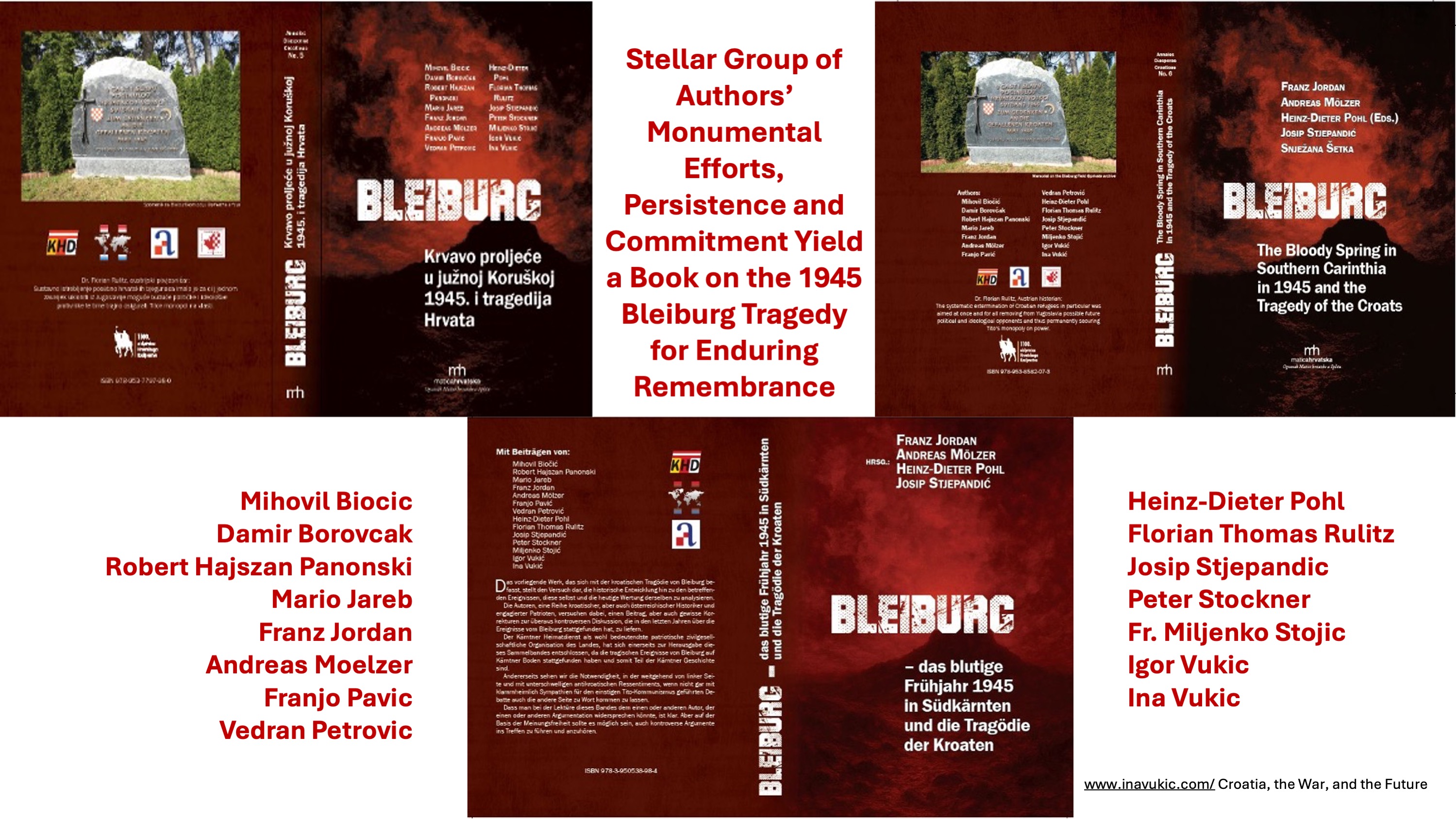
I am so very proud to have co-authored with 14 other authors this book that is being published in three languages: Croatian, English and German. Through various, important and relevant topics, presented professionally and factually, this book addresses the tragedy of the patriotic Croatian people during and after World War Two at the hands of Yugoslav communists and their terrible crimes. The younger generations, born to Croats especially, are the most important and most affected stakeholders in understanding and retaining a Croatian identity and this book, to my view and the view of many provides them with a personal and national resource to cherish.
The well-attended book launch, led by the renowned award-winning journalist, author and film director Nada Prkacin, occurred in Zagreb, Croatia, on Friday 3rd October 2025. Nada Prkacin was born in 1968 in Pozega, Croatia, graduated from the University of Zagreb with a degree in journalism. She was a War reporter from the East Slavonian warfronts during the Croatian Homeland War of 1990’s. She is the author of several books, a screenwriter and the director of over thirty documentary films. The topics she covers are taken from Croatian history. She also deals with them in her journalistic and research work. She is a winner of several distinguished awards for her work. Currently. Nada is a PhD candidate in history with a focus on communist crimes. Following are excerpts from her speech at the book launch:
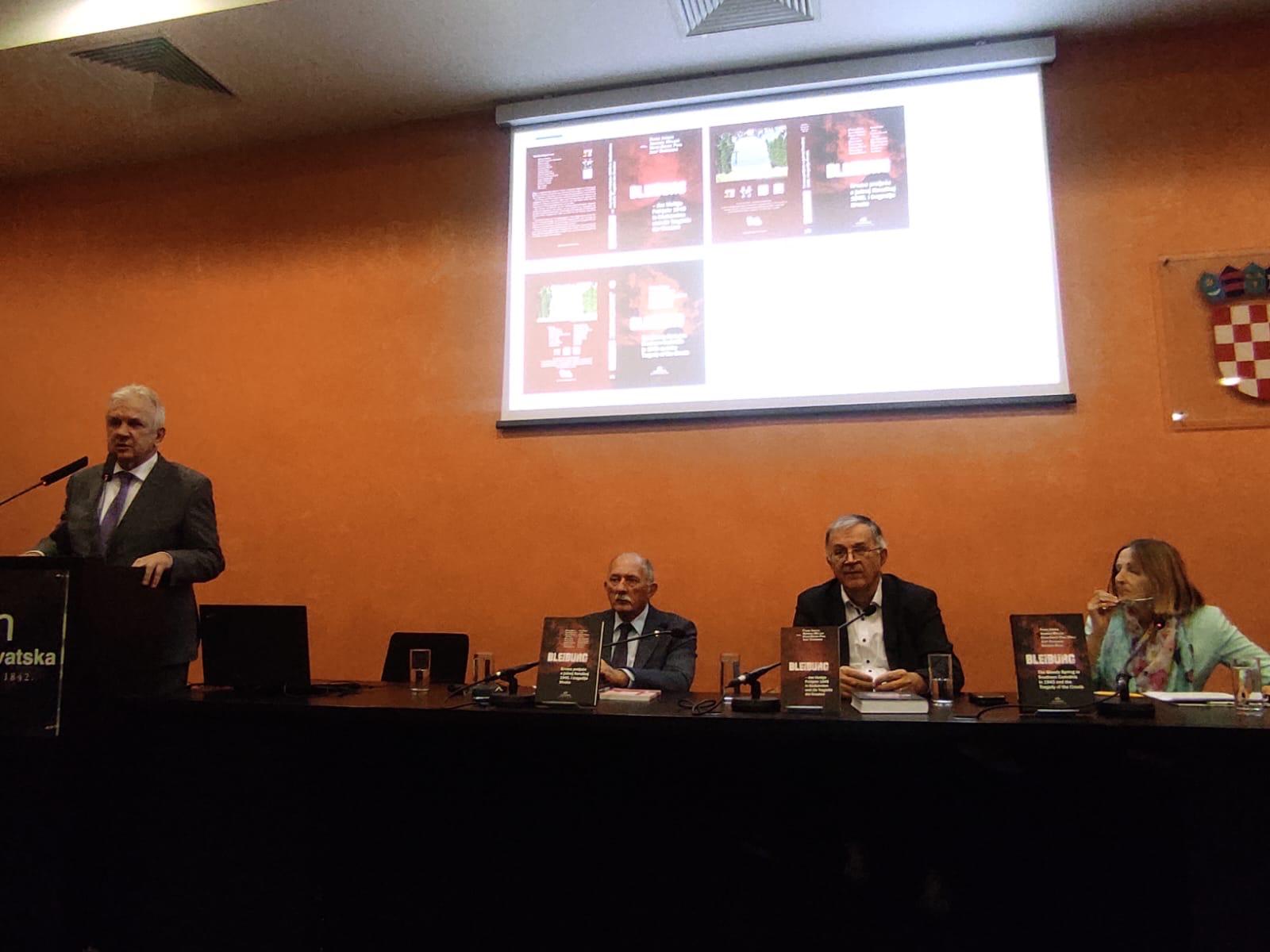
“This book titled “BLEIBURG – THE BLOODY SPRING IN SOUTH CARINTHIA 1945 AND THE TRAGEDY OF THE CROATIANS” is published by the Split Branch of the Matica Hrvatska (Matrix Croatica) and co-published by the Croatian Academy of Sciences and Arts in Diaspora and Homeland, tells of the unimaginable crimes committed by Tito’s criminal Yugoslav People’s Army. And this with the assistance of British troops who fraudulently disarmed members of the Croatian army and sent back desperate Croatian refugees by train.
To make no mistake, it was not only Croats who were killed, there were many others in the death columns…The images are terrible, the numbers are terrible, and the consequences of the terrible massacre are still felt today in all areas of life in Croatia. Perhaps the most important thing is that Croatian youth were killed on that road, those who were yet to become parents – fathers and mothers.
Today, we have no direct descendants of the victims of the Way of the Cross.
How many of us would there be if Bleiburg had not happened?
The editors of the book we are presenting today are Franz Jordan, Andreas Moelzer, prof., dr. Heinz-Dieter Pohl, Josip Stjepandic and Snjezana Setka. Translation by Marina Manjaka, dr. sc Robert Hajszam Panonski and Ina Vukic, proofreading by Dubravka Puljiz and excellent graphic preparation by Dejan Berlan. The afterword was written by Franjo Pavic and also prof., dr. Heinz-Dieter Pohl. It was printed in 1000 copies in Grafotiske Grude, with the support of the Split-Dalmatia County.
The collection contains 18 papers and three homilies. Some papers are enriched with photographs, archival material, geographical maps and tables. The introductions were written by Snjezana Setka and Josip Stjepandic.
There are fifteen authors. In alphabetical order, two to three sentences about each:

Prof. dr. sc. Mihovil Biocic (born 1946 in Kastel Sucurac). Specialist in Pediatric Surgery and General Surgery, Doctor of Science, taught at the Faculty of Medicine in Split. With a brilliant scientific biography, especially from the Homeland War when, among other things, he was a surgeon in war hospitals on the Southern Front. He is the author of numerous articles on current problems of Croatian society and politics, and we recently had the honour of attending the presentation of his book Lies about Serbian Antifascism and Antisemitism.
Damir Borovcak: (born 1949 in Zagreb) graduated in mechanical engineering, retired. Historical researcher, political analyst, travel writer, publicist. Damir is the author of about 20 books that mainly deal with major Croatian execution sites such as Zrin, Gvozdansko and Macelj. He is a valuable member of Croatian victimology societies, a tireless spokesperson for the truth about Croatian martyrdom throughout history.
Dr. Robert Hajszan Panonski, born in 1948 in Guettenbach. In addition to teaching at the Secondary School and the Pedagogical Academy in Eisenstadt, he published many scientific papers and was the editor of proceedings and journals. The list of his scientific articles and monographs is longer, as are the awards for his dedicated work.
Dr. Mario Jareb (born 1969 in Zagreb), Croatian historian who works at the Croatian Institute of Historical Sciences. His field of study is contemporary Croatian history. He has published many scientific papers and books. The topics he deals with are sometimes labelled as controversial, although in reality they are not, e.g. the Independent State of Croatia, the activities of the Zagreb Archbishop Alojzije Stepinac during World War II, national symbols.
Franz Jordan was born in 1959 in Klagenfurt. Paramedic in the Red Cross Emergency Department. Active in the Carinthian Homeland Service. From his areas of activity, I would like to highlight the care for victims of all totalitarian regimes in the war and post-war period, along with the memory of victims killed by Tito’s partisans. One of those who organises commemorations for victims and fosters a culture of remembrance outside the borders of Croatia.
Andreas Moelzer born in 1952 in Loeben, publicist and political advisor, one of the leading Austrian Christian Democratic intellectuals, during the war in Croatia he advocated for Croatian independence. He studied law, history and ethnography at the University of Graz. Since 2020, president of the Carinthian Homeland Service, the largest patriotic civic initiative in Austria. Most importantly, he is a father of six children.
Franjo Pavic born in 1960 in Virovitica. Engineer and entrepreneur, since 1971 he has lived in Germany. Member of various cultural associations on a voluntary basis. One of the initiators of the restoration of the Bleiburg Monument.
Vedran Petrovic, born in 1980 in Tuzla. A descendant of ethnic Germans from Brcko, his family lost 34 members in World War II. Currently pursuing a doctorate in history at the Faculty of Croatian Studies.
Heinz-Dieter Pohl – a well-known linguist from Austria, especially in historical linguistics. As a professor at the University of Klagenfurt, he has published numerous scientific publications. In his texts, he emphasizes how historical events are related to language and cultural identity in general. He is important for the reconstruction of the communist period of Josip Broz’s rule and the consequences of that rule on the Alpine-Adriatic region.
Florian Thomas Rulitz, Austrian historian and expert in contemporary history with an emphasis on crimes and post-war events in the Alpine-Adria region, especially in connection with the massacres in Bleiburg and Viktring. Extremely important for a true, real culture of remembrance of the events of May and June 1945.
Josip Stjepandic born in 1961 in Modrica, graduated in mechanical engineering in Zagreb, received his doctorate in Graz as the youngest doctor in history at the time. He is the author of about 50 scientific papers and 20 books. He is the president of the Croatian Academy of Sciences and Arts in Diaspora and Homeland.
Peter Stockner, Austrian writer, historian of his homeland (if I may use that term) and president of the Fellowship of Former Members of the 139th Mountain Infantry Regiment. For decades he has been researching the war service and imprisonment of his father, as well as his comrades, in communist Yugoslavia. His father returned home from Yugoslav-communist captivity in 1948 weighing 37 kilograms.
Fr. Miljenko Stojic born in 1960 in Dragicina near Medjugorje, Franciscan monk, contemporary Croatian writer and journalist. Initiated committees for the arrangement and marking of cemeteries from World War II and the postwar period in Herceg Bosna. Member of the HBK Commission for Croatian Martyrology. Vice-postulator of the martyrdom proceedings of Fra Leo Petrović and 65 brothers.
Igor Vukic, born in 1966 in Zagreb. Graduated from the Faculty of Political Science, currently a doctoral candidate at the Faculty of Croatian Studies. Formerly a journalist, today president of the Society for Research on the Jasenovac Triple Camp. Author of books and many articles about the Jasenovac labour camp.
Ina Vukic, born in Croatia in 1949, lives in Australia, contributed significantly during the struggle for Croatian independence. A psychologist by profession, a successful blogger in English, she tirelessly writes about the challenges Croatia has been dealing with since the fall of the Berlin Wall, i.e. communism. Vice-president of the Croatian Academy of Sciences and Arts in Diaspora and Homeland.

BOOK CONTENTS
The chapter titles also speak for themselves. Two or three sentences about each of them…
The Croatian tragedy is also part of Carinthian history. (Andreas Moelzer) The chapter discusses how the great Croatian tragedy remained in the collective consciousness of the Carinthian population that witnessed it, and that the commemoration of this tragedy should be a point of union, not separation, between the two states, or rather the institutions responsible for commemoration.
Austrian Croatian historical interference and the settlement of Burgenland Croats in the 16th century. (Robert Hajszan Panonski) The historical perspective given in this paper addresses the perception of war crimes and the dominance of the “victor narrative” after World War II, as well as the consequences for the culture of memory due to this and such a narrative according to which the victims are the criminals and the criminals are the victims.
Croatia in the clutches of Greater Serbia from 1918 to 1945. (Mihovil Biocic) Here we follow the spiral of violence against the Croatian people due to the forcibly imposed Serbian domination as well as the consequences of that violence. Everything written is documented, on the basis of which it is crystal clear that the crimes in the synergy of Greater Serbia and communist ideology were not spontaneous but carefully planned.
The Jasenovac camp 1941-1945. as a motive for long-term political conflicts. (Igor Vukic) The main thesis of the work is that the camps in Jasenovac and Stara Gradiska were not places of mass and serial murders, so the number of victims cannot be what is imposed.
Partisan massacres of the Franciscans of the Herzegovina Province. (Vedran Petrovic, Fr Miljenko Stojic) This chapter presents the systematic massacre of the Franciscans of the Herzegovina Province in Siroki Brijeg and the surrounding area in February 1945 as one of the most drastic examples of partisan terror against Croats in Herzegovina. It reminds us of the fact that in today’s Croatian society, the descendants of the perpetrators of that time play an important role in the governing apparatus.
The Bleiburg Massacres versus the “Great Finale in Carinthia.” (Dr. Florian Thomas Rulitz) This chapter summarizes the central issues and insights into the events in Carinthia and the massacres in May 1945 on Austrian territory, as well as their perception in historical research and the culture of remembrance. This chapter sheds light on the brutal reality of reprisals, violence, and mass murders committed under the guise of liberation from fascism, but in reality, the violent implementation of the communist revolution, which dealt with dissenters in the worst possible way.
The Bleiburg Massacres: Eyewitness Testimonies on the Killing of Croats in Carinthia. (Dr. Florian Thomas Rulitz). This historical study explicitly deals with the victims of the Bleiburg Massacre and the Bleiburg and Viktring Tragedy in Austria, their actual numbers, the locations of the execution sites, the memories of eyewitnesses and the consequences of what happened, as well as the difficulties of dealing with the described events.
Macelj: The Scene and Place of Commemoration of a Little-Known Mass Crime. (Damir Borovcak) It is estimated that more than 12,000 Croatian prisoners were killed at Macelj, including 21 priests and seminarians. 1,163 victims have been exhumed from 23 graves so far. What about the other 130 previously unexamined graves? The chapter reminds us that Croatian institutions are insufficiently prepared to face the consequences of the crimes of the Yugoslav communists despite the European Parliament’s resolution condemning communist crimes. Conclusion: NO to border, NO to revenge, we only seek the TRUTH.
A contemporary account of the Austrian Heinrich Stockner: The crimes of Tito’s partisans against defenceless German prisoners of war. (Peter Stockner) This chapter sheds light on the little-researched history of German Wehrmacht soldiers in Yugoslavia after the end of World War II on May 8, 1945, as well as the diversity of views on the events after the war regarding the atrocities of communist partisans.
Reflections on equal research into National Socialist and communist crimes in the Alps-Adriatic region. (Prof. Dr. Heinz.Dieter Pohl) The chapter, among other things, examines the complex ethnic and national conflicts in the Alps-Adriatic and Southeastern European regions during and after the war. It calls for objective scientific research in order to finally put an end to the controversies imposed by representatives of those who committed crimes.
Psychological aspects of the importance of researching the history and future of a people with a focus on the Croatian people. (Ina Vukic) The article explores the effects of disinformation by totalitarian regimes and its consequences for society, through specific cases. It explores the effects of the illusion of truth imposed as a tool of national identity. Only factual history helps to heal society as a whole, or the psychological health of both individuals and the nation as a whole.
The UDBA murder in Klagenfurt: Nikola Martinovic – the last victim of Bleiburg in Austria. (Dr. Florian Thomas Rulitz) This chapter discusses the repression and terror of the Yugoslav secret police UDBA against the Croatian exile community and the Honorary Bleiburg Platoon in Carinthia, and the murder of Nikola Martinovic, one of those who contributed to the culture of remembrance of the victims of Bleiburg.
Austria and Croatian Independence. (Vedran Petrovic) The chapter deals with the role of Austria in Croatian independence, a role that was complex and multifaceted, from humanitarian aid, diplomatic efforts for international recognition and maintaining stability in the region, as well as Austria’s contribution to the process of transition and stabilization of Southeast Europe during the period of the breakup of Yugoslavia. Let us remember only the great Croatian friend Alois Mock, who wholeheartedly advocated Croatian independence.
The Croatian checkered coat of arms over more than five centuries. (Dr. Mario Jareb) I will highlight one piece of information from the text: the oldest known example of the Croatian checkered coat of arms is that from Bozen in South Tyrol, and dates from the period between 1490 and 1494. Enough with the clever.
On the so-called “Bleiburg” expert report commissioned by the Austrian Federal Ministry of the Interior. (Josip Stjepandic, Franz Jordan) After the report of the “Bleiburg” expert group was published at the end of November 2021 on behalf of the Federal Ministry of the Interior of the Republic of Austria, outrage reigned over the numerous shortcomings of that report. This chapter lists and analyses nine errors and offers facts instead of insinuations.
Reflections on the joint commemoration of the tragic spring of 1945 in southern Carinthia. (Franz Jordan) This chapter highlights the numerous activities that have developed under the leadership of the Carinthian Homeland Service and friendly homeland and traditional associations, such as the Association of Carinthian Defenders, and prove that joint commemoration is possible, or rather necessary, despite all resistance.
Bosnia and Herzegovina on the road to the next crisis: a view from the Croatian perspective. (Josip Stjepandic) The chapter explains why BiH is a constant source of crises, who and what contributes to this and how to put an end to those who live at the expense of such a state of affairs.
I mentioned that the book contains three homilies, namely the homilies of Bishop Slobodan Stambuk of Hvar-Brac-Vis delivered in Bleiburg on May 17, 2008, Bishop Zdenko Krizic of Gospic-Senj delivered at a mass on the square in front of the Church of the Croatian Martyrs on May 15, 2021, and the homily of Bishop Egidij Zivkovic of Zeljezani delivered at a memorial mass in Vukovar on Sunday, November 18, 2018. I cannot fail to mention one sentence from this homily. I quote: ‘Dear Brothers and Sisters, fear no one, never!’
CONCLUSION
…We do not want to forget! We lost family members on the Stations of the Cross, many problems that have accumulated due to the never acknowledged crime against the Croatian people have not been resolved (they have only accumulated) and we are terribly angry because of the communist legacy that is in the fabric of our homeland Croatia! We are angry, yes, we have the right to be angry! All the more so because thanks to the blood of Croatian defenders, we have gained a free and independent Croatia. In which we are still bound by the shackles of those who did not want it at any cost.
But we will not allow anger to cloud our reason.
Slowly, very slowly, from under the sediment of silence, the truth about the events at Bleiburg is penetrating, the truth about the terrible pits throughout our beautiful Croatia and beyond, where many of our fellow citizens found their death. The pits have still not been exhumed, and at the same time, the wounds have not healed either. It is striking that patriotic associations and courageous individuals are the ones who are most concerned about this. So, the information I received these days is not surprising. The information reads:
‘Together with a group of Croatian patriots and the Association of Veterans of the 145th Brigade of the Croatian Army from Dubrava (Zagreb), we have started a long-term project Partisan Crimes of World War II and the Postwar Period, discovering pits and numerous execution sites where innocent Croatian citizens were killed. There are more than a hundred graves, larger and smaller, in the Podsljeme zone alone.
As citizens of the Republic of Croatia, our goal is the truth and according to our Christian conscience we have an obligation to follow the principle of humanity and in exposing crimes and criminals the principle of objectivity, while respecting historical scientific methodology.
Motto: Let truth become law, love be queen and let purpose be eternity.’
This announcement seems to belong to the early nineties, not the present. Like a hamster in a feeder, we are constantly going in circles instead of once and for all moving away from the crossroads (and history teaches us that it is also circular) and going into our future.
This book is proof of our awareness that Croatia does not have a democratically mature future without the truth about the past. There will be more. More books and more truths. We will never tire of it. As in the struggle of the Igbo tribe for independence (Nigeria) under the motto – The world was silent while we were dying, today, as in the era of communism, we are expected to remain silent.
It is high time that silence falls silent forever and we can and must speak as loudly as we can!
Bleiburg is our truth!
This collection is our truth! Congratulations and thanks to everyone who contributed to its publication!”
Prepared and translated by Ina Vukic




 Croatia, the War, and the Future
Leave a comment