
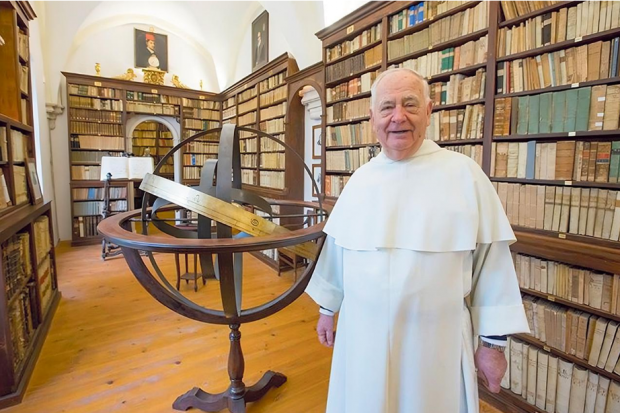
During the past week we experienced a true and wonderful sensation laid out for the public in Croatia. Professor Dr. Stjepan Krasić, O.P., a Dominican friar from Dubrovnik, historian and theologian, has published an article in the scientific journal of the University of Split, ST-OPEN, titled: Croatian as an international language in the 16th and 17th centuries: evidence from the Vatican Archives.
PDF format of scientific article can be accessed on this link here!
It refers to research in the Vatican archives in which he found evidence of the important role of the Croatian language for the Catholic Church during the 16th and 17th centuries. Professor Krasić finds the discovery of the privileged position of the Croatian language in the papal administration in the period from the end of the 16th to the end of the 17th century particularly interesting, when the Pope issued a decree according to which the Croatian language was included in the curriculum of prestigious universities such as those in Paris, Oxford and Rome.
The fundamental importance of Krasic’s discovery is that medieval linguists chose the Croatian language as the most suitable (of all Slavic languages) for the missionary activity of the Catholic Church among the Slavs. That is why it was taught as a compulsory subject at universities and why the Croat Bartol Kašić was commissioned to write a grammar of the Croatian language.
This means that the norming and standardisation of the Croatian language and its international recognition began about two and a half centuries before the official introduction of the national language into the Croatian education system and the Croatian State Parliament.
In his above cited paper the author performed a detailed analysis of documents from the 16th and 17th centuries concerning the Croatian language preserved in the Vatican archives.
The study was conducted in the historical archive of the former Congregation for the Propagation of the Faith (Congregatio de Propaganda Fide) and focused on periods of intensive missionary activity and the linguistic policies of the Catholic Church during the 16th and 17th centuries, when strategies for the evangelization of Slavic peoples were being formulated.
In his paper the author presents six original documents from the archives of the Vatican Congregation for the Propagation of the Faith. These documents prove that in the 16th century, based on the advice of distinguished linguists on the most suitable language for communication with Slavic peoples, the Catholic Church chose the Croatian language for this purpose (lingua croatica). That is why in 1599 it founded the Academy of the Illyrian Language at the Roman College, because at that time Illyrian was the common name for the Croatian language in Italy. The article provides indisputable evidence of this.
The article then cites the Decree of Pope Gregory XV of December 6, 1622, on the compulsory learning of the Illyrian and Arabic languages throughout the entire territory of the Venetian Republic
(Document 3): The Decree of Pope Urban VIII of 16 October 1623 on the inclusion of Hebrew, Greek (classical and colloquial), Arabic, Chaldean and Illyrian in the curricula of the most prestigious European universities
(Document 4): Official instructions of the Congregation for the Propagation of the Faith of 17 December 1624 to all superiors of the ecclesiastical orders on the preparation of future missionaries through thorough language study.
(Document 5): Correspondence between the Congregation for the Propagation of the Faith and the Dominican Order on this subject
(Document 6): which was concluded in 1628 with a text accepted by the general assembly of the order (Appendix to Document 6).
The creation of the first grammar of the Croatian language was entrusted to a young Jesuit from the island of Pag, Bartol Kašić, who worked on it for four years and in 1604 it was published in Rome.
In short, in the 16th and 17th centuries, Croatian gained the prestigious status of a “world language” in European intellectual circles, enjoying equal importance with traditionally respected languages such as Hebrew, Chaldean, Greek, Latin, and Arabic, and was studied at the most prestigious European universities, such as those in Salamanca, Paris, Bologna, and Oxford.
When asked a few days ago why he had researched the history of the Croatian language, and not some other, perhaps more attractive topic, Dr. Krasic replied:
– “Is there anything more attractive than language? It is the soul of a people. It is an essential determinant of the identity of every people, the connective tissue of its cultural and political unity. It lives in the people and with the people. Therefore, to speak of language means to speak of the people who speak that language. Without language, there is no people. Namely, the people create the language, but language also creates the people, and even individuals. Therefore, a nation is rightfully not only known and recognised by its language but also identified with it. In the Old Church Slavonic language, the first written language of the Slavic peoples, but also in Croatian, the noun ‘language’ also meant people.” Ina Vukic





 Croatia, the War, and the Future
Leave a comment