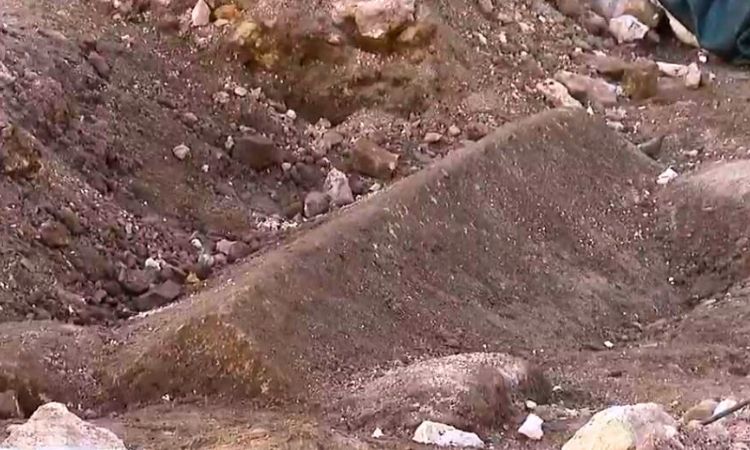

„One of the deepest impulses in man is the impulse to record, to scratch a drawing on a tusk or keep a diary… The enduring value of the past is, one might say, the very basis of civilisation.” John Jay Chapman (1862-1933). It would seem that somewhere along history’s long path, notes, scratches, and drawings become lost, and we stand in awe when the lost is found.
What started as routine pavement repairs in Dubrovnik’s historic centre this past week has led to a remarkable archaeological discovery — a Late Roman sarcophagus lid found just outside the city’s cathedral, writes Mark Thomas of Dubrovnik Times.
The stone structure was uncovered at a shallow depth shortly after workers removed the protective surface layer of the square in front of the cathedral (The Assumption of the Blessed Virgin Mary Cathedral). Although the project was carried out under archaeological supervision, the find surprised both construction crews and experts.

The cathedral was built on the site of several formal cathedrals, including 7th-, 10th-, and 11th-century buildings, and their 12th-century successor in a Romanesque style. There is a legend attached to Dubrovnik Cathedral. It is said that Richard the Lionheart was shipwrecked in Dubrovnik in 1192. As a votive for his survival, he contributed funds towards building the cathedral.
Dubrovnik is a renowned UNESCO World Heritage site in southern Croatia, well known worldwide for its massive 16th-century stone walls, medieval Old Town, and as the filming location for “King’s Landing” in Game of Thrones. Key attractions include the limestone-paved Stradun, Fort Lovrijenac, and the Rector’s Palace.
The present-day Dubrovnik cathedral of the Assumption of the Blessed Virgin Mary, was built between 1671 and 1713 as a substitute for a Romanesque basilica of the same dedication, destroyed in the earthquake of 1667. Nevertheless, the famous medieval cathedral which was, according to ancient writers of local history, unrivalled “throughout Illyria”, replaced an even older large-scale building, the remains of which were found during archaeological excavations in the 1980s. There is no mention of this building in the local historical tradition, largely consisting of late medieval compilations written in the form of chronicles and annals and named as such. Their authors share the common opinion that the first cathedral was erected ex novo in the course of the 12th century. Despite the indisputable fact that local prelates (successors to the archpriests of the Late Antiquity see of the nearby Epidaurum) had, by then, been residing in Dubrovnik for centuries, none of the old writers posed an obvious question: which church was, hitherto, the episcopal church? In more recent historical literature, the “cathedral before the cathedral” has been alternatively identified with the churches of Saint Peter the Great and Saint Stephen, both of which were of a rather modest size. The latter was famous for its multitude of holy relics and it was also the most commonly chosen burial site of the archbishops of the 11th century Dubrovnik.
„At locations like this, we always expect historical remains,” said last week the director of the Dubrovnik Restoration Institute. “Previous research suggested drainage channels and old house walls beneath the surface. But discovering a sarcophagus lid so close to the modern pavement was unexpected.”

For now, only the upper stone lid is visible. In the coming weeks, detailed protective excavations will begin to determine whether a complete burial chamber lies beneath it.
Experts say it is too early to confirm whether the find is an intact sarcophagus or simply a displaced lid. Each layer of soil and stone will be carefully documented, photographed and analyzed before further excavation continues.
The area around Dubrovnik Cathedral has long been known as a burial site through various historical periods. This new discovery adds another chapter to the city’s layered and complex past.
Pavement repairs not directly connected to the discovery will continue, but the zone surrounding the sarcophagus will be separated from the main construction site. Officials acknowledge that some delays are likely, as the protection of cultural heritage takes priority.
It remains unclear who was buried at this location. Archaeologists must also determine whether the sarcophagus is in its original position or was moved at some point in history.
Once documentation and analysis are complete, conservation authorities will decide whether the structure remains in place or is relocated.
For now, the discovery serves as a powerful reminder that beneath Dubrovnik’s smooth stone streets lies a city still holding secrets from centuries past.
Ina Vukic






Leave a Reply