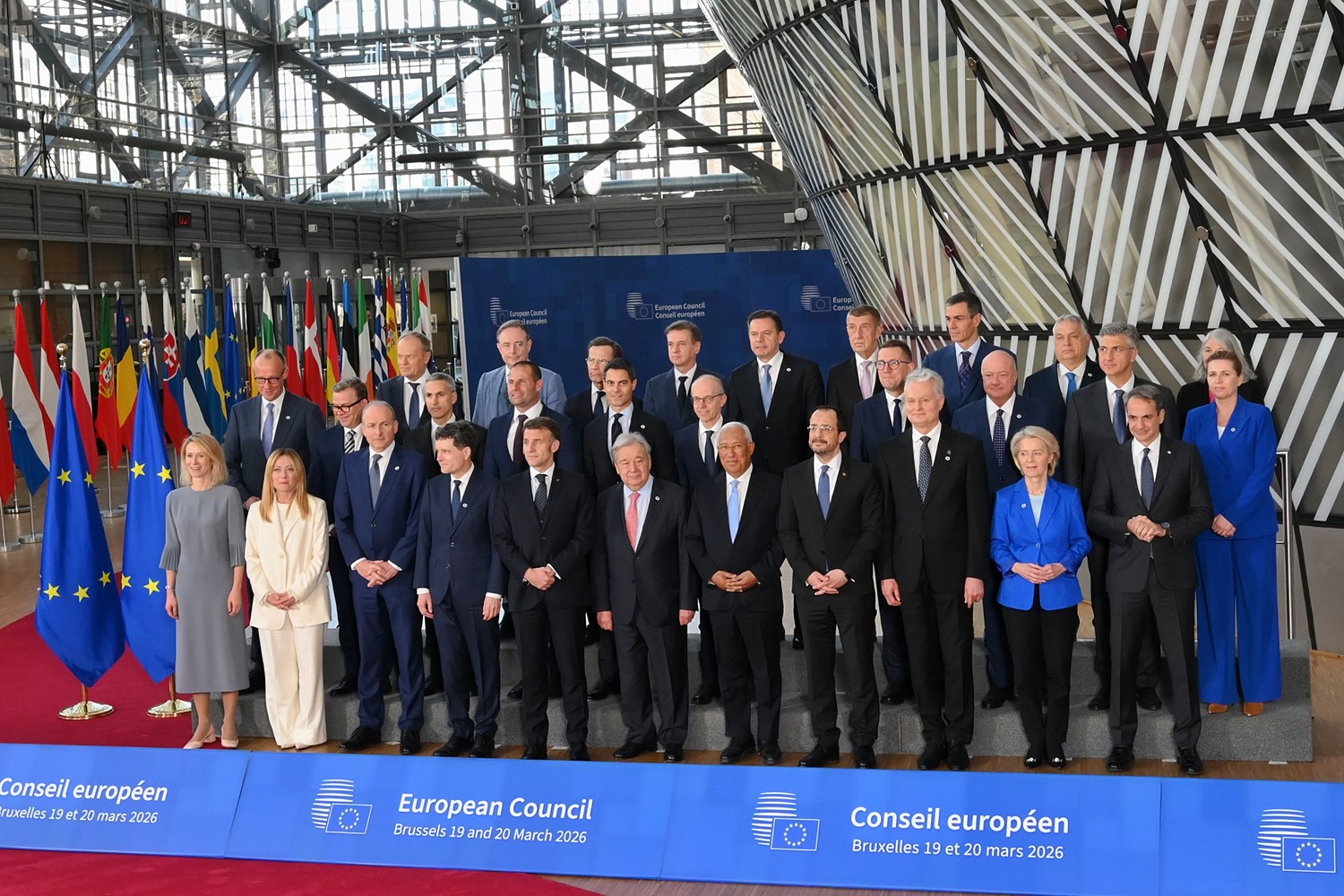

While Croatia’s Prime Minister Andrej Plenkovic was among the EU leaders at their summit in Brussels on Thursday, 19 March 2026, they displayed political unity but failed to approve a €90 billion loan for Ukraine, as Hungary’s Viktor Orban vetoed it over the dispute with Ukraine over Russian oil transit restrictions. The summit was held alongside the European Council meeting.
The meeting in Brussels focused less on geopolitical positioning in the ongoing Middle East conflict and more on its consequences. The surge in oil prices, but in particular that in electricity prices. It is noted that the real problem is the clearly asymmetrical impact. Not all countries are bearing the same burden of the crisis. Those countries that are most dependent on gas supplies are being hit hardest and calling for urgent measures, while those with an energy mix based mainly on renewables or nuclear power are feeling the effects much less and minimising them. This situation is exacerbating a deep divide within the EU.
Viktor Orbán conditioned Hungary’s support on resolving the dispute that is blocking Russian oil transit through Ukraine via the Druzhba pipeline, which is critical to Budapest’s and Slovakia’s energy security. 25 of 27 EU leaders backed the loan, according to diplomats, but unanimity is required. Lack of unanimity on this issue among the EU leaders would seem to produce all the hallmarks of giving licence to Russia, Vladimir Putin, to continue with land-grabbing aggression against Ukraine.
Andrej Plenkovic emphasised that Croatia can ensure oil supplies to Hungary and Slovakia through the JANAF (Adriatic Oil Pipeline), thereby eliminating concerns about energy insecurity.
He stated that the MOL (Hungarian Oil and Gas) company is ordering tankers that are coming to Omisalj on the Croatian Adriatic coast, a total of 13 of them, all with non-Russian oil, of which four to five have already been unloaded. This oil was transported via JANAF to refineries in Százhalombatta and Bratislava, and the total quantity that left was about 1.5 million tons per month, he said. He added that these data clearly show Croatia’s capacities and that it can fully meet the supply needs of both Hungary and Slovakia through JANAF.
“Security of supply is extremely important, and through JANAF, they will receive all the necessary oil,” he said.
Hence, Croatia says 13 tankers carrying non-Russian oil are ready to supply Hungary, even as Budapest presses Ukraine to deliver cheaper Russian fuel in exchange for lifting its veto on a €90bn loan for Kyiv at Thursday’s (19 March) EU summit.
“The total amount of oil that has been shipped is approximately one and a half million tonnes in a month,” Andrej Plenkovicc , Croatia’s prime minister, told reporters in Brussels on Thursday morning, ahead of the meeting.
Plenkovic says the tankers were ordered by the Hungarian oil company MOL. Four of those tankers have docked in Croatia.
He also said oil from the tankers has been moved to storage facilities further down the Adria pipeline and shipped to refineries in Százhalombatta in Hungary and Bratislava in Slovakia.
To date, the total volume transferred amounts to 1.5 million tonnes. When multiplied by 12, Plenkovic says this could supply Hungary and Slovakia with all their oil needs.
“It’s simply a matter of oil prices. So, that is the only issue at stake, and one that everyone likely understands all too well,” he said, noting that Budapest still insists on cheaper Russia fuel.
“They say that the price difference is 30 per cent lower. So perhaps this gives you a pretty solid answer as to where the problem lies,” he said, in a nod to Hungary’s prime minister Viktor Orbán.
In a nutshell Plenkovic said Croatia is ready to play its part to assist EU member states’ energy needs, stressing that Zagreb had repeatedly argued to partners including Hungary and Slovakia – which are currently in a row with Ukraine over damage to the Druzhba pipeline, via which they import cheap oil from Russia – that the Adriatic pipeline should be viewed as a primary, not secondary, supply route.
Despite Croatia’s achievable offer to solve the oil supply problem for Hungary and Slovakia, Orbán’s slogan, widely seen as a domestic electoral move, remains: “No Oil, No Money” as he holds Ukraine to ransom, favouring the supply of Russian oil. His cover is flimsy at best and politically charged, keeping Russia as an important player in the EU’s energy supply, which is seen as a ploy that provides it with at least some legitimacy in the public’s eyes for its aggression against Ukraine.
Orban, Russian President Vladimir Putin’s key ally in an unfriendly bloc, has taken a stance that has angered other EU leaders, as Kyiv could run short of money in weeks if it does not receive new funding. His U-turn since December of last year (when a loan to Ukraine was pledged by EU member states) has called into question the credibility of the European Council, the EU’s highest decision-making body. The unravelling of this impasse regarding EU financial assistance to Ukraine may well be solved by bypassing the unanimity rule.
We shall watch this space for any dumping of existing rules in favour of new ones, which may alleviate this particular crisis that has wide-ranging implications for the war in Ukraine, but also, upon the simmering down of the global energy crisis as a whole. Every drop of rain wets, so to speak.
It seems evident that EU leaders are hoping that their experience weaning off Russian energy in the wake of the 2022 invasion of Ukraine, and their efforts to build up the bloc’s military spending toward self-sufficiency, will enable them to do the same for energy independence.
European Council President Antonio Costa said that “energy means security” and that the EU should “build our own capacity to produce our own energy, because it’s the only way to be secure.”
Reportedly, the leaders from Italy, Austria, Croatia, Greece, Romania, Bulgaria, the Czech Republic, Hungary, Poland and Slovakia asked Costa, and European Commission President Ursula von der Leyen pushed for a slowdown in the rollout of the EU’s Emissions Trading System. They said it was “too steep and overly ambitious” in light of “the fragility of today’s economic ecosystems”.
Touching firmly upon the war in the Middle East the European leaders were deeply critical of the Iranian government, but none have offered immediate help to the U.S. Britain is flat-out refusing to be drawn into the war. France says the fighting would have to die down first.
Austrian Chancellor Christian Stocker said that Europe “will not allow itself to be blackmailed” into joining the United States and Israel military campaign in the Middle East. “Europe — and Austria as well — will not allow itself to be blackmailed,” he said. “Intervention in the Strait of Hormuz is not an option for Austria anyway.”
EU foreign policy chief Kaja Kallas said there was “no appetite” among leaders to expand a European naval force in the Red Sea to help secure the Strait of Hormuz or otherwise join the fray.
Four of the EU’s largest economies signalled a willingness to contribute to “appropriate efforts” to ensure ships can pass safely through the Strait of Hormuz.
France, Germany, Italy, and the Netherlands, alongside the United Kingdom and Japan, issued a joint statement welcoming “the commitment of nations who are engaging in preparatory planning” for securing the key oil route, and demanding Iran “cease immediately” its drone and missile attacks and other attempts at blocking it.
Chancellor Friedrich Merz said the war must end before his country can help with matters such as keeping shipping lanes clear.
“We can and will commit ourselves only when the weapons fall silent,” he said of potential German military support to secure shipping lanes in the Strait of Hormuz. “We can then do a great deal, up to opening sea lanes and keeping them clear, but we’re not doing it during ongoing combat operations.”
He said that would require an international mandate, among other complicated steps, “before we can even consider such an issue.”
While the EU isn’t a party to the conflict, Dutch Prime Minister Rob Jetten said he understood the U.S. and Israeli reasons for launching the campaign against the “brutal” Iranian government. He called for the EU to increase both sanctions on Iran and support for Iranian opposition groups
But others blasted the war as “illegal” and destabilising.
“We are against this war because it is illegal,” Spanish Prime Minister Pedro Sánchez said: “It’s causing a lot of damage to civilians, of course, refugees and the economic consequences that the whole world, especially the global south, is already suffering.”
Ina Vukic




Leave a Reply