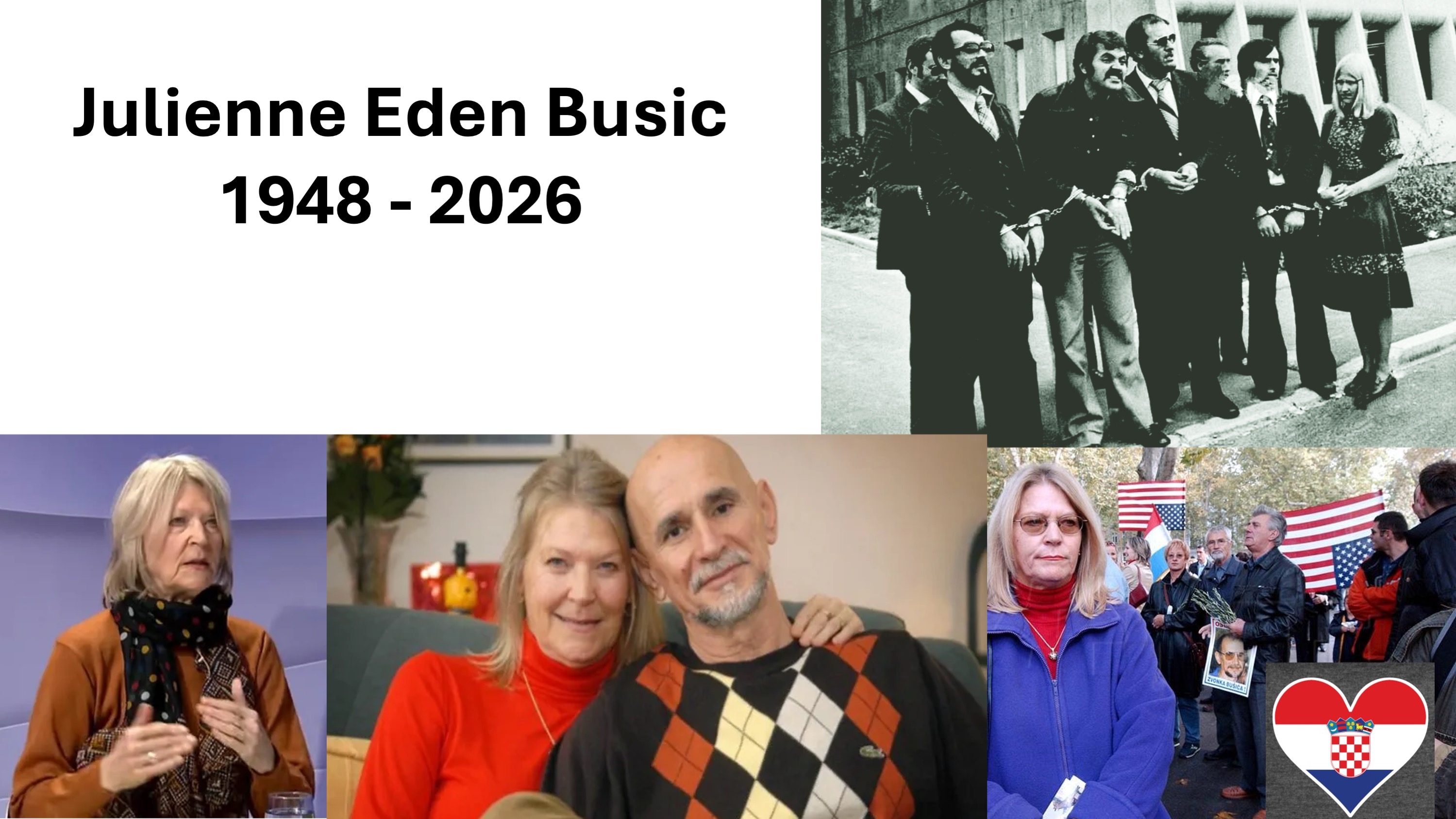
On Thursday, 21 May 2026, Julienne Eden Bušić passed away in a hospital in Zagreb at the age of 77, following sudden health complications. Her death broke my heart, as it did the hearts of so many others whose lives she touched.
Julie lived a life of extraordinary intensity, conviction, and consequence. Her unwavering dedication to Croatian causes and to the fight for freedom from communist oppression remains among the defining achievements of her remarkable life — achievements that will undoubtedly be discussed, the unplanned tragedies occurring amidst her political activism for a just cause will continue to be weighed and regretted, her activism honoured, and remembered for decades to come. She left a legacy of a plethora of books, essays, and articles that will preserve her devotion to justice and patriotism for generations to explore, love, and marvel at.
Julie touched my life as well as the lives of millions – deeply. Her sense of noble purpose in the pursuit of freedom from oppression was quite remarkable. At this time of profound sorrow, the most meaningful tribute I can offer Julie on this blog is to share a brief excerpt from the draft of my forthcoming memoir.
“…This event, much to my delight, attracted the attention of mainstream media not only in Australia, but also in the United States, the United Kingdom, and across Europe. As I recall, the convincingly politically left-leaning newspapers of the time, such as The Sydney Morning Herald and The New York Times, branded all Croatian patriots as Croatian nationalists, often with undertones of extremism and intolerance. Yet if nationalism also meant fighting for freedom from oppression and persecution, then I was comfortable wearing that label. Regardless of how we were described, our efforts to raise international awareness of Croatia’s struggle for freedom from communism were remarkably successful.
The event also unlocked a chamber of memories from the 1970s — memories of the extraordinary courage shown by four men and one woman from the Croatian diaspora who, in 1976, hijacked a TWA aircraft in an effort to draw the world’s attention to Croatia’s plight under communist Yugoslavia. They were Zvonko Bušić, Julienne Eden Bušić, Marko Vlašić, Petar Matanić, and Frane Pešut.
The fight for justice and freedom for Croatia was never easy while Yugoslavia endured. It demanded immense sacrifice, courage, and personal risk. Before the digital age and the internet, only the most dramatic acts managed to capture worldwide attention. In the 1970s, acts such as piracy and aircraft hijackings proved particularly effective in forcing the international public to notice causes that would otherwise remain ignored. Television networks rarely covered public appeals unless they aligned with government interests, and mainstream newspaper editors were exceptionally selective in deciding what deserved public attention.
Those who have never personally experienced the devastation and suffocating oppression imposed by totalitarian regimes may struggle to comprehend the extreme determination individuals sometimes display in trying to right such terrible wrongs. Croatian émigrés, many of whose families fled or resisted the communist regime of former Yugoslavia, understood all too well the sacrifices required to keep alive the hope of freedom and self-determination — and, ultimately, to transform that hope into reality.
Love for one’s country can indeed be sublime. Yet under oppression, it can also become a painful affliction — an ache that grows more unbearable as injustice deepens and longs desperately for release.
‘Please, do not call it nationalism — call it patriotism. But whatever you choose to call it, search your soul and ask yourself how much love for your country lives within your chest. You will discover that, by any name, it is a profound love. It is the place from which the word ‘home’ is born. It is where you feel safe. It is where you are truly yourself.’
That sentiment became something of a personal mantra from my teenage years onward. I believe I first heard it from a man passionately waving his Australian Army conscription papers above his head during the anti-Vietnam War protests in Sydney’s Hyde Park in 1968 or 1969. His words struck a deep chord within me and have remained with me ever since, resurfacing now as I write these memoirs.
Many university students of my generation found themselves deeply conflicted over Vietnam. They opposed the spread of communism from North Vietnam into the South, yet they were profoundly divided over whether they should take up arms and fight what many saw as another people’s war in a distant land.
Zvonko Bušić, a Croatian émigré whose uncompromising devotion to Croatian freedom and liberation from oppression earned him both admiration and notoriety internationally, became one of the most controversial figures associated with the Croatian struggle against communist Yugoslavia. In 1976, he and a group of fellow activists used fake explosives to hijack a TWA aircraft departing from LaGuardia Airport, while simultaneously placing a real bomb in a locker beneath Grand Central Terminal.
During attempts to defuse the bomb at a police demolition site, far from where it had originally been planted, tragedy struck. According to later accounts, the instructions provided by Bušić to the New York police regarding the bomb’s safe dismantling were not fully followed. The device exploded, killing Police Officer Brian J. Murray and injuring several others.
At the time, Bušić was thirty years old and living in Manhattan. He maintained that the hijacking was intended not as an act of terror, but as a dramatic attempt to draw the world’s attention to Croatia’s struggle for independence from Josip Broz Tito’s Yugoslavia. Together with his American wife, Julienne Eden Bušić, and fellow Croatian émigrés Frane Pešut, Petar Matanić, and Marko Vlašić, he boarded the TWA Boeing 727 on the evening of September 10, 1976. The aircraft carried more than eighty passengers and crew and was bound for Chicago.
“During the flight, Zvonko Busic handed a note to a flight attendant, who delivered it to the pilot. The note said that he and his co-conspirators had five bombs on board and were commandeering the plane, and that another had been planted in a subway station locker under Grand Central. Implicit in the note was that they would detonate the devices if their demands were not met.
The hijackers demanded that a declaration of Croatian independence be published in The New York Times, The Chicago Tribune, The Washington Post, The Los Angeles Times and The International Herald Tribune in Paris, the next morning. They also demanded that authorities drop leaflets printed with the declaration over London, Paris, Montreal, Chicago and New York.
Their demands were largely met: all the newspapers except The Herald Tribune printed the declaration, and leaflets fluttered over all five cities, some from an escort plane, some from helicopters.
But what the hijackers had displayed as one of their bombs was actually a metal pot with wires and clay cobbled together to look like the real thing. The hijackers had smuggled the components through security and assembled them on board. Only the one below Grand Central was real, as the New York City police discovered after being directed there while the hijacking was in progress.
In his note, Mr. Busic explained where the bomb was hidden and how to remove it safely. He never intended to detonate it, he said later; it was a ruse, to convince the authorities that he had real bombs on the plane.
The police officers took the device to a bomb squad demolition range in the Bronx. There, as officers tried to defuse the bomb, it detonated, killing Officer Brian J. Murray, partly blinding Sgt. Terrence McTigue and wounding Officer Hank Dworkin and Deputy Inspector Fritz O. Behr.
Meanwhile, the plane was heading for Europe under the escort of a Boeing 707, making four stops to refuel; the 727 was not designed for trans-Atlantic flight. In one stop, in Gander, Newfoundland, 35 hostages were released.
The French government allowed the plane to land in Paris when it became clear that it was low on fuel. Surrounding it at Charles de Gaulle airport, the French police shot out its wheels during a 12-hour standoff that ended with the hijackers’ surrender at 8 a.m. Sunday, Sept. 12.
None of the hostages was harmed.
“I wish them well,” one passenger, Warren Benson, told The New York Times. “They had nothing against us, but wanted only to get a story across. They were concerned for our welfare, and we were treated well during most of it.”
All five were convicted in 1977. Mr Busic and his wife received mandatory life sentences, while the others — Frane Pesut, Petar Matanic and Mark Vlasic — received 30-year sentences,” wrote The New York Times, 5 September 2013, after Zvonko Busic’s death in Croatia, having a few years back been released from a US prison after serving 32 years in a high-security one. Julie was released from a minimum-security prison in 1989, and Zvonko in 2008; both continued their significant activism for Croatian independence after living in Croatia.”
Forming a collaborative, professional, and deeply warm friendship with Julienne Eden Bušić became one of the most enduring sources of my motivation for political activism in support of Croatian independence over many years. In our commitment to Croatian freedom, we were truly kindred spirits. Yet there was something remarkable in that bond: Julie was an American with no Croatian roots, while I was a full-blooded Croat.
What united us so profoundly was not ethnicity, but a shared and unwavering love of freedom — freedom from oppression, injustice, and imposed silence. We carried that love with equal intensity. It reminded me that the reach of genuine human compassion and conviction extends far beyond bloodlines, nationality, or birthplace. The tentacles of pure love truly stretch far and wide. What a blessing that is, I always thought.
Rest in God’s peace, Julie, Julienne Eden Busic.
Ina Vukic
A video tribute to Julie:




Leave a Reply