According to the Croatian Defenders internet portal more than 70% of Serbian citizens have a negative attitude towards the Hague tribunal (International Criminal Tribunal for Former Yugoslavia/ICTY) and consider that the Hague trials do not contribute to the reconciliation process.
These are the results from recent research ordered by the Belgrade Centre for Human Rights and OSCE Mission in Serbia (Organisation for Security and Co-Operation in Europe), carried out by Ipsos Strategic Marketing and presented to the public on Tuesday February 28. A representative sample of citizens over 16 years of age was surveyed in this research.
The research showed that 66% of Serbian citizens consider the establishment of the Hague tribunal unnecessary, and that the purpose of the Hague court is to transfer the guilt for the war and war victims onto Serbia.
Half of those surveyed consider that Radovan Karadzic is not responsible for the crimes he is charged with, and 41% consider Ratko Mladic should not have been arrested nor handed over to ICTY.
Croatian news portal Nacional on the subject of the same research writes that 45% of research participants stated that everyone should judge their own people. 12% consider that it’s not important in which country or which institution carry out trials for war crimes.
16% hold that in order to achieve justice, it’s necessary to cooperate with the ICTY. 19% hold that cooperation with the ICTY is only necessary to the extent by which it prevents further pressure. 40% hold that cooperation with the Hague is not welcome because it has not in any way benefitted Serbia. A dozen or so consider cooperation with ICTY necessary as a condition for Serbia’s accession to European Union.
Just over 20% hold that reconciliation is a key factor for future relations between the countries of former Yugoslavia. With this, 34% consider apologies by state leaders beneficial while 57% think apologies are useless.
Given that this research stipulates that those surveyed form a representative sample of citizens of Serbia it seems as clear as a sunny day that Serbs have not accepted, nor do they intend to accept, the fact that it WAS they who started the horrific wars in Croatia and Bosnia and Herzegovina in the 1990’s.
Furthermore the concept of human rights does not, for Serbs, spread beyond Serbia – as if there are no humans outside it. They want the world to leave them alone to judge their own people and if the world is to get involved then Serbs want Serbia to benefit from that.
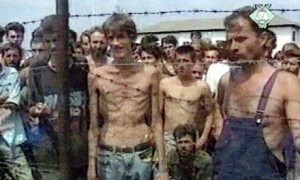
Indeed, judging by the results of this research it seems that for a whopping slice of Serbian population Srebrenica, Vukovar, Skabrnja, Sibenik, Zadar … million refugees, countless rapes and tortures, numerous concentration camps across Serbia, Bosnia and Herzegovina and Croatia – did not happen!
Now that Serbia has received the status of candidate for EU accession (with unjustifiable ease) let’s wait and see if the EU, International Human Rights watch and Amnesty International will criticise Serbs for their protective stance on war crimes committed by their people and hostility towards internationally administered justice. These three international bodies have always been so quick to react against Croatia and make her path to EU accession an undeserved nightmare. Ina Vukic, Prof. (Zgb); B.A.,M.A.Ps.(Syd)
“List of war criminals in Vukovar, Velepromet concentration camp and Ovcara” (Croatia 1991)





 Croatia, the War, and the Future
Leave a reply to inavukic Cancel reply