
About time, I say!
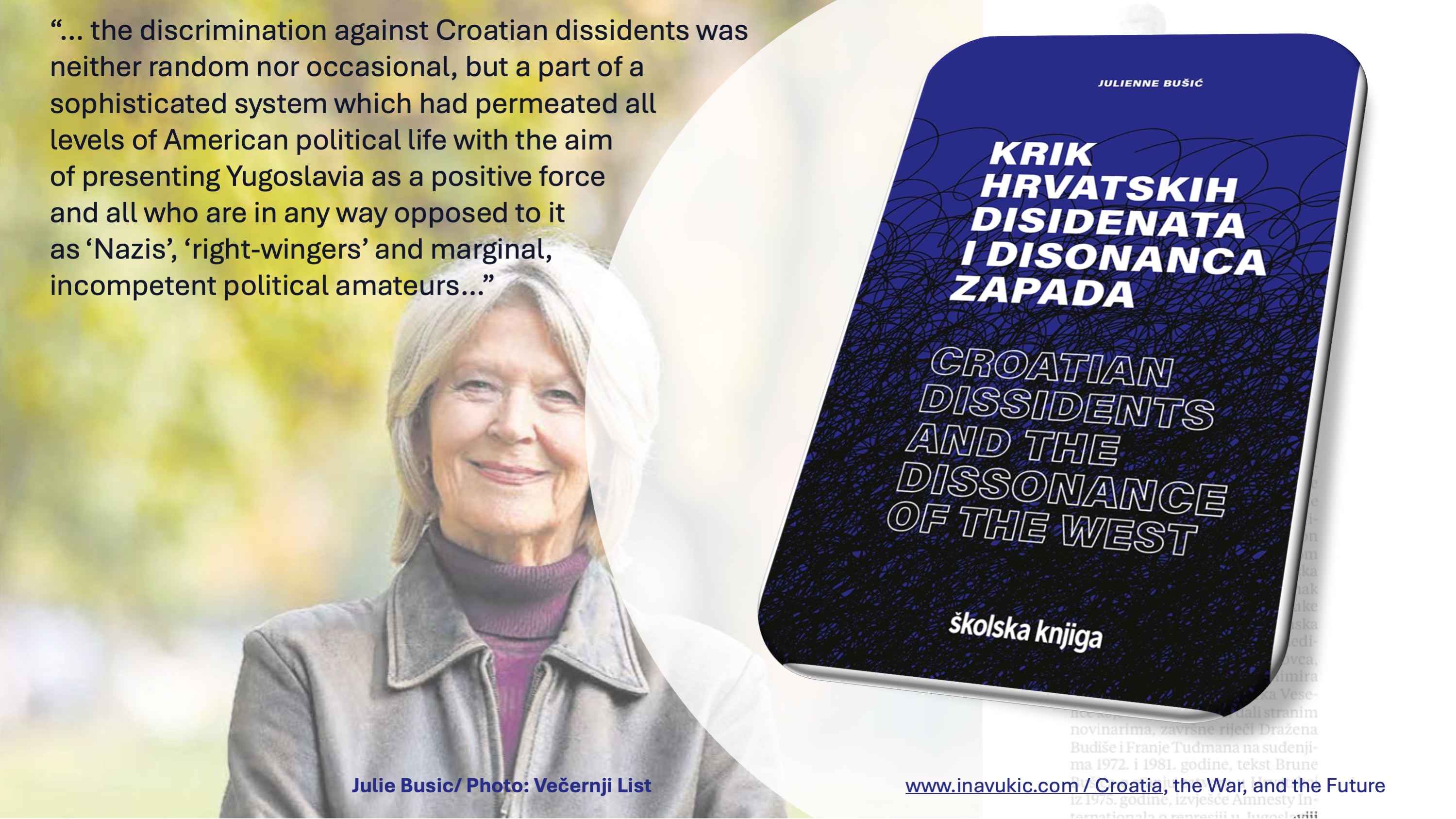
A tremendously needed and interesting book “Croatian Dissidents and the Dissonance of the West” has just been published in both the English and the Croatian languages (Krik hrvatskih disidenata i disonanca zapada), which, among other things, brings up a hitherto scarcely, if at all, explored area – the relationship of the United States of America towards Croatian dissidents during the communist Yugoslavia era. American born Julienne Busic who has spent much of her life living in the US, author and publicist, former Croatian independence and democracy activist from the 1970’s, former adviser at the Embassy of the Republic of Croatia in the USA and senior adviser at the Office of the President of the Republic Franjo Tudjman has now offered the public the results of her extensive studies and research in this most interesting and historically pertinent field and subject.
Juienne Busic is the editor of the new book that carries the same title as this article. Her research in this field and her analyses certainly offer a thorough foundation upon which we are able to interpret the entire history of US policy towards Yugoslavia after 1948. The book is published by Školska knjiga, and in it the reader can also find articles by historians Zlatko Begonja and Luka Knez about how the Yugoslav secret service monitored foreign media, as well as interviews Vlado Gotovac, Franjo Tudjman, Ivan Zvonimir Cicak, Petar Segedin and Marko Veselica as dissidents gave to foreign journalists, the closing statements made by Drazen Budisa and Franjo Tudjman at their trials in 1972 and 1981, Bruno Busic’s writing about the state of prisons in Croatia in 1975, 1972 Amnesty International report on repression in Yugoslavia, the minutes of the conversation between Henry Kissinger and Yugoslav ambassador Bogdan Crnobrnja from 1971, and the Declaration of the Supreme Command of the Croatian National Liberation Forces written by Bruno Busic.
„The book details the discrepancy between what the West, in particular United States of America, preached and what it practiced, especially when it comes to their relationship to Croatian dissidents, as opposed to Soviet and other Eastern European dissidents. The book provides an exhaustive analysis of ways in which this discrepancy manifested itself in Yugoslavia after Tito’s alleged breakup with Stalin in 1948, when the American narrative completely changed. I say ‘alleged’ because in the ideological sense, the breakup did not actually happen, as can be seen from the fact that the Soviet Union and Yugoslavia while at the United Nations for that period voted exactly the same. Soviet archives have further confirmed that symbiosis. In his new book ‘To Overthrow the World: The Rise and Fall and Rise of Communism’ Sean McMeekin says that ‘the files of the Comintern, which are now available in Soviet archives in Moscow, show that Tito debated with Georgi Dimitrov and Stalin every move Fitzroy Maclean made, that he submitted detailed reports of all things the British delivered to him by air and requested instructions from Moscow even about the smallest protocol matters,” said Julie Busic in the interview conducted with her by journalist Zarko Ivkovic and published in the Sunday Evening paper Vecernji List on 10 November 2024.
On the subject of Western Media treatment of Croatian dissidents, the American born and bred Julie Busic said the following: “Every American student knew about Solzhenitsyn and Sakharov, we all studied them in social and political sciences classes. The media followed every step they took, they celebrated them and created idols and icons from them because of the sacrifices and the sufferings they endured in the fight for democracy and human rights, and at the same time they portrayed the Soviet Union in a negative light because of its actions against them and other Soviet dissidents. It was the Cold war era, and things were black and white then, at least in the United States. But it is interesting that the same treatment did not apply towards the Croatian dissidents. Đilas (Djilas) and Mihajlov enjoyed a special status and had access to all major US media, especially after 1948, while Croatian dissidents, although promoting the same values as the Soviet dissidents did and although they were also imprisoned, abused and even tortured, they were silenced.”
In the book “Croatian Dissidents and the Dissonance of the West” a clear and irrefutable reason for the silencing of Croatian dissidents by the West is offered via research and analysis that yield the real frame within which the West, particularly the USA, crafted its treatment of Croats. The Croatian dissidents always, after World War Two in relation to matters addressed by this book, strived towards an independent Croatia and advocated for the breakup or disintegration of Yugoslavia while, for example, Djilas and Mihajlov advocated for changes within Yugoslavia itself. “Croatian dissidents mostly advocated for disintegration of Yugoslavia, and that was completely unacceptable to the Western powers, especially to the United States. Croatian dissidents believed that Yugoslavia neither could nor wanted to protect Croatia rights, so they considered independence the only rational solution for Croatian people,” said Julie Busic.
In presenting the manner by which Croatian dissidents were silenced the book offers among other sources the following: “In the American archives there is an extensive report by George Kennan, who is considered by many to be the leading expert on Soviet Union. Kennan was ambassador to Soviet Union and Yugoslavia; he wrote that report during his mandate in Yugoslavia in 1962. He was extremely dissatisfied with the picture of Yugoslavia in the West, so he offered guidelines for its improvement, which included the silencing of Croatian dissidents. His proposals were implemented at all levels. For example, the mainstream American media regularly blocked news about Croatian dissidents and Tito’s crimes, even news about the murders of dissidents outside of Croatia. The government influenced the editors and columnists, engaged them, and some even cooperated with the CIA. Also, it encouraged politicians and the media to call Yugoslavia ‘socialist’, and not a communist country, and that they cease calling the peoples of Yugoslavia ‘captive nations’. Those phrases appeared regularly during Weeks of Captive Nations, annual official events in the USA that expressed solidarity with “captured nations” in authoritarian regimes. Even though the American government knew very well that Tito’s regime was authoritarian, it used all possible means to cover up that truth or distorted it in public. Protests against Yugoslavia were also discouraged in the USA, and if regardless of that they still happened, the media and politicians mostly ignored them. Although protests are a basic and constitutionally protect right in the USA, Croats were told that they are ‘not in USA national interests’”.
The Kennan report (1962) that the discrimination against Croatian dissidents was “neither random nor occasional, but a part of a sophisticated system which had permeated all levels of American political life with the aim of presenting Yugoslavia as a positive force and all who are in any way opposed to it as ‘Nazis’, ‘right-wingers’ and marginal, incompetent political amateurs.”
Although this book deals with the treatment of Croatian dissidents in the USA during the Cold War era and beyond, while Yugoslavia still existed, Croatian diaspora across the so-called Western democratic world will find itself in the similar position. If I were to transpose the subject of this book onto the Australian soil, where I have spent most of my life since 1962, I would, I am quite certain, find little if any difference in the treatment of Croatian dissidents or freedom from communist Yugoslavia and democracy advocates. The current historic judicial inquiry into the 1981 convictions for alleged planning of terrorist activities in Sydney against the “Croatian Six” may shed a further light on aspects of the treatment of Croatian dissidents in Australia as fuelled by the Yugoslav Intelligence Service UDB and its task to destroy and blacken the Croatian name across the world.
It appears to me that the book “Zbornik Krik hrvatskih disidenata i disonanca Zapada / Croatian dissidents and the dissonance of the West” by Julie Busic as Editor of the book, who also has authored her own contribution to this collection of articles, is a book most valuable to have, especially for those who have little or no understanding of how communist Yugoslavia treated and oppressed patriotic Croatians vying for freedom. The book can be purchased online from the publisher Skolska Knjiga in Zagreb, Croatia via this Link. Ina Vukic




 Croatia, the War, and the Future
Leave a comment