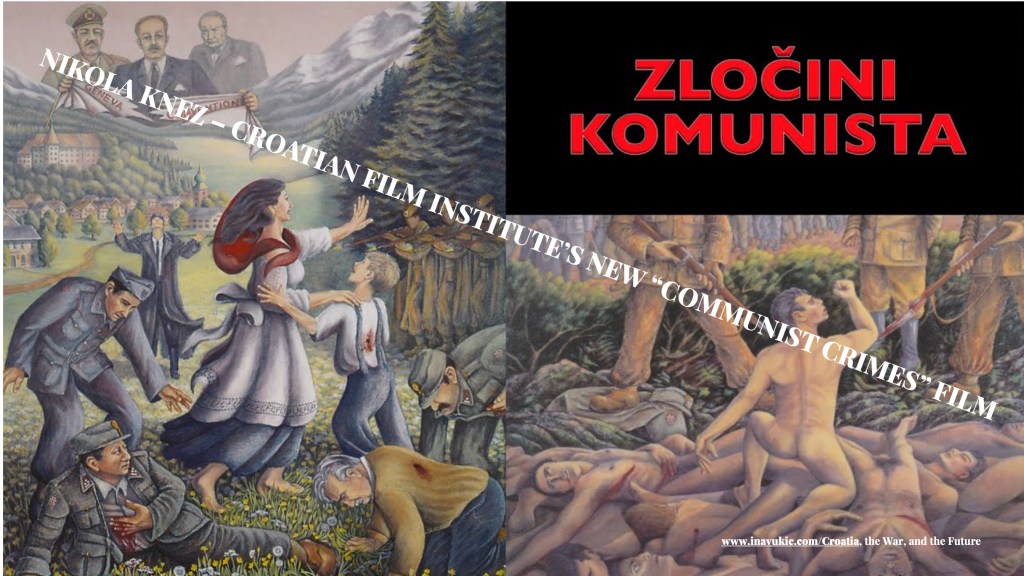
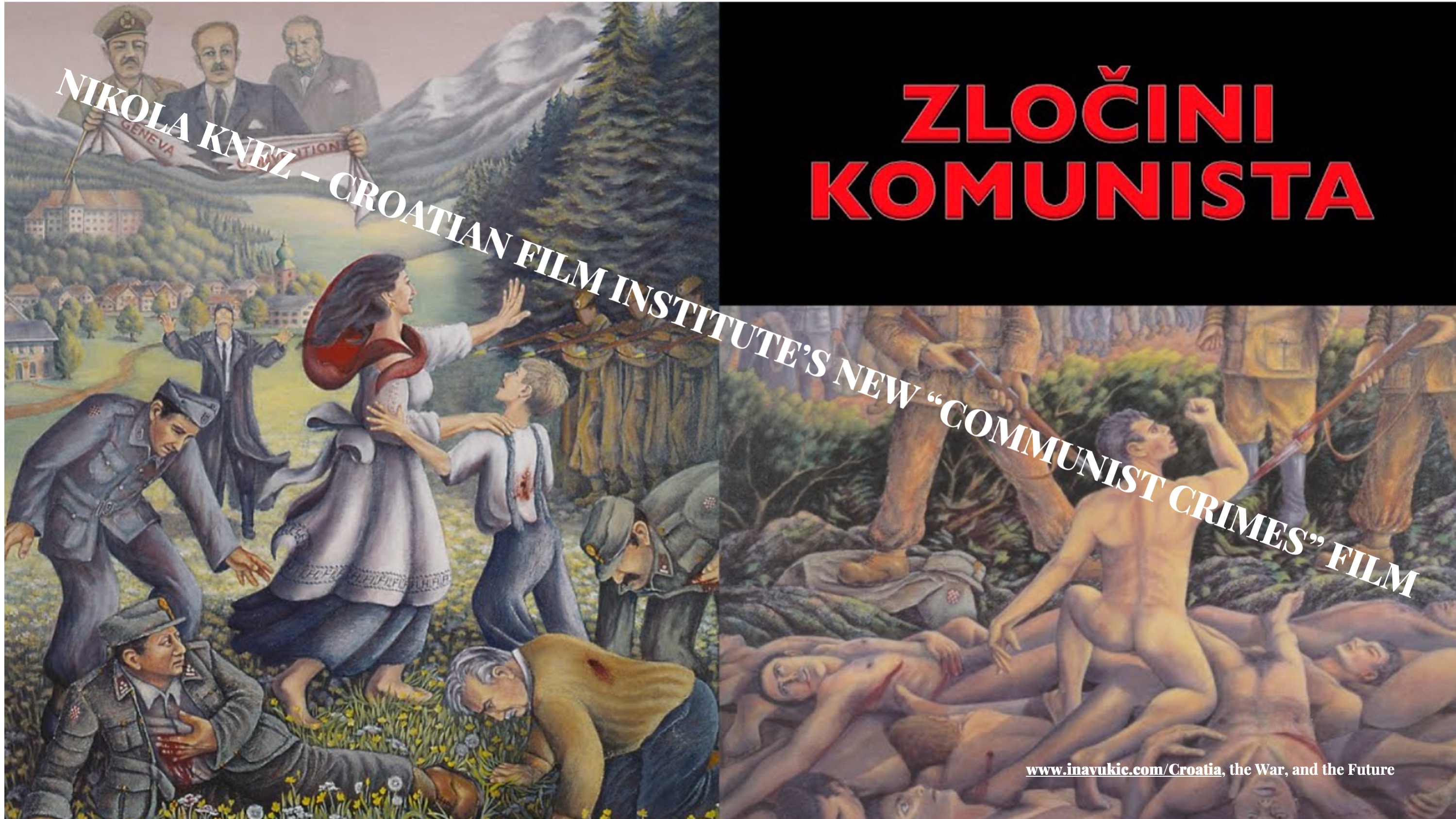
Released to the public on 10 February 2025, this 36 minute documentary film directed by Texas-based Croatian Film Institute’s Nikola Knez, produced by David O. Rados, with screenplay by Dr. Dorothy McClellan and director of Photography David Knez, „this film captures the terror inflicted on Croatia and its citizens by the Communist Party of Yugoslavia and its leader, Marshal Josip Broz Tito in 1945. Relying on newly uncovered archives, including KGB documents from Moscow, and eyewitness testimony, the film offers a telescopic view of the brutality, cruelty, and ruthless tactics that characterised this regime from its very beginning. The mass liquidation of innocents is unveiled, as hidden gravesites are revealed. The mark left by this unspeakable horror on an entire generation of Croatian people is evident. We learn about the actors, the victims, and the witnesses. People watched but were afraid to speak out for fear of becoming victims. The viewer comes away with a fuller understanding of the crimes and bloodshed of the Yugoslav communists and Serbian fascists against the Croatian people after the end of World War II in 1945 and onwards.”
This film presents the historical facts in potent summary. On May 8, 1945, World War Two ended. On May 8, 1945. Zagreb, the capital of the Independent State of Croatia, was an undefended city. The leader of the Independent State of Croatia, Ante Pavelic, left the capital and Croatia on Sunday May 6, 1945. The entire government and numerous officials from the state apparatus left with him. The Croatian people were abandoned without political representation. A few days before his departure, Pavelic entrusted the handover of Zagreb to units of the Yugoslav Army, to the director of the parliamentary chancellery, Dr. Djuro Kumicic, after Bishop Alojzije Stepinac had refused Pavelic’s offer to take the reins. On My 6, 1945, Kumicic declared Zagreb an “open city” on Zagreb radio, which meant that the capital of the Independent State of Croatia (NDH) did not intend to defend itself. 180,000 NDH soldiers with their families and 500,000 civilians set off towards the dedicated British security zones in Austria. On May 8, 1945, the first Partisan units entered Zagreb. By order of Tito, passage was allowed to the 1st and 2nd units of the Yugoslav Army – the Serbian units manned by mobilized Chetniks who had occupied the city. They called themselves Liberators.
“When the Partisans entered Zagreb, there were wounded people in the school near our house. Our house was in Vrbik district, and the school was in Sava Street. It was a school run by nuns, but towards the end of World War II there was little room in the hospitals for the wounded, so they put them in that school. When the Partisans came, they took the wounded out of the school, lined them up next to a pit, and shot them during the night,” says in the film the communist crimes’ witness Dr. Jasminka Klaric. “When the first bursts of machine gun fire were heard, my parents opened the window and looked across the street as people fell, mowed down by bullets. There was an open area between the school and out house, so the view as clear. My parents were horrified. When my dad went to work in the morning, he passed by that place where dirt had been freshly thrown over the wounded and dead. The same night our neighbour from what was then Cvijetna Street, now called Poljicka, had also watched the scene. He had an even better view of the whole situation. I was only few months old and didn’t see what was happening, but my parents and my two, now deceased, sisters did. This event was repeatedly described in our home, but only among close friends who we were sure wouldn’t spread the news further. I never mentioned it in my life at school. Later, the area that was unmarked gravesite was paved and became a basketball court. One more detail: on the Day of the Dead, candles were often it there. So, people new that one of their own had died there. Horrible, horrible!” Dr. Klaric recounted and continued: “What I want to emphasise is that I wish to testify because these are people who were condemned to death without trial.”
By 30 April 1945, 19 Partisan camps had been established holding 77,049 prisoners of war. On 14 May, 1945 Josip Broz Tito presided at the headquarters of the 1st and 2nd units of the Yugoslav Army in Zagreb. The main topics of the session were: the establishment and the operation of communist concentration camps for the extermination of Croatians, determination of the routes of movement and the staged implementation of prisoner death marches, and locating a large number of hidden execution sites, organising a mass killing of Croatians. By the end of 1946, there were 175, 922 prisoners of war after mass liquidations carried out from 12 May to 12 June 1945.
Dealing with various aspects of 20th century history still poses a significant challenge to Croatian society. This also includes dealing with the socialist period. In the last fifteen years, propelled by the Eastern enlargement (2004, 2007), the EU has developed a common European memory of the totalitarian and authoritarian regimes of the 20th century, including communism. While at the end of June 2006 Croatia joined the countries which had officially condemned communist crimes, with parliament adopting a declaration condemning crimes committed during the communist regime in Croatia from 1945 to 1990. The declaration condemning communist crimes says the fall of totalitarian communist regimes was not always followed by investigations of crimes committed by those regimes, that perpetrators were not brought to international justice, and that the consequence is a very low public awareness of those crimes. And yet, there has been no actions to solidify this condemnation into national actions in Croatia. No monuments to communist crimes’ victims raised. No plaques on building marking communist mass murders and purges. No banning on public spaces and buildings of communist Yugoslavia insignia. No duly significant government funds or grants to speak of for the production of documentaries or historical book writing, for historical research… In 2006 onwards the Croatian Parliament maintained it should become the key national institution for the condemnation of crimes committed by Yugoslav and Croatian totalitarian communism, and that science and judicial institutions should systematically investigate the history of those crimes and yet undertook no action to achieve any of those commitments! But that is, regretfully, only an empty lip service to the horrors of the past.
So far, 1700 mass graves filled with victims of communist crimes have been unearthed across former states of communist Yugoslavia, Slovenia, Croatia and Bosnia and Herzegovina, with most relatively being located in Croatia. New mass graves are being unearthed in the very capital city of Zagreb and its periphery, as we speak. Some 60 unearthed there to date!
Hence, documentary films like this one directed by Nikola Knez represent great wealth for Croatian people and the world in general.
The film in the Croatian language can be watched here:.
This documentary film also provides a focused and succinct opportunity to learn about the perpetrators of these crimes, their victims, and witnesses to the crimes. The grave and terrifying fear that Croatians lived with in that murderous regime that tolerated nobody who was anti-communist is also clearly weaved into this film through witness statements. It delves into the darkest period of Croatia’s violent years of communist onslaught against patriotic Croatians at the end and after World War Two, the bloody communist mass murders of those that wanted and fought for an independent state of Croatia and had rejected to be a part of Yugoslavia, which topic even after eighty years present with a raw a memory which, sadly and utterly unjustly, remains largely brushed from mainstream debate in Croatia as well as from its taxpayer purse. In my view, this documentary is very much worth watching and spreading around. It represents a valuable addition to records of truth about Croatian suffering. Records that hopefully will one day grow legs of due justice for the victims. Ina Vukic





 Croatia, the War, and the Future
Leave a comment