
The Judicial Inquiry Into the 1981 Convictions against the Croatian Six Completes Court Hearings
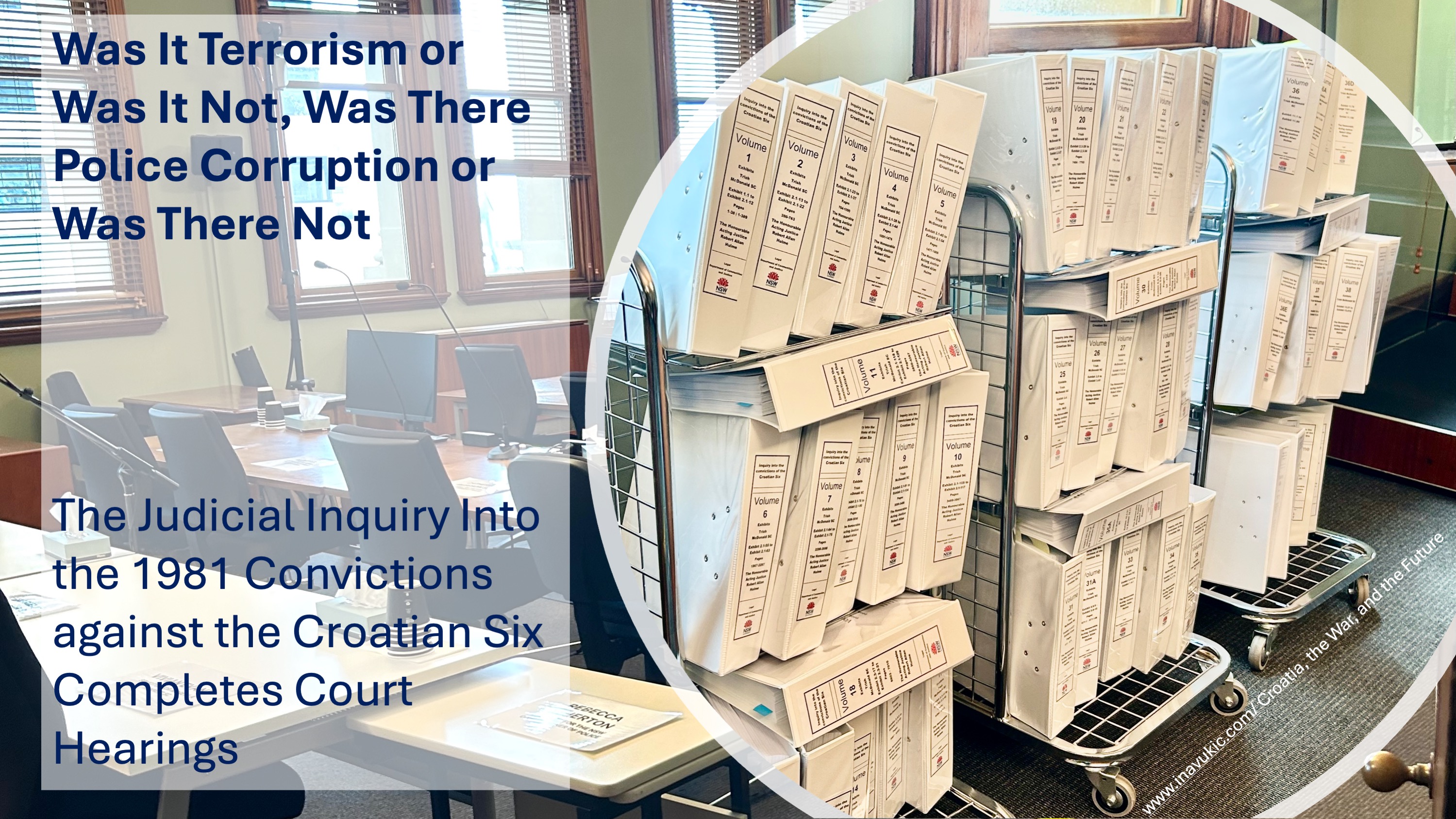
44 days testing the evidence in court and two-and-a-half days of submissions by the legal teams before the Honourable Justice Robert A. Hulme since late 2023, 53,000 A4 pages of material, have on Friday 7 March 2025 seen this phase of the Supreme Court of New South Wales in Sydney, Australia, ordered Judicial Inquiry into the 1981 criminal convictions against the so-called Croatian Six come to an end. What remains now is the waiting for the Honourable Justice Hulme to deliver his recommendations and findings, what could take a few months, at least.
More than 44 years later, this judicial inquiry probed the convictions of the so-called Croatian Six, including whether police fabricated evidence, extracted false confessions and collaborated with the communist Yugoslavia Intelligence Services (UDBA) whose aim had evidently been to label Croats as terrorists and extremists using lies, fabrications, stitch-ups and frameups. Ordinary people would say that the main aim of this judicial inquiry is to answer the question: were the criminal convictions for alleged conspiracy or plan to bomb a number of sites in Sydney Australia, including its water supply, safe? The Croatian community in Australia and its supporters, including the six men convicted with long jail sentences, in this matter had never seen that justice had been done in this case. The convictions of February 1981 and consequent sentencing in February 1981 to 15 years prison each, affected Vjekoslav Brajkovic, Maksimilian Bebic, Mile Nekic (now deceased), Anton Zvirotic and brothers Ilija and Joseph Kokotovic.
All of the men denied making confessions attributed to them by police, and four including Brajkovic claimed to have been severely beaten while in custody. To remind ourselves, tendered confessions of the accused were a key component of the prosecution’s case against the Croatian Six. All of the six men maintained their innocence at all times.
During the court hearings in Sydney, Australia, Honourable Justice Robert Allan Hulme, who is heading the judicial inquiry, said it was “beyond dispute” police at the time had a culture of fabricating evidence.
“I see this topic as relatively free of controversy amongst us in 2023,” he said.
“It might have been a controversy in 1980.
“It can happen … but the more critical point is, did it happen in this particular case?”
The court hearings had revealed that Vico Virkez, who in February 1979 approached the police station at Lithgow, a small mining town not far from Sydney, did walk into the police station telling the police he was a member of a group of Croats who are involved in a conspiracy to bomb several places in Sydney. While the Croatian Six were in prison serving their sentences for planned terrorist bombing alleged by Virkez, it took the ABC TV Four Corners program investigative journalist, Chris Masters, in 1991 to locate Vico Virkez in Bosnia and Herzegovina. Masters discovered that the man had been an imposter planted within the Croatian community of Sydney, and was an Orthodox Chrisian Serb named Vitomir Misimovic who confessed to have been working with the communist Yugoslavia Intelligence Services UDBA in the frame up of the Croatian Six for planned terrorist attacks. Since we are in the field of investigative journalism in this case, works by Hamish McDonald, including the books Framed (2012) and Unreasonable Doubt: Spies, Police and the Croatian Six (2019) offer a great wealth of material upon which this case may, after Honourable Justice Hulme’s report, be labelled as the greatest miscarriage of justice in Australia’s history. Indeed, it was the findings contained in these two books that were included in the Supreme Courts’ 2022 deliberations upon which a judicial review was ordered.
Counsel representing three of the convicted Croatian Six (Brajkovic, Bebic and late Nekic) at the judicial inquiry, David Buchanan SC, pointed during last year in court to a 1991 TV interview with the disgraced and crooked police officer Roger Rogerson (who was one of the 1979 arresting officers of the Croatian Six, died in prison during 2024 where he served his sentence for murder) in which he said police frequently “verballed” people, fabricated evidence and “loaded people up” resulting in their convictions.
Mr Buchanan said for a jury to have found the Croatian Six not guilty in 1980, it would have meant accepting 39 police officers fabricated evidence. “This was a big ask,” he said. This conclusion would be particularly valid given that at the original trial, judge Victor Maxwell, in his address to the jury has been reported as having said to the jury that police corruption was inconceivable even though the credibility and reliability of Virkez were strongly challenged during the first trial, with lawyers for the accused arguing he was an agent of Yugoslavian intelligence service the UDBA and had a motive to lie. Since then, there had been at least a couple of Royal Commission inquiries in Australia (Wood Royal Commission into NSW Police Corruption comes to mind) that found that police corruption did exist in those years. Here, it’s a matter of finding evidence that points to police corruption in the treatment and processing of the Croatian Six on charges of bombing conspiracy.
His Honour Justice Hulme replied to Buchanan SC: „Yes. I’m not a jury of lay people. I’m a judicial officer, with some experience in the criminal law, and for some period of time, which extends back to the relevant time, and I have had the advantage of having lived through all of the news and the reporting that occurred through the course of the Wood Royal Commission. I don’t think I’m going to be hearing, from any party, a submission along the lines of what Maxwell J put to the jury, a number of times, as I understand it, that it’s just, implicitly, incomprehensible that police would conduct themselves in this way. I just don’t see this being an area of controversy that needs further material placed before me to convince me of something that is just beyond dispute.”
„Whilst former Detective Sergeant (Roger) Rogerson went to the media in 1991 and said, ‘There was a practice we would give crims half sticks of gelignite or a weapon for the purpose of incriminating them in criminal proceedings,’ the guns segment of the Operation Florida Report provides a great deal of detail as to exactly how police went around doing this. It sort of follows in a way, although Detective Sergeant Rogerson never actually said this, that there must have been stashes of – drawing from the Operation Florida Report – firearms kept by police that were moved around as the teams moved wherever they happened to work from, that were regarded by members of these squads as sufficiently incriminating of them and their colleagues if found to warrant their secret disposal; in this case, in the particular instance under consideration, in the Hawkesbury River…,“ Buchanan SC added in court.
Generally, it struck me as a lay observer in court during the judicial inquiry that the prosecution had not spent any noticeable time in court or been able to prove and establish, to what I would classify as acceptable standard, that all six men charged for the same conspiracy to bomb knew each other in their private or business lives nor that all six plus the police informer Virkez met together in person ever or intermittently or regularly as one would expect for group of people planning a conspiracy. I may have missed that part of the court hearings, however, I did not miss the part for example when Vic Brajkovic gave evidence in court that he met Bebic, for instance, for the first time in his life at the Croatian Six committal hearing in Central Court in Sydney in 1979. Those were the years without accessible Internet meeting facilities such as Skype or Zoom to all, without mobile phones or phone conferencing utilities. A question that jumped out at me, at least, if physical meetings did occur, where did they occur, and if not, what were the lines of communication between six or, rather, eight people (when we include Virkez [who as kept separate from the Six in police custody at all times!] as well as Josip Stipic, originally arrested in the matter of conspiracy to bomb but soon released) who allegedly planned bombings together but not all knew each other. It is unclear to this day, despite the court hearings, allegations, narratives, finger-pointing by the police that the six and even the eight men knew each other as a group. Back in 1979 the NSW Police did get to boast about having stopped the imminent bombing of Sydney’s Elizabethan Theatre during an event attended by up to 1600 people, the bombing of several city businesses and the cutting of Sydney’s water supply. The six Croatian men were accused, successfully prosecuted and each sentenced to 15 years’ jail, convictions and sentences upheld on appeal in 1982.
Sitting in the courtroom during the evidence presentation and testing for the judicial inquiry on few occasions since December 2023 it is beyond me to understand how the arresting police officers and those obtaining and processing the evidence in February 1979 against the Croatian Six got away “without a scratch on their bodies” with proceeding in blatant breach of Police Department’s relevant Procedure Manual! No safety precautions taken whatsoever before raiding houses in which they were told dangerous explosives will be found, where alleged terrorists lived, no safety precautions taken in transporting the gelignite sticks the police said they found in those houses (without taking a single photo in situ!), careless storage of explosive sticks within police station premises etc. To me it was most telling of suspect dealings by the arresting police when in 2024, in court, one of the February 1979 arresting and evidence processing officers for the arraignment hearing of the Croatian Six, said that he was not aware of the existence of 1974-issued Police Manual on handling explosives etc., for police officers to adhere to, I believe, as part of their job and duty of care. Although a different department at that time I myself was a public servant in NSW and know very well what Procedure Manuals meant and the responsibility to adhere to them in one’s work. It seemed to me that individual police officers made up their own rules and procedures as they went along the road of prosecuting the Croatian Six. This on its own and in my personal standards would render the 1981 criminal convictions against the six Croatian men unsafe.
On Friday 7th March 2025 the Honourable Justice Hulme closed the court hearings and submissions parts of the judicial inquiry saying that this was the biggest and the most significant case he ever presided over, this judicial inquiry, he said, is like no other he had ever encountered. The inquiry will take unravelling and understanding of events that occurred over 40 years ago and that while there will be matters that the inquiry will resolve, there will be those that will remain unresolved as several witnesses have died in the meantime. There will be a number of controversies to consider. Honourable Justice Hulme thanked everyone who cooperated with this Judicial Inquiry as well as those who found evidence needed.
One fact always crops up when we consider this case and the possible involvement of communist Yugoslavia Intelligence Services UDBa and that is that over the last thirty years of Yugoslavia’s existence (it dissolved in 1991), something approaching one-hundred Yugoslav oppositionists, anti-communists, Croatian freedom activists were murdered in the West by UDBA, many of them in a wilfully savage manner beyond what was usual even from the Soviet Bloc even during the Stalin days. But because Yugoslavia had broken with the Soviets (1948), and was tacitly counted among NATO’s divisions should the balloon go up, a blind eye was evidently turned to much of this. Croatian émigré organisations in the diaspora were gradually infiltrated by the UDBA and the case of Virkez serves as an example. This meant the Yugoslav regime was able to neutralise the Croatian nationalist or freedom movement and UDBA agents pretending to be Croats behaved in a violent and extremist manner that brought political discredit on the Croatian freedom movement in the West. The 2014-2016 work of the German courts after the murder of Stepjan Djurekovic in Munich in 1983 by two UDBA agents was the case that began to pry open the dark history of what UDBA had done in Europe, Australia and America against Croats who rejected communist Yugoslavia and fought for an independent and democratic Croatia. For UDBA, for communist Yugoslavia, the Croatian Six case would have been counted among its crowning achievements in blackening the Croatian name, creating general community fear of “extremist and terrorist” Croats that were fabricated by it, stopping for quite some years the outward activism in Western societies of Croatian freedom from Yugoslavia, and, in this case, sadly, most likely helped along by corrupt police officers. We await Honourable Justice Hulme’s decision with much hope for the future. Ina Vukic




 Croatia, the War, and the Future
Leave a comment