
Communist crimes – New documentary film by Nikola Knez, Croatian Film Institute

The unbearable agony of Široki Brijeg (Herzegovina) began on 7 February 1945 when the town was taken by the communist partisans…They came in the morning, and by the end of the day, they committed a grotesque murder against 12 Franciscan monks. First, they killed them with a bullet in the back of their head, and then they incinerated them in the war shelter in the monastery garden. The murderers murdered a total of 30 Franciscans from the monastery community of Široki Brijeg, as well as four others from the monastery area, which is more than half of all 66 murdered Herzegovinian Franciscans during those months.
It has been witnessed that on 7th February 1945, the Communist partisans arrived and said, “God is dead, there is no God, there is no Pope, there is no Church, there is no need for you, you also go out in the world and work.” The communists ignored that the Franciscans were working; most of the Franciscans were teaching in the adjoining school. Some of the Franciscans were renowned professors and had written books. The communists asked them to remove their habits. The Franciscans refused. One angry soldier took the Crucifix and threw it on the ground. He said, “you can now choose either life or death.” Each of the Franciscans knelt down, embraced the Crucifix and said, “You are my God and my All.”
More than 80 years after the murder of 66 Herzegovinian Franciscans, the Texas, USA-based Croatian Film Institute, which was established in 2015 by Nikola Knez, an American Croatian director and producer, has just released its newest documentary film about the mass murder. This film reveals the detailed events surrounding these crimes committed by the Yugoslav communist regime between 1942 and 1945.
To this day, no one has been held accountable for the murders of the Herzegovinian friars.

Participants in the film are: Fr. Jozo Grbeš, Provincial of the Herzegovinian Franciscan Province / Fr. Miljenko Stojić, Vice-Postulator of the Martyrdom Process of the Herzegovinian Franciscans / Prof. Dr. Fra Andrija Nikić, President of the Croatian Academy of Sciences and Arts / Anita Martinac, Writer and Advisor to the Minister for Veterans’ Affairs of the HNC / Dragan Čović, President of the HDZ BiH / Member of the Presidency of BiH / Mile Pušić, Head of the Subdivision for World War II and the Post-War Period in the Croatian National Assembly.
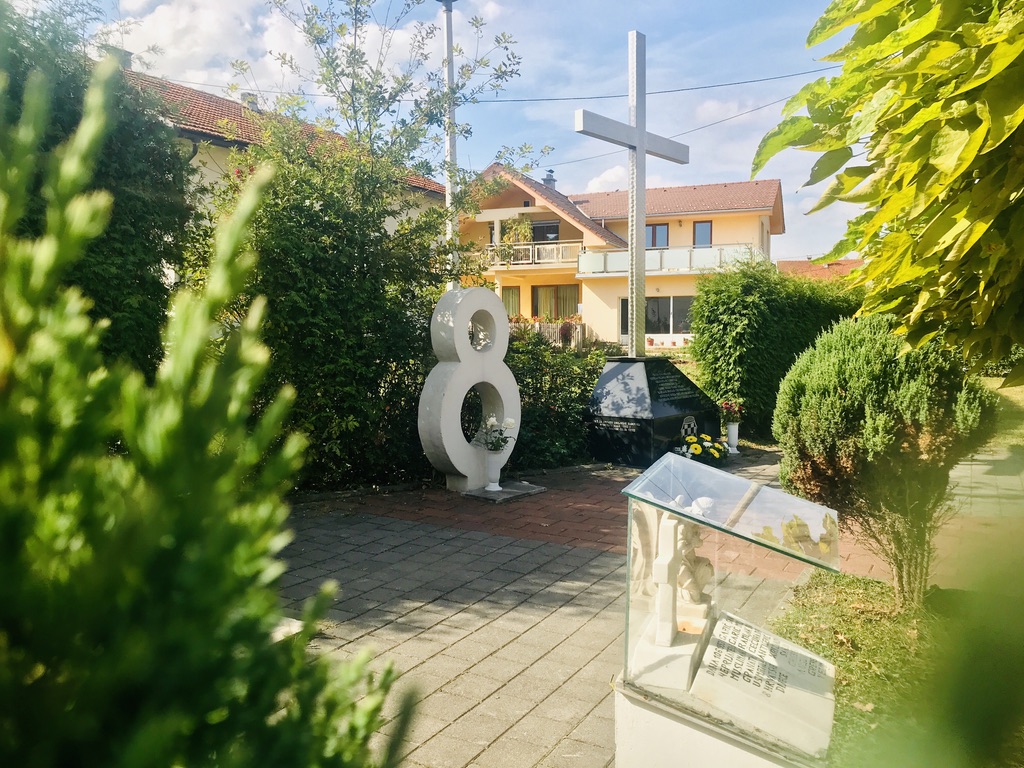
Despite the enforced silence and persecution of truth tellers by the Yugoslavian communist regime for almost half a century, the spirit of the Croatian people and their faith has kept the truth alive. The determination of the faithful in the Franciscan community has resulted in the discovery of the bodies of more than half of the friars and the provision of dignified burial for their remains. The legacy of silence enforced by the perpetrators of these events and their followers has been challenged through the successful efforts of many to create a Cemetery of Peace in Bila, an extraordinary memorial site in the breathtaking foothills of the Dinaric Alps. Individual crosses with engraved names will honour the more than 52,000 Croatian victims of totalitarian crimes in Bosnia and Herzegovina.

Although the provincial martyrdom procedure for the massacre of the Herzegovinian friars was completed in 2010, the diocesan process for beatification has not yet begun.

Despite the extensive cinema documentary and other forms of coverage of communist crimes to date, not one has explored in any depth the almost total lack of justice, statistically, towards the vast numbers of eagerly participating perpetrators who, at war’s end, simply walked away – untouched by justice. The communist Yugoslavia perpetrators of these grotesque mass murders have evaded justice and in no uncertain terms this is because they still ‘enjoy’ the status of a ‘protected species’ even though communist Yugoslavia ceased to exist in 1991, by the will of the majority of the Croatian people. This 2025 film, produced and directed by Nikola Knez, with a Screenplay by Dr Dorothy McClellan and photography by David Knez, co-produced by Damir O. Radoš, in both Croatian and English languages, addresses this glaring omission in the prosecution of communist crimes in Croatia and Bosnia and Herzegovina, which were part of the World War II Independent State of Croatia. The chilling, horrific, heartbreaking facts of the mass murders by gunshots and boiling oil poured over the victims, so competently and vividly summarised in this documentary, serve as a priceless repository with which justice for the victims may one day be achieved. This film offers a distinct light beam of truth through a historical overview of distressing events, revealing what was discovered and how it was done within the limited ideological constraints of political creations: Yugoslav communism and democratic liberalism.
“Today, we still do not know where these people are. For half of the murdered 66 Franciscans, we do not know where their bodies are. Someone knows. Someone knows. We care about the truth, and that is why we will never stop speaking, celebrating their lives, being inspired by their lives, and telling the next generations about the testimony of their lives, so that this does not happen to us again. This is what our Jewish brothers, who since 1945 have constantly told the world ‘Never Again’, have taught us. We have the same task. We have the same mission. We have the same history,” says, among other things, Fr. Jozo Grbeš in the film.
Watch the film on link below:
I highly recommend watching this 35-minute-long outstanding film. The film is not only powerful in its overall production quality, but it will also leave you with a wealth of factual historical information about the suffering of the Croatian people at the hands of the communist Yugoslavia regime, which lay hidden for decades, and it will generally reward your sense of what justice should look like were it not for the grave injustice suffered. It also may inspire and equip some to become active in a notable pursuit of justice for victims of communist crimes. Ina Vukic




 Croatia, the War, and the Future
Leave a comment