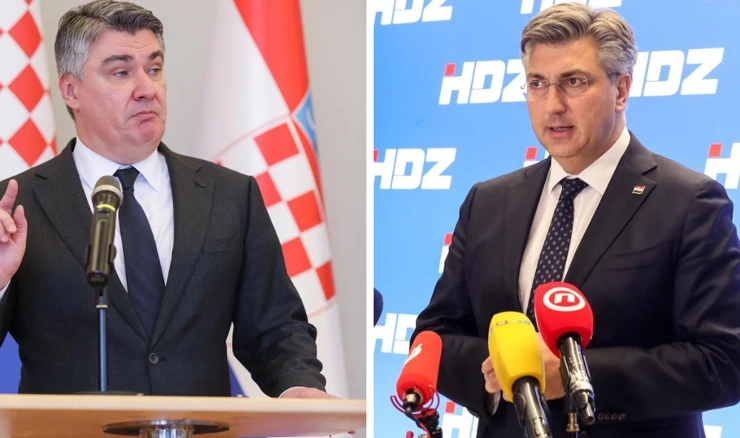

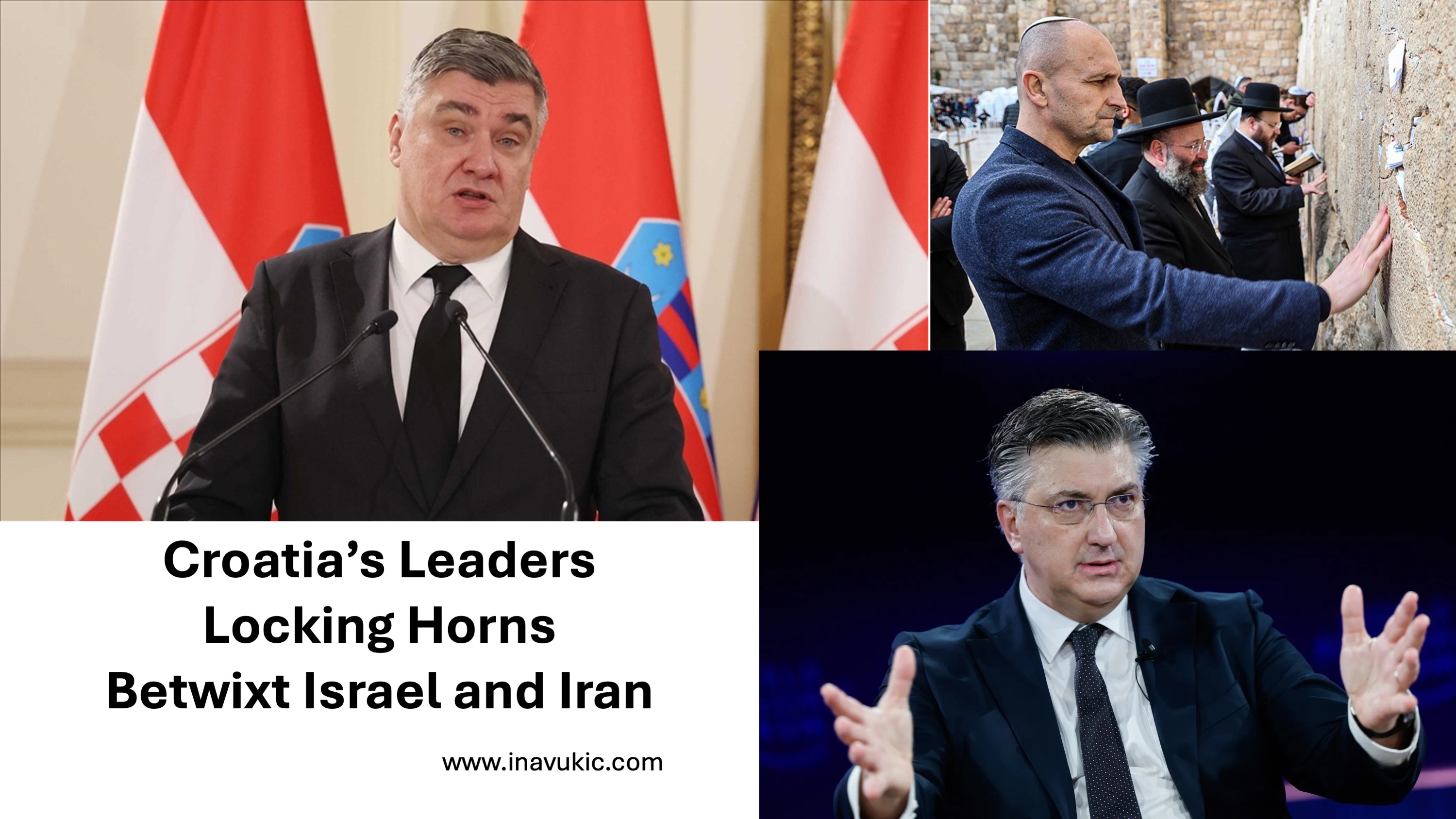
The relationship between the government and the opposition is fundamentally adversarial by design in parliamentary democracies. The opposition’s primary role is to act as an “alternative government” that scrutinises, critiques, and opposes the government’s policies and legislation, rather than simply agreeing with them. The situation in Croatia is the same in this respect as in any other democracy. However, it is a different matter when such adversaries sit in the two top chairs of the country: the President’s and the Prime Minister’s! Since becoming president in early 2020, the former League of Communists/Social Democrat leftist Zoran Milanovic has frequently crossed swords with Prime Minister Andrej Plenkovic’s centre-right Croatian Democratic Union (HDZ) government. The relationship between the President and Prime Minister of Croatia has been characterised by intense conflict, personal animosity, and a lack of cooperation, which boils down to political conflict, legislative deadlock, a dysfunctional judiciary, and an overall embarrassment for the country, about which I have written before on this blog.
The latest publicly aired rivalries between the two concern the overdue meeting of the National Security Council, which, due to the rift between them, has reportedly not met for five years, and the appointment of the chief judge of the Supreme Court. Left unsolved, both leave Croatia exposed to an operational disarray. Croatia has been without a Supreme Court president/chief Justice for over a year, which, in itself and in several ways, constitutes an obstruction of justice. The President and the Prime Minister keep on blaming each other for the failure to agree on a candidate to be appointed as president of the Supreme Court. It is a case of pathetic misconduct in relation to their duties as heads of state and government, where those duties must take precedence over any personal animosities between them.
Then, a few days ago, President Zoran Milanović strongly opposed Andrej Plenkovic’s government’s announced cooperation with Israel on the procurement of the David’s Sling anti-aircraft system and said that he will use his powers as commander-in-chief to ban the Croatian Army from participating in the arrangement. He warned that Israel is simultaneously arming Serbia, which the Croatian government sees as a security problem.
“If the Minister of Defence or anyone else wants to enter into that type of arrangement with Israel, it means that the Croatian Army – people from the General Staff, from the units, from the command system – needs to cooperate with the Israeli army. I swear to God, that will not happen. The Croatian Army, by my order, will not participate in that,” said Zoran Milanovic.
“This is a warning – do not do it. No Croatian soldier will participate in that. If civilians do it, it will be the first time in history,” he added. Regarding the “David’s Sling” system itself, he said that it is replaceable, “even if it is the last in the world, which it is not.”
David’s Sling is an Israeli medium-range missile defence system, developed jointly by the Israeli company Rafael and the US Raytheon. It is designed to intercept a variety of threats between the Iron Dome (short-range) and Arrow (long-range ballistic missiles) systems.
Milanovic articulates his argument with: “We buy tanks and David’s Slings, and Israel arms our closest neighbour – Serbia.” Israel has indeed been selling drones, missiles and other equipment to Serbia in recent years. Milanovic sees this as a direct security threat to Croatia, especially given the Serbian CM-400 missiles, known as Zagrebcanka – named after the capital city of Croatia.
The fact that Milanovic swears by God to justify his attempts to destroy military relations with Israel is the height of destructive cynicism. He uses religious symbols as a cover for a policy that directly plays into the hands of those who do not wish Croatia well. It is a transparent manipulation: while Prime Minister Andrej Plenkovic deals with concrete solutions, Rafales and modern air defence, Milanovic offers only poor acting and dangerous isolation. Treason comes to mind when the President attempts to undercut the government’s attempts to secure essential military defence mechanisms.
President Zoran Milanovic has finally accepted Andrej Plenkovic’s proposal to convene sessions of the National Security Council and the Defence Council, and has proposed holding them next week. As Supreme Commander of the Armed Forces, President Milanovic can block the Croatian Army’s operational cooperation, and it seems clear he is firing pre-emptive shots ahead of the meetings to assert his power and position, thereby attempting to intimidate Andrej Plenkovic’s government into a defensive posture. Such developments and rhetoric not only throw a spanner in the works of the Croatian domestic safety mood but also cause damage to its international reputation. While Israel is not a member of the NATO alliance, it is a key partner. Israel has been part of NATO’s Mediterranean Dialogue since 1994, focusing on security and military cooperation. Furthermore, the United States formally designates Israel as a “Major Non-NATO Ally,” a status providing special defence and security cooperation.
It is now abundantly clear that the Constitution of the Republic of Croatia has nowhere envisaged a conflict between the President and the Prime Minister. In fact, one may say that the Constitution has envisaged a co-operative and harmonious relationship between the president, who is the head of the nation and the Prime Minister, who is the head of the government and is directly answerable to the people of the country and the legislature. A clash is not in the country’s interest, as it can derail the entire mechanism established by the Constitution.
In Article 94, the Constitution states that the President of the Republic shall ensure the regular and balanced functioning and stability of state authority, and that the President of the Republic shall be responsible for the defence of the independence and territorial integrity of the Republic of Croatia. On both of these issues, and because of alarming disagreements between the President and the Prime Minister, the functioning of authorities, for example, the Supreme Court, and defence plans are certainly far from stable.
Crucial decisions are delayed, and policymaking is sluggish as the two leaders struggle to find consensus. The public in Croatia is unsure of who is responsible for policy successes and failures, leading to a threatened stability in the country and divisions within a minority government, which, by the way, in the protracted lead-up to the next parliamentary elections due in 2028, may be one of the motives behind the President’s aggressive outbursts against the government.
But cohabitation in its full form, the peaceful coexistence of a president and a prime minister of different political loyalties cannot be said to be the order of the day for Croatia as it was, for example in France during 1980s where a Socialist president (e.g., François Mitterrand) has had to work with a right-wing prime minister (e.g., Jacques Chirac), or vice versa, forcing them to share power. In Croatia, the situation is more one of fierce battles and competition for power between the president and the prime minister, regardless of each’s inherent duty to maintain stability in the country on all fronts. Since the Constitution does not seem to provide for a situation in which the constant rifts between the President and the Prime Minister cause widespread despair in the country’s national strategies and stability, perhaps it is the people who are the only ones who could bring both to order! Judging by the outcries of discontent and anger consistently found on social media and other media outlets in Croatia, a scenario of public pressure may yet yield a path to real change in the country’s leadership. On the other hand, and as it used to be in communist Yugoslavia, the voices of dissent may become suffocated in one way or another. Or we may see a consolidation of a nation significantly populated by perpetual complainants who lack the impetus to bring about political and, hence, leadership change. We may yet see the brave with authority and clout ask the question, “Does such profound rivalry constitute a treasonous behaviour against the national interests of Croatia, and if so, which one, if not both, is to blame? Ina Vukic





Leave a Reply to inavukicCancel reply