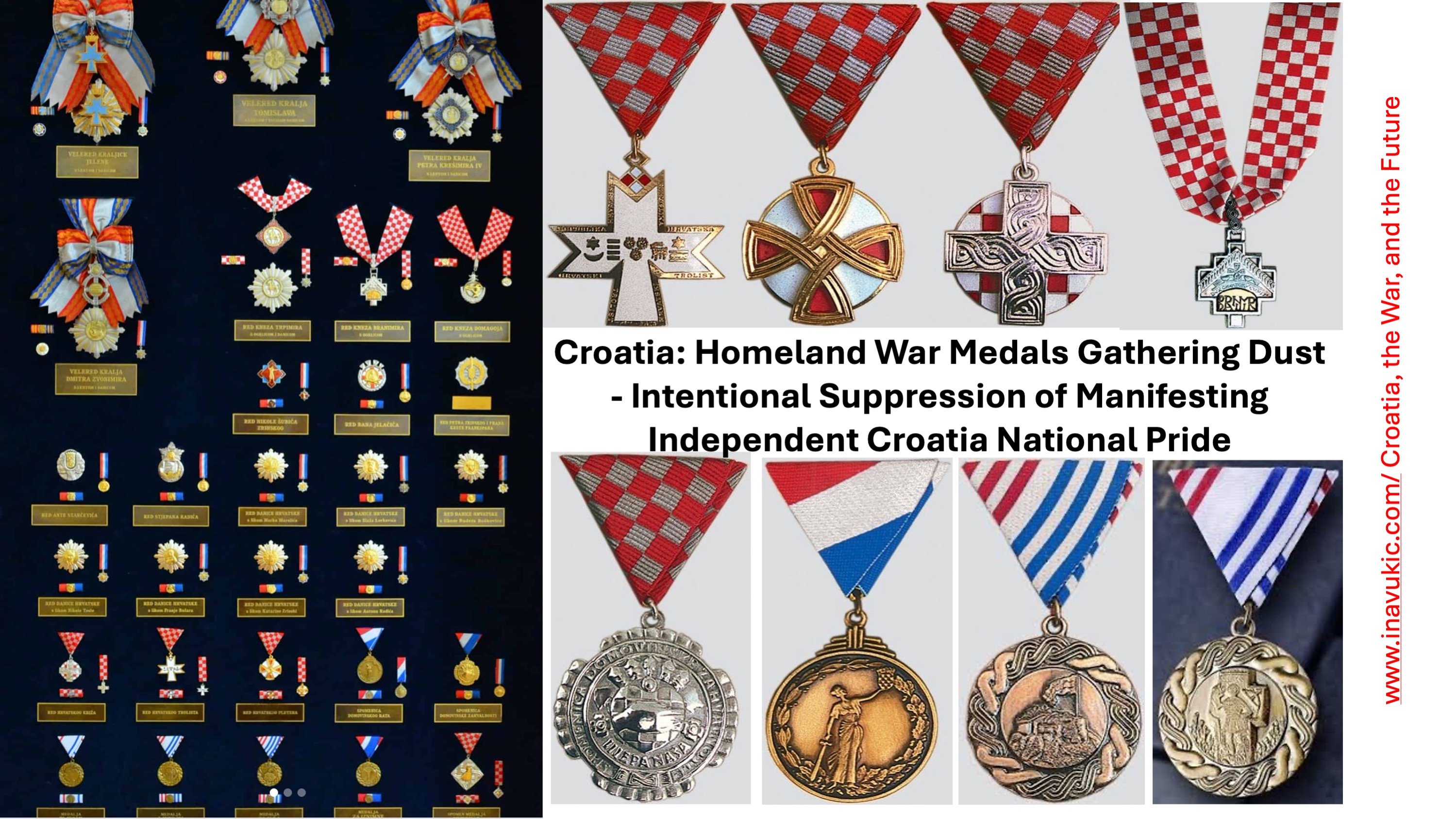

After World War II, the communists of Yugoslavia had gone into extraordinary efforts to bury the memory of all the fighters and civilians who fought for an independent state of Croatia. It is clear to me that the same scenario of culture of erasing, or at least minimising, the national pride in those who created today’s independent Croatia is being implemented. Openly or by stealth. What is not clear to me is why those who fought for independence tolerate this situation. Why do they tolerate that in the first rows of dignitaries at national remembrance or independence celebration gatherings, there are mostly persons in power who have not spent a single day fighting for independence from communist Yugoslavia, while those who have are almost nowhere to be seen in official government-organised events? Why do they tolerate that there are no Homeland War medals on any chests of veterans in civilian clothes on these occasions?
There are nineteen main decorations awarded by the highest authorities of the Republic since 1995, in addition to several other medals. Orders and decorations are for merit in establishing, maintaining and promoting an autonomous, independent and sovereign Republic of Croatia, deserved merit in the realisation of the Croatian nation-building idea and the development and construction of the Republic of Croatia, and for exceptional courage and heroism in war, in immediate war danger or in special peacetime circumstances.
The point of celebrating Veterans Day, Victory Day, Homeland Gratitude Day, and Operation Storm, etc., is to honour those who contributed to the creation of an independent and democratic Croatia. But, year after year after the war and occupation of Croatian territory had ended in 1998, all the public sees at celebrations of these days are career military personnel (most of whom had not spent a day on the battlefields) or politicians (most of whom have not spent a day fighting for an independent Croatia in any manner). The public does not get to see the faces of decorated participants or veterans in civilian clothing wearing their well-deserved medals, nor the display of medals awarded to those who gave their lives for freedom. One feels that such celebrations and events honouring those who fought in Croatia are driven more by cold, hollow duty, which brings opportunities for political speeches than by national pride and joy, as they are in other democratic countries. How sad this is!

There is a historic, current, and widespread sentiment, at least in the Western World of democracy, towards which Croatia has always striven, that remembering the war has no face unless medals of honour are worn. This highlights the vital role of material symbols in personalising, honouring, and anchoring the memories of conflict for freedom. While war is often remembered through abstract numbers or general narratives, medals serve as an “embodiment” of individual experience, representing the stories, sacrifices, and identities of veterans and all those who have, in other ways, contributed to freedom or battled for their country’s independence. Indeed, people in the Western World, at least, are encouraged to wear their medals of honour on significant national occasions.

Medals of honour are profound symbols of national pride, representing a collective memory of military bravery, public service, and the sacrifices individuals make for the nation. They serve as visible recognition of acts that go “above and beyond” the call of duty, fostering a shared identity and honouring the commitment to one’s country.

Sadly, I have yet to see and witness those, in civilian clothes, who have earned medals of honour during Croatia’s 1990s Homeland War and the creation of independent Croatia wear their medals at the country’s Victory and Homeland Thanksgiving Day and the Day of Croatian Defenders (August 5), Remembrance Day / Day of Remembering the Victims of the Homeland War and the Vukovar and Skabrnja Victims (November 18) or Official state events, funerals of veterans, and military anniversaries. While there may be individuals who choose not to wear their medals for one reason or another, it is conspicuously unsettling that no one wears them when in civilian clothes at these important celebrations and remembrances.

A definite measure of national pride and its continued nurturing rests in the medals of honour bestowed upon people. But this cannot be seen in its full glory in Croatia. Indeed, any medals one might see in Croatia worn on the chest are those on army, navy, and air force uniforms. This, of course, has little to do with national pride but more with personal careers in the country’s armed forces. Such is the perception these practices evoke in public.
The manifestation of national pride would have a great deal to do with the public display of medals at important events, awarded for a nation’s existence and life. The former communists and their descendants who hold power in Croatia seem to be intent on belittling the contributions of the many individuals who made it possible for Croatia to become an independent nation. Just like their predecessors have after World War II.
I have heard many excuses or attempts of explanations for this from people, and one is that too many medals have been awarded for individual efforts, bravery and contribution to the victorious Homeland War; hence, the medals, they say, don’t mean much because there are too many and they devalue those who truly deserved them! When I hear that, I gasp in horror. Of course, there had to be a large number of people earning, through their sacrifices, the medals of honour for their contribution to Croatia’s victorious exit from communist Yugoslavia. If there weren’t, Croatia would not be free. There are some awarded by the President who, in the eyes of many, did not deserve them! But why do the deserving recipients have to suffer because of a few seemingly undeserving ones!? There had to be many patriots to achieve independence; otherwise, the independence movement would have been in vain, and rivers of Croatian blood would have been spilt for nothing.

Although during the defence against the Serb and Yugoslav aggression (Homeland War) and the building of an independent and sovereign state, the late President Franjo Tudjman often awarded medals of honour, and appropriately so, his presidential successor (after his death), Stjepan Mesic (2000- 2010, also the last President of the Presidency of former Communist Yugoslavia), had turned the institution of awarding medals of honour into a real circus. One would say it was intentional and aimed at de-Tudjmanising Croatia, which included degrading and devaluing the work Tudjman did. We must not forget that Mesic, while pretending to support it for personal gain, was against an independent Croatia, attempted to criminalise the Homeland War, worked hard to try and equate the aggressor with the victim, appeared in the International Criminal Tribunal for the former Yugoslavia in The Hague as a witness for the prosecution, against Croatia, and spread many lies and fabrications regarding that war. This, though, is not the reason medals of honour pertaining to the Homeland War and the creation of the independent state of Croatia should be gathering dust in drawers and dark corners.
As the war, in essence, ended in 1998 with the reintegration into Croatia of the last bits of its territory that had been occupied by Serbs, it would have been the time to institute Victory parades, honouring the people who fought in the war and helped significantly in creating the new state of Croatia. As evidenced by Tudjman’s speech on 30 May 1990 at the inauguration of the Croatian Parliament, he sought to emulate Western democracies in many aspects of freedom, jurisprudence, and economic policy. I recall a phone conversation with him in 1997, before he became terminally ill, in which we discussed such parades and the wearing of medals of honour.
Whether one looks at Australia, America, Britain, Canada, France, Italy, Japan, veterans and civilians openly wear their medals of honour on specific commemorative occasions and formal events where the uniform or civilian dress code allows, typically on the left. Remembrance /Armistice Day/ANZAC Day, Independence Parades, Funerals for Veterans, Formal Occasions: Weddings, formal dinners, or evening functions (where miniature medals are typically worn), Civic Duties: When invited to official functions such as award ceremonies, receptions at Embassies or High Commissions…are some of the occasions medals of honour are or can be worn in the Western World of democracy. In Croatia, all medals of honour, bar those awarded to personnel of armed forces – be they war or postwar related – are gathering dust in drawers or on cabinet shelves at home, and one is justified in feeling alarmed by this. Medals of honour and military decorations remain highly significant worldwide, tangible links to personal and national history.
Yet, in Croatia, most likely by design and political purpose, these strongest symbols of national pride are kept out of sight and thus on a sure path to forgetfulness. What a shame!
There is no passion more universal than pride. It pervades all orders of society: from the thrones or presidential offices to the cottage or apartment. National pride means being proud of one’s country. It can take the form of defending the country in times of need or standing by it in difficult times. National pride arises from real or imagined national advantages and is an important part of personal development. It encourages unity, hope, and effective representation of one’s country. National symbols like flags help instil national pride through their historical and cultural significance. The national flag, in particular, is seen as the true symbol of national pride in most countries, representing struggles for freedom and aspirations of the people. And Croatia struggled long and hard for its own flag. It was the people who received medals of honour from the 1990s war and around it that have made the national flag stand and fly freely. And we cannot see their faces because their well-deserved medals are not worn, are not displayed for all to see. What a shame! Ina Vukic



Leave a Reply to LuanneCancel reply