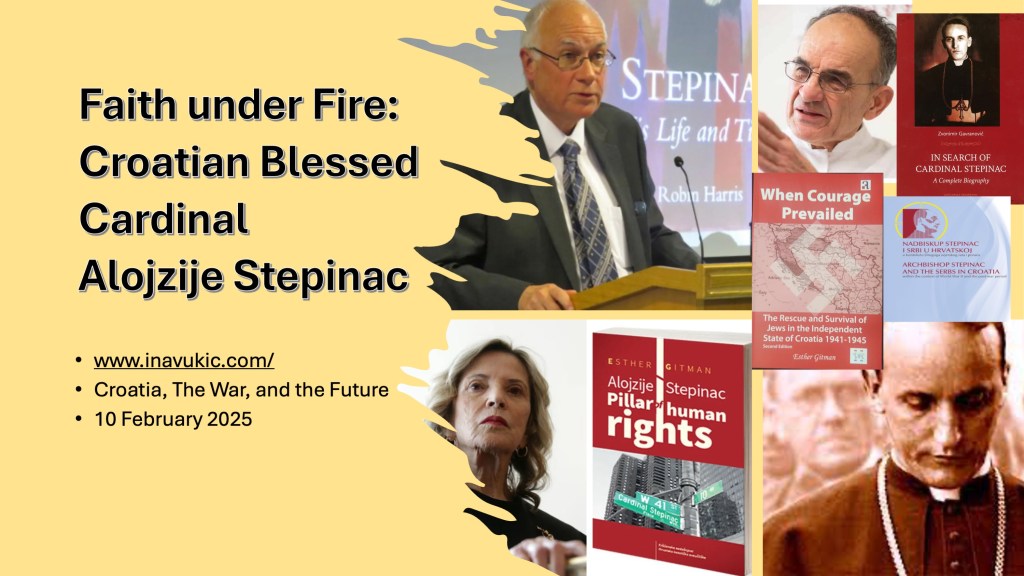

February 10th, 2025 marks the 65th anniversary of the death of Blessed Croatian Cardinal Aloysius (Alojzije) Stepinac (1898-1960). What stands out more than anything else in Stepinac’s biography and character is that he was a man whose actions were opposed to the destructive tendencies of Yugoslav communist regime, to the destructive tendencies of the Nazi National Socialism and Italian Fascist occupying forces as well as the destructive tendencies of racial laws adopted from them by the Ustasha Movement whose main source of ideological inspiration was, in essence and fact, in the pure, deeply rooted traditional glorious Croatian plights for freedom. All those destructive forces were the enemy of his pursuits in humanity and his devoutness to his belief that there was only one human race walking the earth and that was “God’s race”.
“We affirm then that all peoples and races descend from God. In fact, there exists but one race. The members can be white or black. They can be separated by oceans or live on the opposing poles but they remain first and foremost, the race created by God, according to the precepts of natural law and positive Divine law as it is written, in the hearts and minds of human, or revealed by Jesus Christ, the son of God, the sovereign of all peoples,” Alojzije Stepinac, 25 October 1942.
Indeed, Stepinac’s enormous importance for humanity lies in resisting all tyrannies without distinction regardless of the danger to his very own life such resistance posed during the World War Two.
When I was growing up in the former Yugoslavia, Josip Broz Tito and Cardinal Alojzije Stepinac were two extremely polarising figures – and, given the communist mindset that still prevails in many circles in Croatia, they remain so to this day despite the fact that back in 1991 at the Croatian independence referendum 93.24% of Croatian voters voted in favour of secession from communist Yugoslavia.

The grave injustice inflicted by Yugoslav communists
Alojzije Stepinac’s demise came from no other moral and political enemy than murderous communist Josip Broz Tito of Yugoslavia. The real persecution came only after Stepinac rejected Marshal Tito’s 1945 evil or Mephistophelic offer to separate the Catholic Church in Croatia from the Vatican and transform it into the national and autocephalous “Croatian Catholic Church.” Such a Church would not only have broken away from the rock upon which Jesus has built His Church, but it would also have been a blow to the Croatian liberation movement, since the Yugoslav regime would easily have controlled it. Like in Poland, the Catholic Church in Croatia was one of the key institutions for preserving the national spirit and overthrowing the anti-human and anti-God communist rule. As Stepinac said:
“Communism is born of lies, of lies lives, and of lies will die. The Lord is in no hurry, but He is never late.”
Stepinac’s criticism and contempt for the new communist regime that gained giant feet at the end of WWII, in which Josip Broz Tito was depicted as a hero and a saviour, became increasingly direct, explicit and public, as evidenced by the Joint Pastoral Letter of the Archbishops and Bishops of Yugoslavia, issued after their Conference at Zagreb on September 20, 1945.
“Even during the war, a great number of priests were killed; not so much during battles or actual fighting but following death sentences decreed by the present civil and military authorities. When military operations came to an end, the death sentences against Catholic priests did not cease. According to available data, 243 died, 169 are in prison or concentration camps, and 89 are missing . . . The (communist) tribunals pronounced these death sentences after summary trial, and the accused often did not know with what they were charged until the actual trial. Frequently they were denied any defence and not allowed to call witnesses or to be given legal assistance. If the Public Prosecutor had the right to deny a fair trial to these priests sentenced to death, how could their guilt have been established? . . .”
During communist Yugoslavia, which – following the model of Stalin’s Soviet Union – carried out terror against the civilian and intellectual class as well as Churchmen, Stepinac was soon arrested and in 1946 underwent a typical communist show trial in which he was sentenced to 16 years in prison as an alleged associate of the alleged pro-fascist Croatian authorities. The trial was not based on justice, but, rather, it was an outrage on justice. Stepinac appeared in court as the spiritual leader of the Croatian people and came out of the courtroom as the leader of his people and an example to the world. To this day it remains unknown whether he died in 1960 of systemic poisoning by Yugoslav communist authorities.
Wanting to pre-empt the veneration of Stepinac as a saint, the communist Yugoslavia secret service destroyed his heart. Their attempts, however, were without any success, because the reputation that Stepinac has acquired among Croatian believers since his death, to this day, is equivalent to that of the greatest saints of the Catholic Church.

The prophet of truth and justice
No less important, Stepinac was a prophet of the truth and justice, who foresaw the collapse of all systems which seek to oppose God’s will, and which restrict men in the exercise of their basic human rights. Archbishop Stepinac was a man who instinctively felt the need of justice in the world and acted according to his conscience wherever and whenever human rights were being trampled. He raised his voice in the defence of human rights—and God’s rights. About the strong patriotic feelings of Cardinal Stepinac, which have so often been misinterpreted. He acted out of love for the Catholic Church and for his Croatian nation.
In 1952, Pope Pius XII elevated Stepinac to the cardinalate. He did not go to Rome for the investiture ceremony, knowing he would not be permitted to return home.
Cardinal Aloysius Stepinac was declared a martyr and Pope John Paul II beatified him on October 3, 1998.
“We gather for a devoted and prayerful remembrance of Blessed Aloysius Viktor Stepinac, a fearless pastor and an example of apostolic zeal and Christian fortitude, whose heroic life continues today to illuminate the faithful of the Dioceses of Croatia, sustaining the faith and life of the Church in this land… Precisely because of his strong Christian conscience, he knew how to resist every form of totalitarianism, becoming, in a time of Nazi and Fascist dictatorship, a defender of the Jews, the Orthodox, and of all the persecuted, and then, in the age of communism, an advocate for his own faithful, especially for the many persecuted and murdered priests. Yes, he became an advocate for God on this earth, since he tenaciously defended the truth and man’s right to live with God,” Pope Benedict XVI, 5 June 2011.
But Pope Francis has evidently chosen to take the highly unreliable input from the Serbian Orthodox Church with regards to the canonisation of Stepinac and this choice is looked upon as a purposeful political barrier to the truth. The issue begs the question: how can Serbian Orthodox Church that had made it its historically relentless mission to throw lies and hatred against the Croatian nation be considered as a truth-giver when it comes to Stepinac and Croats in general. According to Irinej’s (Serbian Orthodox Church) allegations that have no basis in facts, Stepinac was guilty of co-operation with the Croatian Ustasha regime, which operated as part of the occupying Axis Force from 1941 to 1945, remaining Hitler’s ally until the end of the war, and which persecuted the Serbian, Jewish, Roma, and politically opposed Croat populations through mass and individual crimes.
The pillar of human rights
But, looking back at historical facts unearthed in historical archives since Croatia’s independence 1991, since the fall of the communist Yugoslavia regime which was headed mainly by Serbs in the corridors of power, the historical irony is not only that Stepinac was not guilty of the crimes he was accused of by the communists of Yugoslavia amd the Serbian Orthodox Church – on the contrary, he was not a persecutor (or even a supporter of the persecution) of the Serbian, Jewish and Roma populations, but their saviour. Relevant research in both the Croatian and English languages – including Stepinac: His Life & Time by Robin Harris, When Courage Prevailed: The Rescue and Survival of the Jews in the Independent State of Croatia 1941-1945 by Esther Gitman, Alojzije Stepinac: Pillar of Human Rights by Esther Gitman, In Search of Cardinal Stepinac by Zvonimir Gavranovic, Archbishop Stepinac and the Serbs in Croatia within the context of World War II and the post-war period By Ivan Majnaric et. al. – shows that books on the subject written in communist Yugoslavia do not reflect the truth about the Croatian cardinal.
“The canonisation of Stepinac is a historic case. He is a virtuous man for this Church, which has proclaimed him Blessed, you can pray [through his intercession]. But at a certain moment of the canonisation process there are unclear points, historic points, and I should sign the canonisation, it is my responsibility, I prayed, I reflected, I asked advice, and I saw that I should ask Irinej (of the Serbian Orthodox Church), a great patriarch, for help…,” said Pope Francis in 2019.
Grave Injustice repeated in modern times
And now we are faced with Francis, as a pope committed to dialogue with non-Catholic Christian communities, seeks to make amends with the Moscow Patriarch Kirill (Cyril) and contribute to Christian unity by building good relations with the Serbian Orthodox Church, which serves as a kind of a link to the Russian Orthodox Church while sacrificing the truth (the truth about Stepinac)! This patriarch Irinej whom Pope Francis called “great”, like many of his predecessors, was a politician as much as he was a priest. Known for his nationalist statements justifying Serbian genocidal imperialism – a transgenerational project which underlies every 20th-century Balkan war – Irinej’s observations about Stepinac, who “did not want to hear the children’s cry” in concentration camps, are a first-class manipulation. The inaccuracies of Irinej’s statements about Stepinac and other historical phenomena were reported to Francis by the Episcopal Conference of Croatia before the Pope called him “great,” which makes Francis’s statement quite problematic and humanly repulsive.
During World War II, Stepinac, for example, saved countless families and individuals of Jewish faith, and others who were persecuted. The methods of Stepinac’s rescue work varied, from interventions with state leaders to giving shelter to the persecuted. Stepinac’s instruction that all persecuted Orthodox who wanted to save themselves by converting to Catholicism should be allowed to do so, saying they would be free to return to their original faith after the war, was turned upside down by communist propaganda, which accused Stepinac of forcibly baptising Orthodox believers. The Serbian Orthodox Church hung onto that communist lie tightly. Although there is no definitive list of his merciful deeds, Stepinac di sav thousands of people. That is a historical fact.
The beatification at the Croatian Marian Shrine, Marija Bistrica, in 1998 only confirmed the historical truth which St. John Paul II summarised on that occasion: “The person of the new Beatus sums up, so to speak, the whole tragedy which befell the Croatian people and Europe in the course of this century marked by the three great evils of fascism, national socialism and communism. He is now in the joy of heaven, surrounded by all those who, like him, fought the good fight, purifying their faith in the crucible of suffering.”
Paradoxes in the canonisation of Stepinac process
The first paradox is tied up with Stepinac’s status in relations of both religious and nationality nature. Under normal circumstances, the Croatian cardinal would not be a cause of animosity but an occasion for bringing the Croatian and Serbian, as well as the Catholic and Orthodox, sides closer. One side, however, does not want that. That side is Serbian, in whose interest it is to perpetuate historical lies and falsities against Stepinac and Croats in general. This is evidenced by the fate of the committee, composed of Croatian and Serbian churchmen and historians, about which the Pope spoke. The commission ended its work in 2017 and the opposing parties remained in their original beliefs, despite the fact that the Serbian part of the commission could not offer any authentic documents or new historical evidence for Stepinac’s guilt contained in their allegations against him.
Finally, all the formal prerequisites for declaring Stepinac holy – including a miracle confirmed by Vatican – are over. For years, everything has been waiting for the pope’s signature. When the process will end is, sadly and unfairly, anyone’s guess. Pope Francis does not seem eager to finish it and the Serbian Orthodox Church now has a new Patriarch (Porphiry) and, hence, Pope Frances shows his tendency to compromise the Church’s spiritual and historical inheritance by making concessions to non-Catholics: Muslims who migrate to the West, the communist Chinese government, progressive elites, and – in Stepinac’s case – Serbian Orthodox Christians. The inclusion of a non-Catholic religious leader in the process of proclaiming a Catholic saint is virtually unprecedented. Francis, however, seems to have initiated an unprecedented number of precedents that sit uncomfortably with multitudes of Catholics and Christians, for that matter.
Stepinac was denied justice by Josip Broz Tito under the communists of Yugoslavia and much points to the scenario where he is being denied justice by Pope Francis himself in the canonisation process. It is safe to assume that Pope Francis is well aware of Pope John Paul II description of Blessed Stepinac: “He knew well that no bargains can be made with truth, because truth is not negotiable. Thus, he faced suffering rather than betray his conscience.” It is not clear to me why Pope Francis chooses to bargain with the truth about Stepinac except, of course, to compromise it or discard it for the sake of his own political and globalistic pursuits with other Christian and non-Christian Churches.
Prepared and written by Ina Vukic



 Croatia, the War, and the Future
Leave a comment