
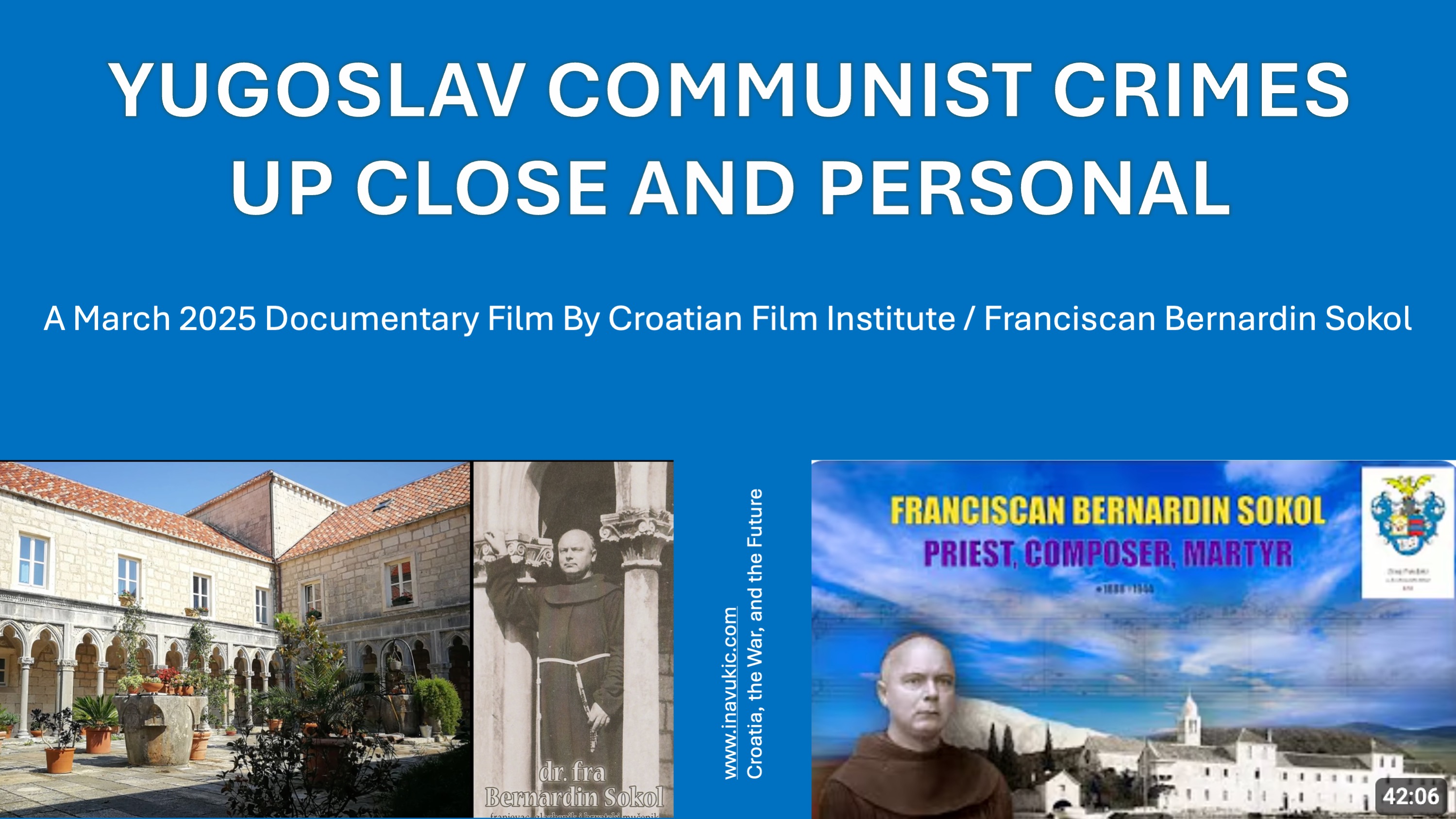
Poignant and for humanity disturbing, emotionally charged portrayal of the 1944 horrific Yugoslav communist partisan murder of dr Bernardin Sokol, a Croatian Catholic friar and a renowned composer, in the Texas-based, USA, Croatian Film Institute, new documentary film titled “dr. fra. Bernardin Sokol” brings home the painful truth of profound suffering and peril during World War Two and after it endured by Croatian patriots and all those who fought for an independent Croatia. The indisputable high value of this emotionally charged documentary is that it provides a revealing “door” to the cruel manner Yugoslav communists murdered and mass murdered Croats. It provides details of Fra. Bernardin Sokol’s martyrdom and dedication to his faith enveloped in his deep love for his country, Croatia. This documentary film, directed by Nikola Knez, Screenplay by dr. Dorothy McClellan, director of photography David Knez, and produced by Nikola Knez and Damir O. Rados provides us with captivating truth-telling vignettes about communist Yugoslavia purges at a personal level, which is, I believe, always the “tool” that assists long-term remembering, learning and visualising history. Undoubtedly, the ability to visualise something from the past assists enduring remembrance the best.
This film shares the long-silenced story of murdered Franciscan composer Bernardin Sokol (Kastel Sucurac 1888 – Badija 1944). During the communist Yugoslav regime (1944-1990), no one was permitted to speak about this gifted composer, pedagogue, and publisher. He had studied church music at the Vienna Academy of Music in 1915 and received his doctorate in theology in 1925 from the University of Rome. As a composer, he was decades ahead of his time, a musician’s musician, alongside Puccini and Wagner with harmonic and compositional innovations.
While he was staying on the island of Badija in Croatia in 1944, communist partisans came for the Franciscan priest during the night, ostensibly for interrogation. They took him by boat from the island of Badija to the mainland. Enroute, they killed him and threw him into the sea, hoping that the sea would hide their crime. But the sea washed his body ashore. He was murdered by people who called themselves anti-fascists. They convicted and killed him without trial. During the Yugoslav communist regime, Sokol’s expressions of love for his own Croatian people and country were considered his greatest sins and deserving of a death sentence.
The film features: Prof. dr. sc. Fra Bernardin Skunca OFM, Dragon of Punta Mira, honorary president of the Croatian Society of Fra Bernardin Sokol (HDBS); Prof. dr. sc. Mihovil Biocic, member of the HDBS; Milivoj Bratincevic, dipl. oecc., Dragon of Putalj II of the Brothers of the Croatian Dragon (DBHZ), vice-president of the HDBS; Prof. dr. sc. Mislav Grgic, Grand Master, DBHZ; Mo Josip degl’ Ivellio, chancellor of DBHZ, president of the Croatian Society Fra Bernardin Sokol; Fra Benjamin Milkovic, Delfi Prizmic, née Bonkovic, witness.
In the film we hear some very potent albeit heart-wrenching testimonies about the crimes against Croats committed by Yugoslav communist partisans during and after World War Two including the following:
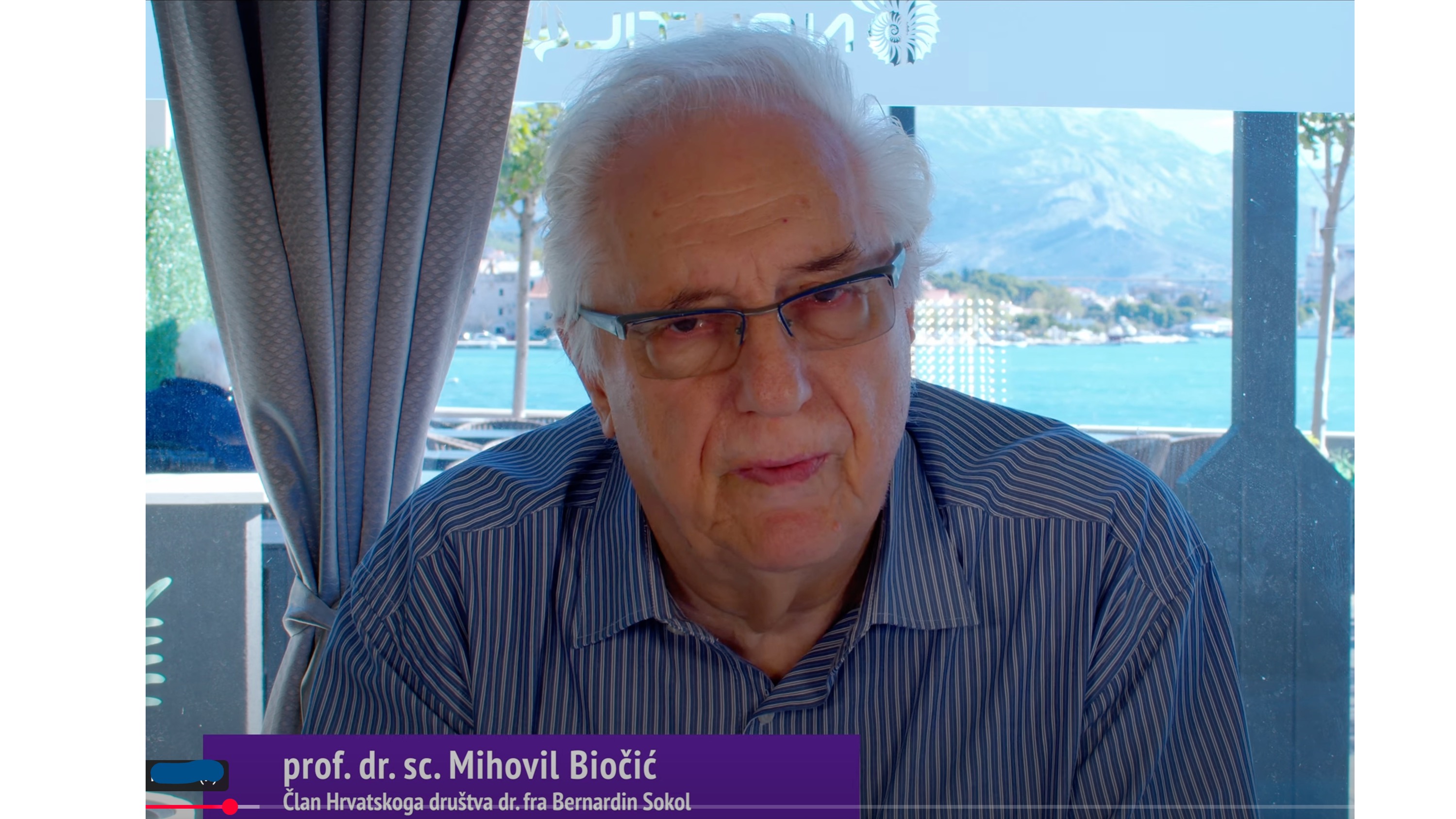
Prof. Dr, Mihovil Biocic, Ph.D.: “… And in the Second World War, communist partisans took him away on the night of September 28, 1944, ostensibly to interrogate him. After they took him from the monastery on the island of Badija to the sea, in a boat, they beat him, killed him there and threw him into the sea… The sea washed up his body two days later on the Trstenica beach near Orebic… he was killed without indictment, without trial and without a verdict. This is a war crime in all countries of the world, and war crimes do not come under any statute of limitations.
Of course, as is customary in Croatia, no one was ever held accountable for war crimes against Croats. And even in this last war, very little, nothing, very symbolic… murders, horrible drownings in the sea, and until the establishment of our dear Croatia, it was not allowed to be spoken about…
Fr. Bernardin Sokol, our martyr, is one of the first victims, the first of the martyrs, of 664 priests, monks, nuns, seminarians, one bishop, Carevic from Dubrovnik, who was called Stepinac of the South, who was a very good man. He was especially tortured and killed. That number of murdered priests is the largest of all the countries of the anti-Hitler coalition. For example, Croatia can be compared to Slovakia, in terms of population, in Slovakia the communists killed 14 priests, in Croatia, I repeat, 664 murdered priests…
So, to kill an intellectual, a patriot, a Croat, at that time, it didn’t take anything but the assumption that the person wouldn’t support the communist system after the war. That was enough to kill him (or her). After all, that was proven at Daksa… there they killed 24 priests and monks without indictment, without trial, without verdict and mostly with cold weapons. What does that mean? In the worst way. They threw them into the grave pits that the friars had dug out beforehand, they stripped them naked, and they sang I praise you, God. You can imagine the scene, after which they were beaten with cold weapons, thrown into the grave pits and buried… In the Dubrovnik area, the entire Dubrovnik elite was killed without a verdict, without an indictment… “.
Delfi Prizmic: “…these were mostly boys, but they all wanted help and tried to somehow grab the body, the upper part of the body of Fr. Bernardin Sokol, he was naked, they took him to the German machine gun nest, protected him in the best possible way, and he temporarily remained there…”.
Milivoj Bratincevic: “…From that group, from those 12 who found his body, one approached me and said that he had witnessed the throwing of Fr. Bernardin’s tortured body into a German machine gun nest. His name was Ivo Mateljak. It is interesting that this man was born in 1932, so he was 12 years old at the time and that he did not have the strength to say this in his native Orebic, but he lived in Split, he visited Orebic, but he first said this when the monument (to Bernardin Sokol) was raised… 2012 … after which we initiated all activities … including approaching the state attorney’s office in Dubrovnik, which quite coldly refused any investigative actions…”.
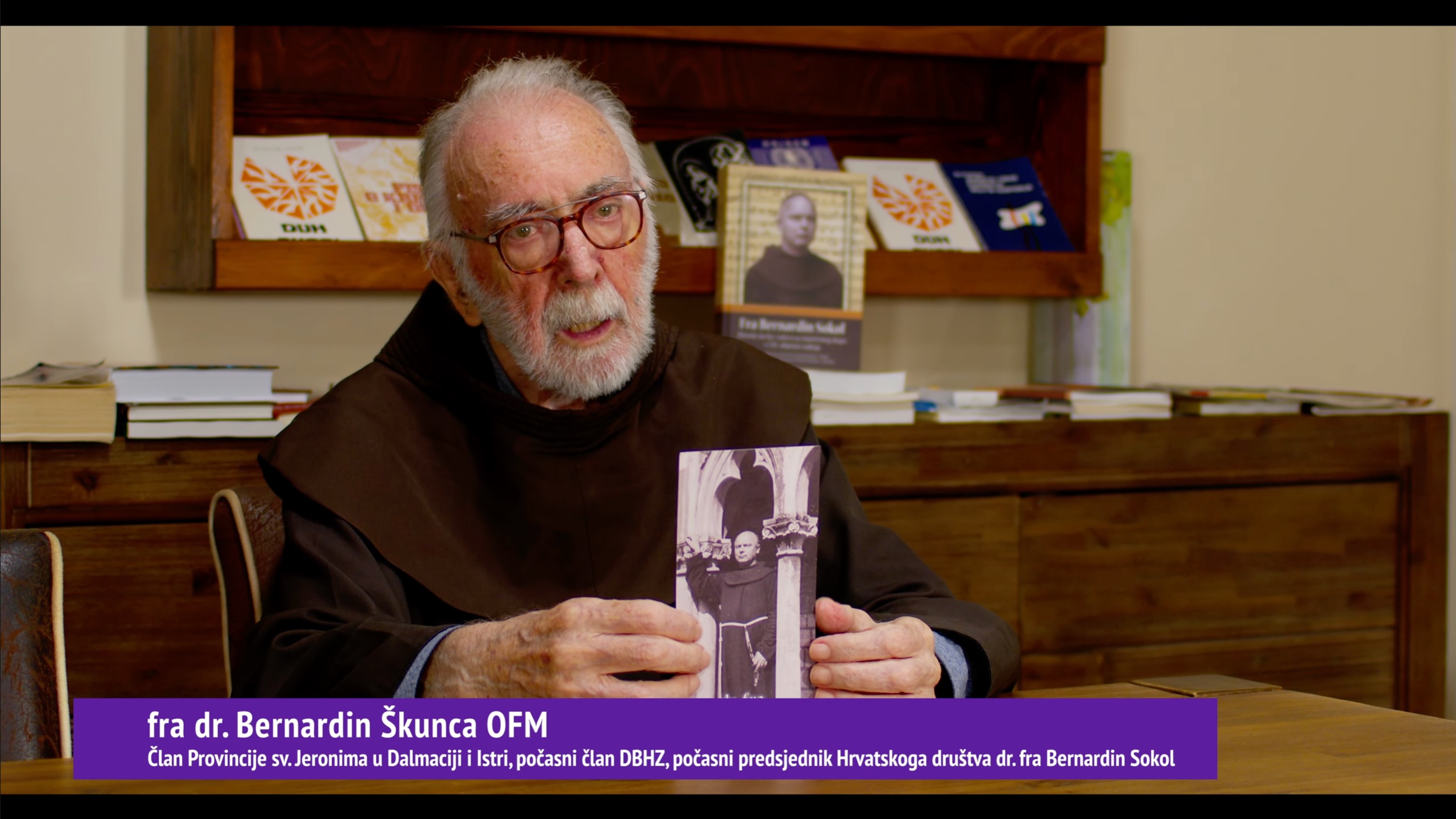
Fr. Dr. Bernardin Skunca OFM: “… he was a pillar his entire life, until his last words, and those words were long live Christ the King, long live the Catholic Church, long live Croatia… Why did they kill him? Precisely because he was a pillar, he was strength, he was greatness in himself…”.
mo. Josip Degl’ Ivellio: “… about the Croatian composer and one of the first martyrs of intellectuals we cannot say post-war because the war was still ongoing, so after September 1944, after his death or murder in the channel between the island of Badija and Peljesac, or Orebic, a long-term, or more than ten-year silence arose. He was not in encyclopedias, he was not in lexicons, he was not mentioned as a composer, as if he was actually a nobody and nothing. However, we must remember that de fra Bernardin Sokol achieved great fame during his lifetime, perhaps not so much in Croatia as mainly in the Czech Republic but also in other neighbouring countries, Hungary and Austria, where his compositions were performed on radio stations…”.
I thoroughly recommend watching this film and sharing it with others, especially the younger generation who often struggle to understand or visualise communist crimes perpetrated against Croatian patriots by Yugoslav partisans. Ina Vukic
The film may be viewed via this link:





 Croatia, the War, and the Future
Leave a comment