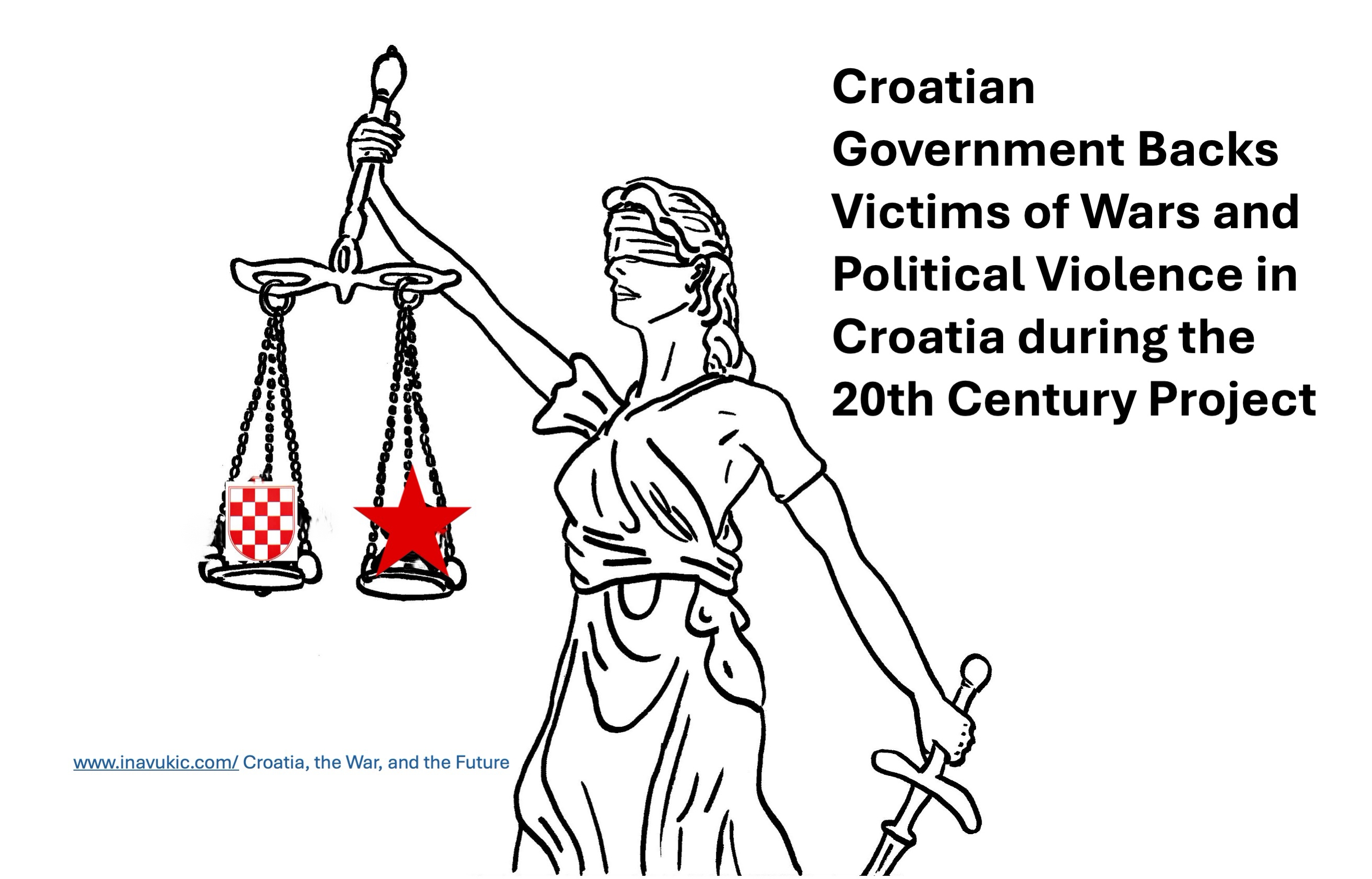

The government of Croatia is launching a scientific research project “Victims of Wars and Political Violence in Croatia during the 20th Century“. This was decided at the Government Cabinet session on Thursday, 16 April 2026.
“The issue of victims of wars and political events in the Croatian historical areas of the 20th century was marked by various forms of violence, suffering and repression through several wars and political regimes and represents a very complex area of research,” emphasised Minister of Science, Education and Youth Radovan Fuchs.
“The aim of the project Victims of Wars and State/Political Violence in Croatian History of the 20th Century is to conduct a detailed investigation of the victims of wars and political violence in Croatia during the 20th century, analysing various forms of violence, repression and their long-term social, political and cultural consequences. The aim of the project is also to list all victims from the territory of present-day Croatia and Croats from the territories of the former Yugoslavia who died and were murdered in wars during the 20th century, as well as Croats whose deaths were a consequence of state/political violence on the territory of the former Yugoslavia, especially immediately after the First and Second World Wars, as well as victims of state/political violence in the Independent State of Croatia…” explained Prime Minister Andrej Plenkovic in his official summary of the Cabinet meeting conclusions.
The project envisages the creation of a digital database with a list of victims, the publication of scientific papers, the creation of interactive maps and participation in domestic and international conferences. It will be implemented and coordinated over five years by the Croatian Institute of History. The total project costs amount to 1.7 million euros and will be provided from the state budget.
A total of 1,726,517 euros will be spent on the new project ‘Victims of wars and state/political violence in Croatian history of the 20th century’, is one of the Cabinet’s conclusions. Namely, as explained in the explanation of the adopted conclusion, the issue of victims of wars and political violence in Croatian historical areas of the 20th century represents a complex area of research, marked by various forms of violence and repression through several wars and political regimes, therefore the project should contribute to a better understanding and overcoming the negative consequences of the past, the improvement of the country’s democratic and humanistic identity and the development of a culture of dialogue and the politics of remembrance.
It is also stated that the aim of the project is to conduct a detailed investigation of victims of wars and political violence in Croatia during the 20th century, analysing various forms of violence, repression and their long-term social, political and cultural consequences.
– For the implementation of the Conclusion in question, 235,680 euros are planned in 2026, 336,319 euros in 2027, and 344,319 euros in 2028 within section 080 of the Ministry of Science, Education and Youth. The remaining funds necessary for the implementation of the Conclusion in question for the period from 2029 to 2031 in the amount of 810,199 euros, i.e. the amount of 339,919 euros in 2029, the amount of 320,320 euros in 2030, and the amount of 149,960 euros in 2031, will be provided within the limit of the total expenditure of section 080 of the Ministry of Science, Education and Youth for activities – the explanation states.
In pursuit of the truth and historical fabrications, it is useful to remind oneself that, in order to increase communist Yugoslavia’s losses and thereby obtain greater reparations, Yugoslavia gave the International Commission for Reparations a fabricated figure of 1,706,000 Yugoslav victims in 1946, without any documentation or proof. At the request of the Federal Republic of Germany in 1964, the Yugoslav authorities made a list of the victims who died in the war (without including the victims of communist crimes, which were horrendous, as the two thousand uncovered mass graves now evidence) in the same year, arriving at a figure lower than 600,000. However, the information about one million victims less than reported in 1946 was officially published for the first time in 1997. The refusal of the authorities in Belgrade to release accurate information led to the false accusation of Croats for the murder of 700,000 or more Serbs in the Jasenovac concentration camp.
Another important source of post-war conflicts between the peoples of Yugoslavia was the slander directed at the Roman Catholic Church in Croatia, which was mainly accused of collaborating with the Ustasha regime in the NDH/Independent State of Croatia WWII. These accusations culminated in the staged trial of Cardinal Alojzije Stepinac in 1946, at which he was denied any defence, and his sentence to 16 years in prison. Not going into detailed facts of exterminations of Croats by the communists here, it is worth noting that in their pursuits of vilification of the Croatian patriots, in 1986, Andrija Artukovic, minister for the interior of WWII Independent State of Croatia, was extradited to Yugoslavia from the USA, to face a trial for alleged war crimes. The trial was important, communist Yugoslavia authorities said, because the very fact that Artukovic was indicted symbolised all the war crimes committed against the Yugoslav nation. Evidence presented by the communist prosecutors would never meet the standards expected by criminal courts in the free world. He was sentenced to death, executed, and his burial place is kept secret to this day, even from his family. On the other hand, communist crimes have neither been condemned nor tried in any courts of law on the territory of the former Yugoslavia.
In the 20th century, hundreds of thousands of Croatian people who desired or fought for Croatian independence from Yugoslavia fell victim to the social mechanics and political pursuits of the communist regime. As evidenced by the multitude of uncovered mass graves which remained secret under the communist regime until 1990, most of them disappeared in unmarked graves, and their recollection, to say nothing of their remembrance, was prohibited during the reign of the communist regime.
The remembrance of the victims of the Holocaust, and of the victims of communist regimes on one and the same day has been called an attempt to deprive the Holocaust genocide of its historical uniqueness. People in Croatia who go about remembering victims of communism are accused of attempting to hide the collaboration of their own people with the national socialists or Ustashas at that time.
The vilification against patriotic Croats seems to never stop, and it is hoped this project will repair at least some damage done through lies, fabrications and innuendos, all of which are politically based.
A large portion of the victims of communist regimes were punished according to their belonging, as ‘socially dangerous elements or enemies of the state’. These were disarmed soldiers for the independence of Croatia, branded opponents of the communist regime, and their family members, women, children and elderly persons
With the new project announced by the Croatian government during this past week, it appears that the time has finally come for victims of communist crimes who have been denied justice, suppressed and erased from collective memory for years to at least have their identity recorded. This would seem a good time for anyone who has information about their family members, neighbours, friends … lost to communist crimes to prepare such lists and hand those over to the new project administrators when the time for information collection comes. Ina Vukic






Leave a Reply