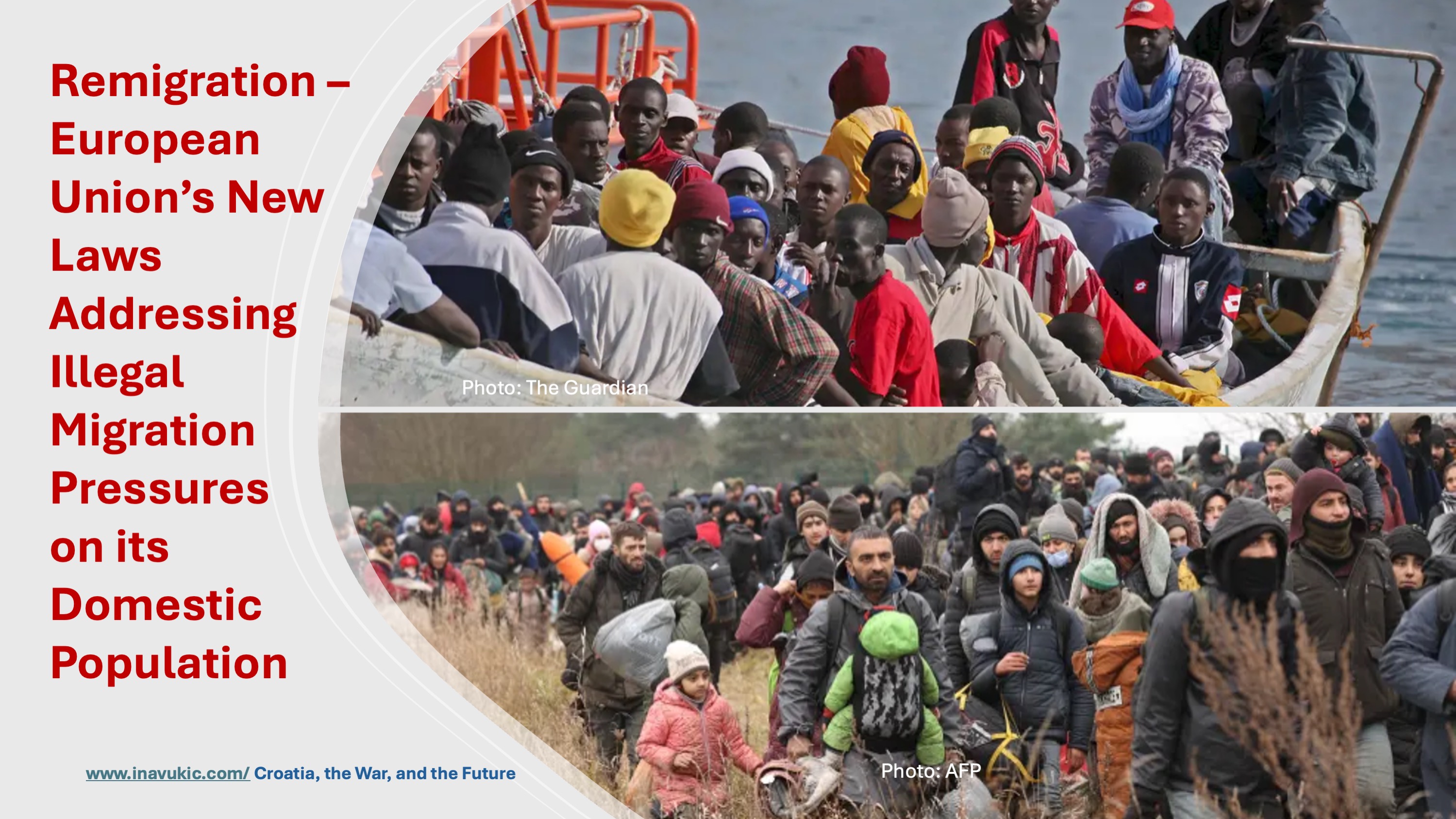
Mass migration, illegal migration, has for more than two decades been an extremely sensitive topic, particularly in Australia, the United States of America, Britain and the European Union member countries.
Almost thirteen years ago, the then “revolutionary” Australia’s “secure borders” policy on mandatory offshore processing for unauthorised maritime arrivals was largely enacted through Operation Sovereign Borders. Since 2012–2013, asylum seekers have been transferred to Nauru or Papua New Guinea (PNG), preventing permanent settlement in Australia. While the policy, aimed at deterring illegal migrant arrivals via offshore processing of asylum applications, etc., and dismantling people-smuggling operations, has been largely successful in achieving its goal, it does in some circles remain a contentious cornerstone of Australian border protection. I guess, Australia being essentially an enormous island, the logistics of slowing down the influx of illegal migrants are much easier than they are for the European Union countries with land borders.
U.S. Immigration and Customs Enforcement (ICE) is a federal law enforcement agency under the Department of Homeland Security, established in 2003 following 9/11 to protect national security and public safety. It enforces federal immigration and customs laws, including investigations and deportations. As of 2026, the agency faces protests over its reportedly harsh tactics against illegal migrants.
It was only this past week that the United Kingdom government agreed to pay France another £660m to curb the number of asylum seekers travelling across the Channel, including plans to fund a riot squad to “contain and disperse” people trying to board small boats. The United Kingdom has also been actively pursuing the plan to send the unsuccessful asylum applicants to third countries, such as those located in the Western Balkans or Africa.
European Union lawmakers cleared the way, on Thursday, March 26, 2026, for tougher penalties for irregular migrants and their potential deportation to so-called “return hubs” outside the bloc. Parliamentarians in Brussels voted 389 to 206 in favour of the reforms, which pave the way for establishing migrant centres outside the bloc’s borders to house migrants whose asylum applications are rejected.
The reform would notably allow the opening of centres, or “return hubs,” outside the EU’s borders to which migrants whose asylum applications have been rejected would be sent. It also envisages harsher penalties for migrants who refuse to leave, including detention and entry bans.
The measures, which have been criticised by human rights groups, are part of broader measures to toughen up Europe’s immigration rules in response to pressure across the 27-nation bloc to curb migration.
According to the AFP news agency, the proposals are being led by a group of EU countries including Denmark, Austria, Greece, Germany and the Netherlands. However, other states such as France and Spain have questioned the strategy’s effectiveness, while human rights groups have warned of asylum seekers disappearing into “legal black holes.”
The goal is to make it easier and faster to return third-country nationals who have no legal right to stay in the EU – primarily rejected asylum seekers and illegal immigrants. The overall aim of the new regulations is to boost the currently abysmal EU return rate (only around 20-30% of issued orders are actually carried out) by streamlining procedures and reducing legal limbo.
Conservatives hailed the vote as a necessary step to restore control, deter illegal immigration, and respond to public opinion after years of mass immigration, failed integration, and migrant crime.
The Left, including migrant-supporting NGOs, called it a “punitive” rollback of rights, warning of longer detentions, offshore processing risks, and potential violations of human rights. Catholic charity Caritas said the regulations would “further stigmatise and criminalise migrants” and focus on “punitive and violent methods” rather than voluntary returns. Swedish MEP Alice Bah Kuhnke (Greens/EFA) called it “a day of sorrow” and said, “we are taking a step closer to ICE forces in the EU.”
Key elements of the Returns regulations are said to be:
- Faster and more efficient returns: Mutual recognition of return decisions across member states (if one country orders a return, others must enforce it more readily).
- Return hubs: Explicit support for establishing facilities in third (non-EU) countries to process and hold people awaiting deportation. This builds on ideas like Italy’s Albania model.
- Longer detention: Up to 24 months in certain cases, especially for those who don’t cooperate, pose a flight risk, or threaten public security.
- Expanded options: Easier returns to safe third countries (even without a direct personal link), home searches/raids in some scenarios, and stricter entry bans.
This vote opens the door for formal negotiations with the Council of the EU. If a deal is reached quickly, the new rules could apply from around mid-2027, providing a vast improvement on the 2024 Migration and Asylum Pact framework, which is already being phased in and emphasises faster asylum processing alongside returns.
The shift reflects a changing mood across Europe and is a late-coming but welcome response to years of public demand for tougher controls on migration.
Whether this new approach will actually boost deportation numbers will depend on the final wording of the rules, fresh bilateral agreements with countries of origin and transit, and how effectively individual nations put it all into practice.
“We are introducing clear and enforceable rules that enable faster rejection of unfounded claims and more efficient returns, while protecting those who truly need international protection. For Croatia, a country on the Union’s external border, these steps carry special weight. That is why attempts to obstruct the reform from the left are incomprehensible,” said Croatian MEP Karlo Ressler (EPP/HDZ), a substitute member of the Committee on Civil Liberties, Justice and Home Affairs (LIBE). He also told Hina news agency that these rules “introduce more order into European migration policy” and commented on the divisions between political groups in the European Parliament.
The Croatian representatives in the EUP who voted in support of this measure to address the problem of illegal migration were HDZ members Karlo Ressler, Tomislav Sokol, Nikolina Brnjac, Zeljana Zovko, Suncana Glavak, and Davor Ivo Stier, as well as DOMiNO party (ECR) member Stjepo Bartulica.
Leftist Social Democratic Party Croatian representatives Biljana Borzan and Marko Vesligaj, and Mozemo’s Gordan Bosanac were against, while Romana Jerkovic and Tonino Picula did not participate in the vote.
Given that this vote for new, stronger measures regarding illegal migration evidently seeks to protect EU borders, preserve the security of EU citizens, and remain true to EU values and identity, it is alarming to me that the majority of the leftist politicians would not vote in their favour. The opposition argues that the policy carries xenophobic implications and a scenario similar to ICE in the USA, which, they say, should be steered away from at all costs. Some express concerns over the upholding of migrants’ human rights in third countries and support efforts to protect them, but fail to say that everyone has the right to protect their own human rights, primarily in this case, the right to live without fear. Like it or not, mass illegal migration has caused overwhelming fears among the local population of every country it affects. These fears exist regardless of whether they are justified. Since they do exist, they must be dealt with by the governments. That being the case, I often wonder whether these leftist politicians in the EUP take that into account when contemplating measures of their own to deal with illegal migration. Certainly, somehow, the poppet must be lifted on the pressure valve built on mass illegal migration. Ina Vukic






Leave a Reply