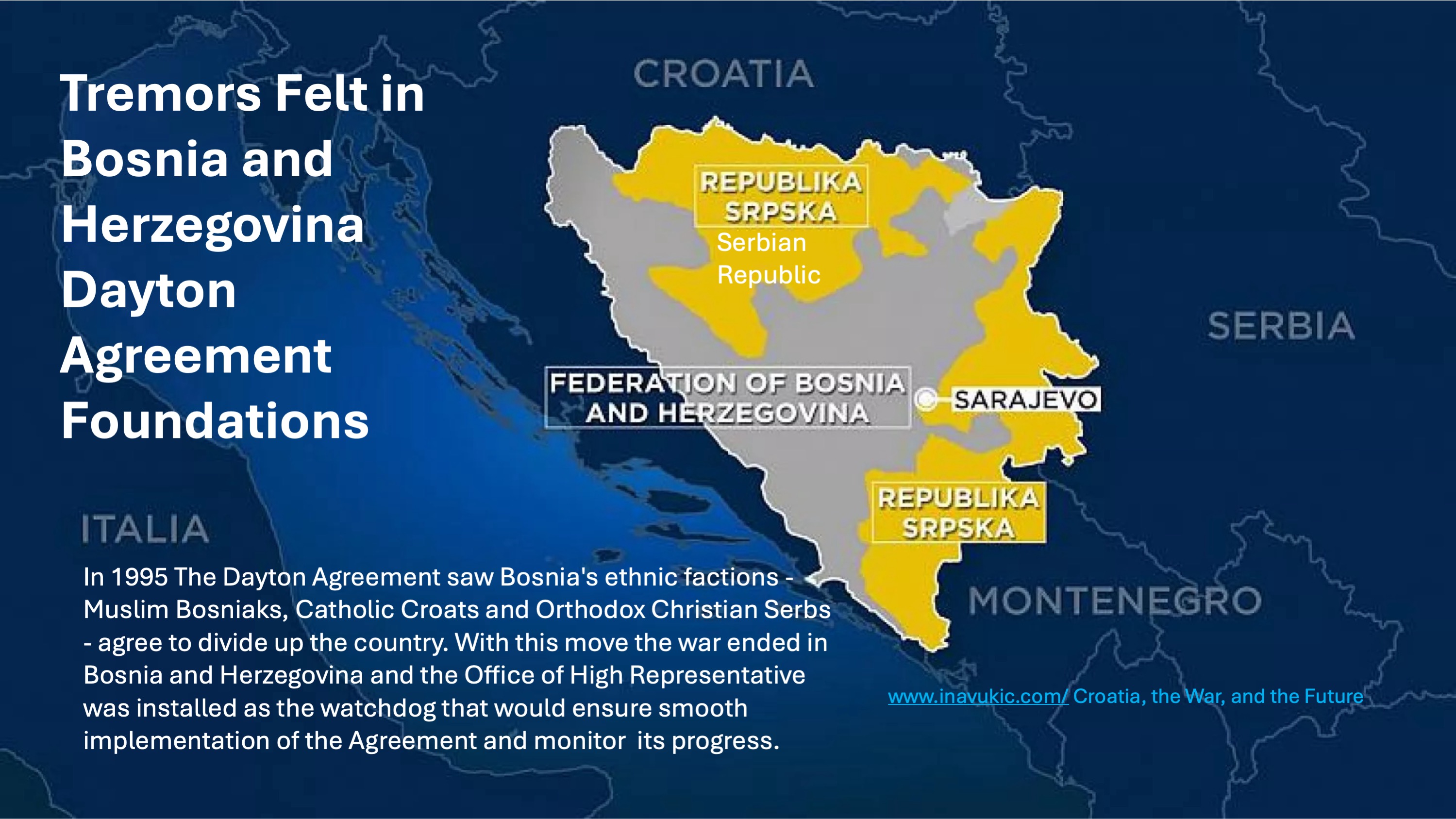

The Bosnia and Herzegovina political cauldron is being shaken and stirred more these days than perhaps its usual share. On May 7, 2026, the Electoral Commission announced the Presidential and Parliamentary elections to be held on October 4, 2026.
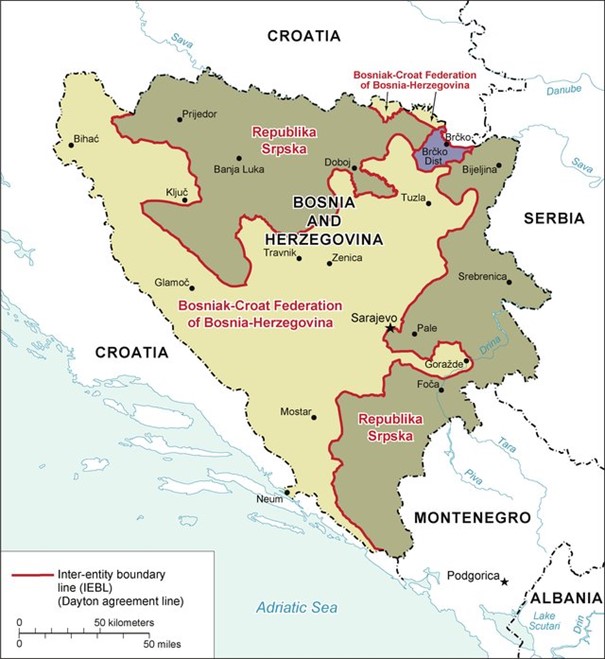
About 3.3 million registered voters will choose the Serb, Croat, and Bosniak members of the tripartite presidency and deputies in the national parliament. They will also vote for parliaments in Bosnia’s two regions, the Bosniak-Croat federation and the Serb Republic, in the neutral Brcko district and in the federation’s 10 cantons. Put simply, the 1995 Dayton Agreement ended the brutal war in the country and established the above governance structure, sealing the division of the country into the Serbian Republic and the Bosniak-Croat Federation. Installed an overseer, the High Representative, who would monitor and oversee the Dayton Agreement implementation.
The political climate around the Dayton Agreement’s continued viability appears to be at a crossroads.
Germany’s Christian Schmidt, the High Representative for Bosnia and Herzegovina, resigned last month under what he said was “enormous” U.S. pressure. His departure comes at a fragile time for Bosnia, which remains deeply divided along ethnic lines. The country has enjoyed strong backing from Washington, but the U.S. State Department, in a May 2026 report on the Western Balkans, signalled a shift in policy towards more commercial terms, stressing “mutually beneficial partnerships”, including through energy projects.
Schmidt’s tenure was beset by tensions with Bosnian Serb leaders, especially Milorad Dodik, who questioned his legitimacy as he opposed their drive to secede their autonomous region from Bosnia and unite it with Serbia. The US pressure Schmidt talks about could also contain an underlying streak whereby the U.S. would condone the independence of the Serbian Republic and its subsequent merger with Serbia proper. Hence, the disbandment of the Dayton Agreement. This would essentially mean a further oppression against Croats in the country, tied to the current Bosniak (Muslim) push to achieve superiority over them in the Federation of Croats and Bosniaks.
In line with such fears, there have been increased political calls in Croatia during the past fortnight to reinstate the Republic of Herzeg-Bosna, which was formed during the 1990s war, essentially to protect the Croat ethnic constitutional group from being overrun by either Serbs or Muslims in the country.
The hot question now is: Who will succeed the current High Representative in Bosnia and Herzegovina, Christian Schmidt? This is the key question among domestic and international officials in Bosnia and Herzegovina after Schmidt confirmed his resignation. Former High Representatives Carl Bildt and Wolfgang Petritsch have also made statements. They, however, are calling for the abolition of the Office of the High Representative. According to them, international supervision over the state has become an outdated solution that no longer contributes to stability. The Vice President of Republika Srpska, Ćamil Duraković, told Bildt that Bosnia and Herzegovina does not need lectures from those who left it without protection in its most difficult moments. While it is being determined whether Schmidt’s successor will come from the US, France, or Italy, domestic politicians, as always, interpret the OHR’s survival differently. Often seeing the OHR/ Office of the High Representative as interfering with domestic decisions.
“What we know for sure is that major shifts have begun regarding the redefinition of the OHR’s position in general, meaning the confrontation with what is known as the Bonn Powers. This means that someone, without any basis in international or domestic law, thinks they can interfere in your lives, impose laws on your institutions, and perform wonders we had to survive here,” said Željka Cvijanović, Member of the Presidency of Bosnia and Herzegovina and former Prime Minister of the Serbian Republic in Bosnia and Herzegovina.
It is useful to be reminded that following the 1997 Peace Implementation Conference in Bonn, the OHR’s authority was controversially expanded. These powers enable the High Representative to legally impose legislation, annul existing laws, and remove local public officials who obstruct the peace process or violate the Dayton Agreement.
“I note that without the Bonn Powers and a decisive High Representative, the Dayton System simply would not be able to function,” said Bosniak representative Bakir Izetbegović, President of the Alliance of Democratic Action. While Borjana Krišto, the Croat representative and Chairwoman of the Council of Ministers of Bosnia and Herzegovina said during the past week: “In our rules of procedure, in our mandate, we do not have a requirement to consult the High Representative, nor do we have a legal foundation to rely on, except for those decisions that have entered into force, which we are obligated to respect.”
Hence, it is clear that the current relationship among political forces in Bosnia and Herzegovina remains deeply fragmented along ethnic lines, with dominant ethno-national parties maintaining control, though signs of fatigue and challenges are evident. The Serb Milorad Dodik remains dominant in the public arena, even though he formally stepped down in 2025 as President of the Serbian Republic following the verdict and pressure from the OHR. In the Croat-Bosniak Federation of Bosnia and Herzegovina, Bakir Izetbegović’s party remains the strongest Bosniak party, but it is clearly losing ground and support, with voters shifting away from it towards Nermin Nikšić’s SDP, Elmedin Konaković’s NiP and Our Party. Croatian Democratic Union/HDZ firmly holds the Croatian bloc and insists on electoral reforms that would ensure legitimate Croatian representation. They seek to fix the injustice of the electoral law that saw, in past, a Croat representative on the presidency not elected by Croats but by Muslim or Bosniak voters. But it seems that the electoral system has a long way to go before it sheds the rampant ethnic vetoes, corruption and clientelism.
Indeed, since the announcement of the October elections, the “old agendas” of the three ethnic constituent groups in Bosnia and Herzegovina have gained momentum. The Serbs are pouring new fuel on their push to secede from Bosnia and Herzegovina and merge into Serbia; the Bosniaks pursue the idea of a united Bosnia and Herzegovina, the cancellation of the Serbian Republic region, with leadership ambitions of it all, while the Croats place a stronger light on the discrimination against the Croats and the need to tighten the rights of Croats under the three-constitutional peoples format and, if that does not work, then the resurrections of Croat entity similar to the 1990s Croatian Republic of Herzeg Bosna may well enter the political competition ring.
Whether coincidental or planned, during the past week, the leader of the Croatian government coalition partner, the Homeland Movement party/DP, Ivan Penava, has requested that a declaration urgently launch an initiative for the establishment of a Croatian electoral unit in the Federation of Bosnia and Herzegovina and that an agreement be urgently reached within the ruling coalition on specific steps that Croatia should take.
Explaining why they are requesting this, the DP, in a statement signed by party leader Ivan Penava, stated that if the proposal is not accepted, the Croatian side has every right to restore the status prior to the agreement (from Washington and Dayton, ed.), which would mean “the return of the Croatian Republic of Herzeg-Bosna as a component of the United States of Bosnia and Herzegovina, in which case it will have our full support.”
Croatia’s Prime Minister/HDZ party, has not released any significant statement that relates to statements made by Ivan Penava, but did voice a lukewarm reactive opinion, which could be interpreted any which way, for or against what Penava announced:
“This is clearly a political effort. For the DP’s visibility, I suppose. We will discuss it in the coalition and determine the point of this initiative. I have serious reservations about the DP’s style. We know very well what is happening in Bosnia and Herzegovina, and the government is aware of the injustice that Croats in BiH face.”
Nikola Grmoja, Member of Croatian Parliament for MOST coalition, said that “Croats are the only stable factor within BiH that wants BiH to survive and who defended BiH and voted for it in the referendum. But if someone outvotes us, if someone denies us our rights, if someone violates the Dayton Agreement, then Croats have the right to demand their own federal unit.”
Should the existence of the Office of the High Representative become mooted even more loudly than at the present time, one could well conclude that continuing with the Dayton Peace Agreement for Bosnia and Herzegovina may also end up on a political chopping block. Certainly, any serious moves towards creating a third entity, e.g., the Croatian Republic of Herzeg Bosna, require a change in the Constitution of Bosnia and Herzegovina itself, and for that to occur, a two-thirds vote is required. That constitution recognises two entities: Serbian Republic and Croat-Bosniak Federation. While the Serbs ethnically cleansed non-Serbs from the territory known as the Serbian Republic and committed genocide against the Muslims, the Federation itself has mostly Muslim and Croatian people sprinkled over it, and the question arises: What would happen if Bosnia and Herzegovina were to introduce a third entity? Would oppression and discrimination between ethnic groups worsen? If history is any guide, the answer is yes, and Croats being less in number than Serbs and Muslims, such an outcome does not seem far-fetched. Hence, should the OHR be dismantled, the Serbian Republic should also topple, and efforts invested in unifying Bosnia and Herzegovina into one entity, a country. But the Serbian Republic would, in that scenario, seek a merger with Serbia proper, either peacefully or through renewed aggression. A unified Bosnia and Herzegovina would entail equal rights between the three ethnic groups; otherwise, either a new war or business as usual: political crisis after political crisis in which only the corrupt prosper. And, sadly, there are plenty of those. Watch this space, as they say. Ina Vukic






Leave a Reply