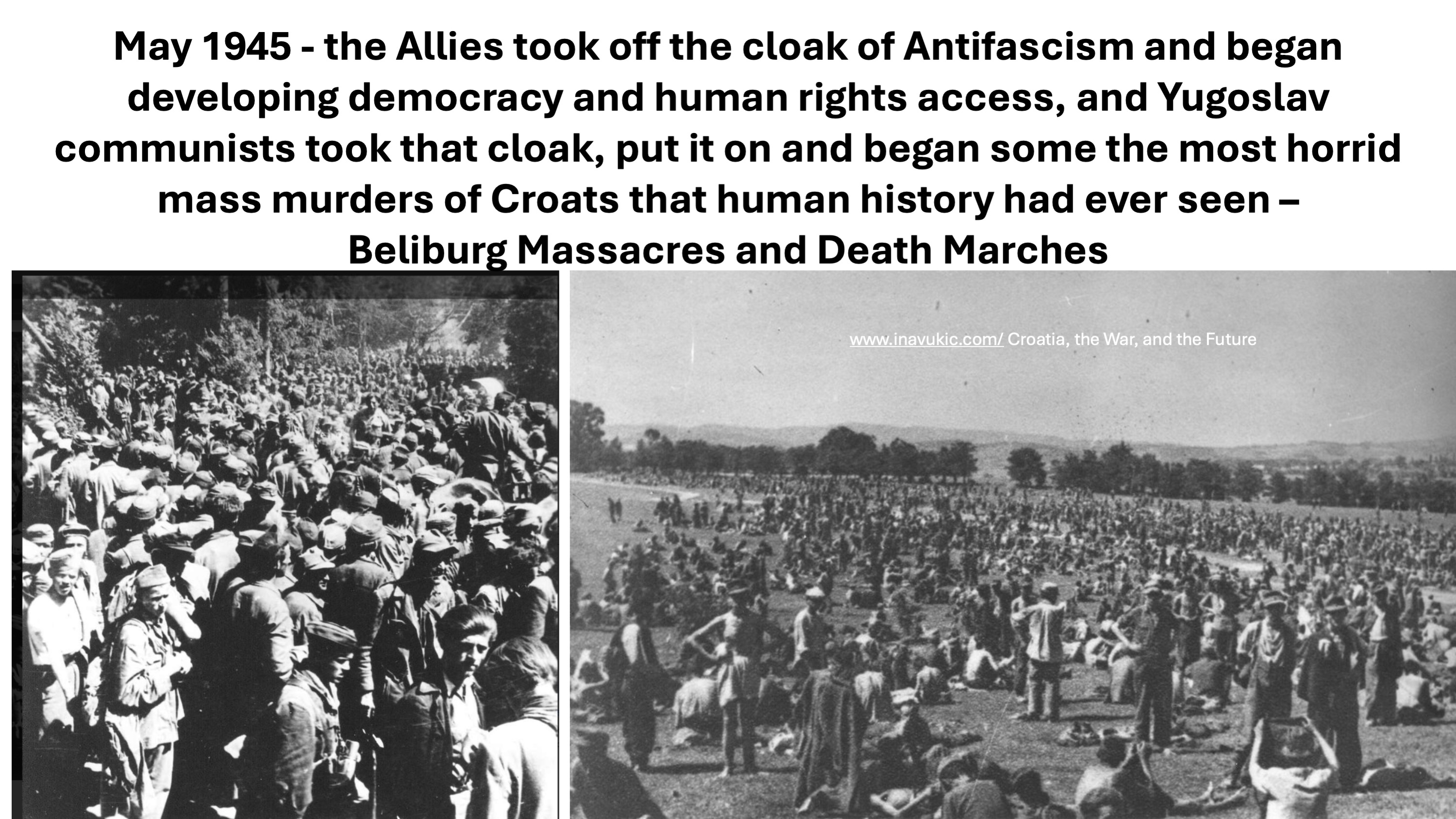
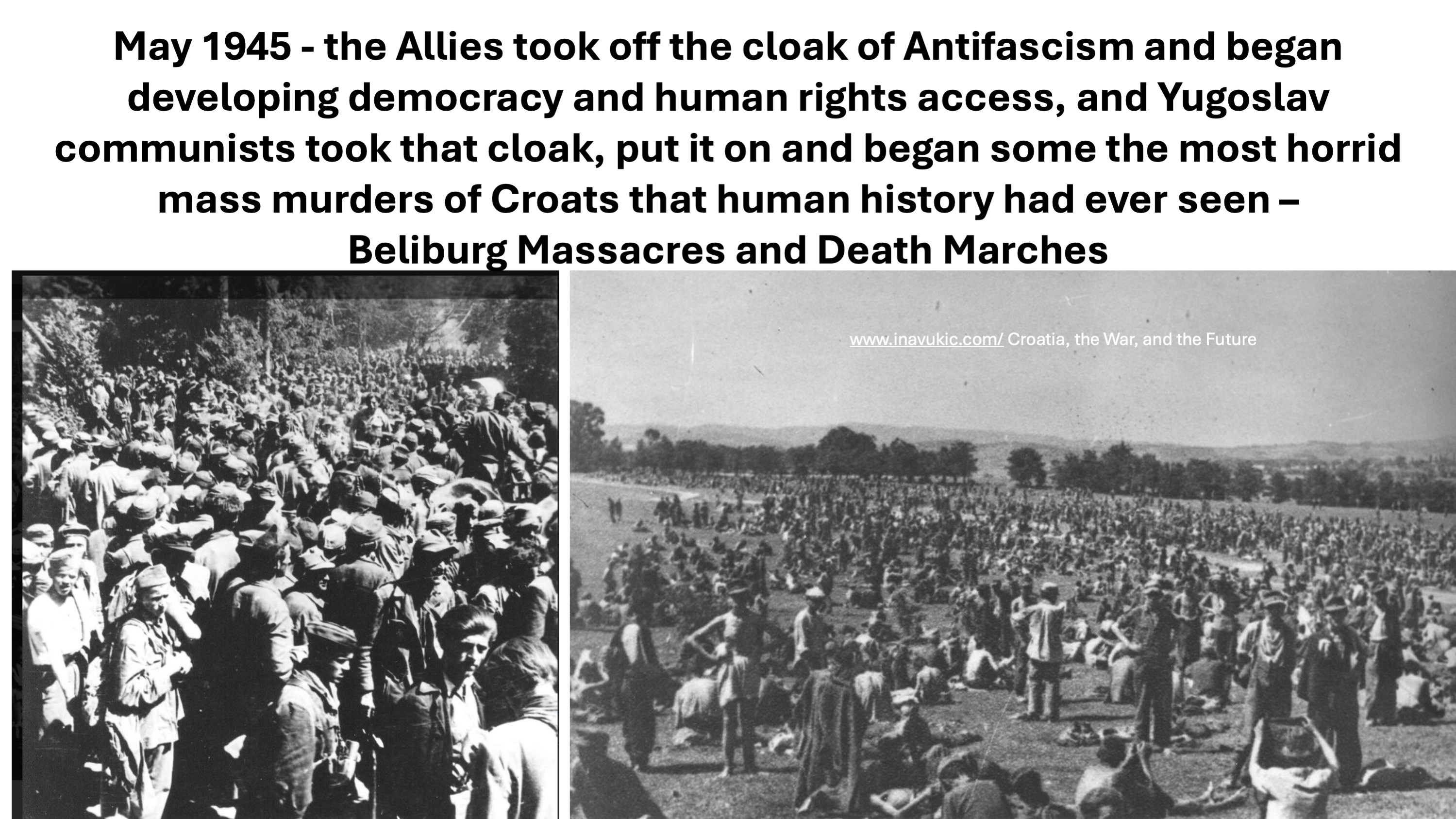
The Second World War left a schism in Europe that evidently still refuses to fully die in Croatia, just as it refused to die in communist Yugoslavia. The schism carried with it often crippling but always conflicting moral, political, and social values. Nevertheless, the Allies shed their cloak of Antifascism in 1945 and began to develop democracy and expand access to human rights. Communist Yugoslavia, tough, took that cloak, put it on in 1945, and with it on their shoulders began the most horrible onslaught against patriotic Croats and the oppression against human rights that terrified people and that post-war European human history had ever seen. This rampage of manic murder of those with different political views from the communist ones is known as the Bleiburg Massacres and the Death Marches or the Way of the Cross. Hundreds of thousands of Croat soldiers, civilians, women, children, and the elderly, clergymen, were slaughtered and their remains dumped into pits or buried in mass graves.
May in Croatia has long ceased to be just a spring season month. It has become a month of glaringly ugly former communist spite against the Croatian patriots, particularly those who fought for Croatian independence during the Second World War. This whole scene skips over the fact that there was an independence war in Croatia from communist Yugoslavia in the 1990s. The more mass graves of victims of communist crimes are being unearthed across Croatia and Slovenia, and there are now about two thousand of them, the louder becomes the so-called glorification of communist Yugoslavia. And so, the month of May is seeing staged celebrations of the so-called liberation from fascism and the resurrection of bonfires the communists lit in 1945 in a gesture to celebrate that liberation. But historical facts increasingly surface with each mass grave unearthed and the facts tell us that the so-called liberation was driven by mass murders, oppression and persecution. The month of May has, therefore, also become the month of Croatian remembrance, a time of deep silence and remembrance of the hundreds of thousands of victims who, in the aftermath of 1945, became victims of the most massive crime in post-war Europe.
Thus, while the families of the victims and the democratic public commemorate execution sites such as Tezno, Huda Jama and Macelj, in the very heart of the capital of Croatia, Zagreb, under the auspices of the current city government, the Trnjan Bonfires are being held. This manifestation is not a cultural event, but a brutal clash of two diametrically opposed approaches and civilisational standards, the likes of which are almost unimaginable in modern, democratic Europe.
The continued denial and the gruesome historical facts of communist crimes by many, coupled with the falsification of Croatian World War Two history by communist Yugoslavia, strongly appear to bring home the bitter truth in philosopher Jean-Jacques Rousseau’s constatation that “the falsification of history has done more to impede human development than any one thing known to mankind.”
In Croatia, regardless of the fact that new historical research and the ever-increasing number of mass graves of communist crime victims demonstrate undeniably that history has been falsified to suit the communist agenda. Regretfully, that falsified history is still given prominence as if it were unfalsified in the public arena, which is heart-wrenching and debilitating. Despite the fact that new research shows that, for instance, the Jasenovac Camp, often called a concentration camp, was not the same as portrayed by the Yugoslav communists, nor were the numbers of people that died there the same as portrayed by it, officially, Croatia has not acknowledged even a little bit of the results of the new research. Thus, maintaining the falsified history as legitimate! Furthermore, despite the thousands of mass graves unearthed, human remains counted, and still being counted, there is no monument in Croatia in its capital city, Zagreb, dedicated to the victims of communist crimes. And indeed, because the mass graves are strewn across the entire country, as well as on the periphery of the capital city, it would only appear just that a monument to the victims is raised in Zagreb.
The Bleiburg Massacre refers to a series of killings carried out by Tito’s Yugoslav partisans, which occurred in May 1945, immediately following the end of World War II in the European theatre. Initially, Croatian independence troops had retreated towards Bleiburg, a town on the border between Austria and Slovenia, to seek refuge under British protection, together with a large number of civilians fleeing the communists. The British, however, sent them back south in a forced march that delivered them to be massacred at the hands of Tito’s partisans, who had begun wearing the cloak of antifascism.
As the many documents and historical sources available show, the directions for the massacres came directly from the Yugoslav Communist Party and were explicit: people should not be targeted based on ethnicity, but on political affiliation. At Bleiburg and subsequent Death Marches, the communists eliminated those they saw as their real opponents, their ‘class enemies’: the bourgeois, businessmen, peasants, their wives, children and frail elderly, clergymen, and all those who might oppose the new communist regime.
The more these victims of communist crimes are remembered in Croatia, the more the leftist opposition accuses the government of permitting the revitalisation of the World War Two Ustasha-led (they call them fascists and Nazis, wrongly). This vicious circle repeats every May for a few years now. The existence of the mass graves was kept secret in former communist Yugoslavia, and research on the subject was forbidden. Seemingly in spite of the political opposition’s vicious rant, there are promising signs that communist crimes may receive their just deserts and finally become officially condemned in Croatia.
While large groups of Croats attended a mass for the victims held at the Bleiburg field on 15 May 2026, the 81st anniversary of the Bleiburg tragedy was also marked with a commemoration at Zagreb’s Mirogoj cemetery on 16 May 2026. Government and parliamentary representatives said that Croatia should cultivate a culture of remembrance for all victims. “Today we remember people who were killed without trial, without the right to a defence. They were killed, that is a historical fact, by the newly formed communist authorities; they were killed in an organised, systematic and massive manner,” they said. “We condemn the crimes of fascism, Nazism and communism, and with special reverence we remember the victims of all three totalitarianisms,” they said further. But they continually fail to ban the symbols of the communist regime, as they have banned the symbols of the other two. They continually distribute taxpayers’ money to maintain the falsified history as legitimate instead of raising an equally large monument to victims of communist crimes, as the one Tito raised in Jasenovac for his falsified, largely fictionalised history about World War II Croatia. Ina Vukic







Leave a Reply