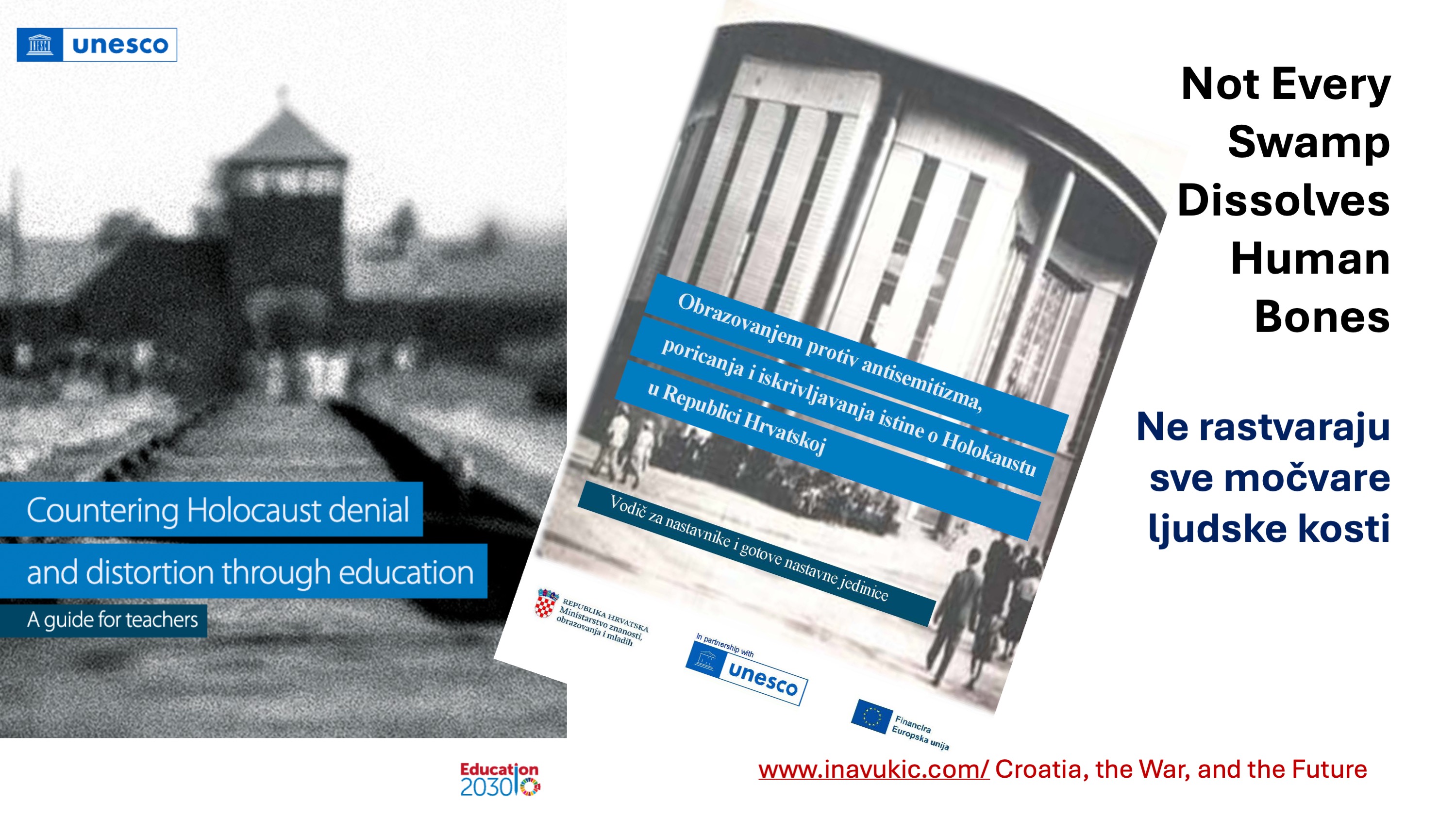
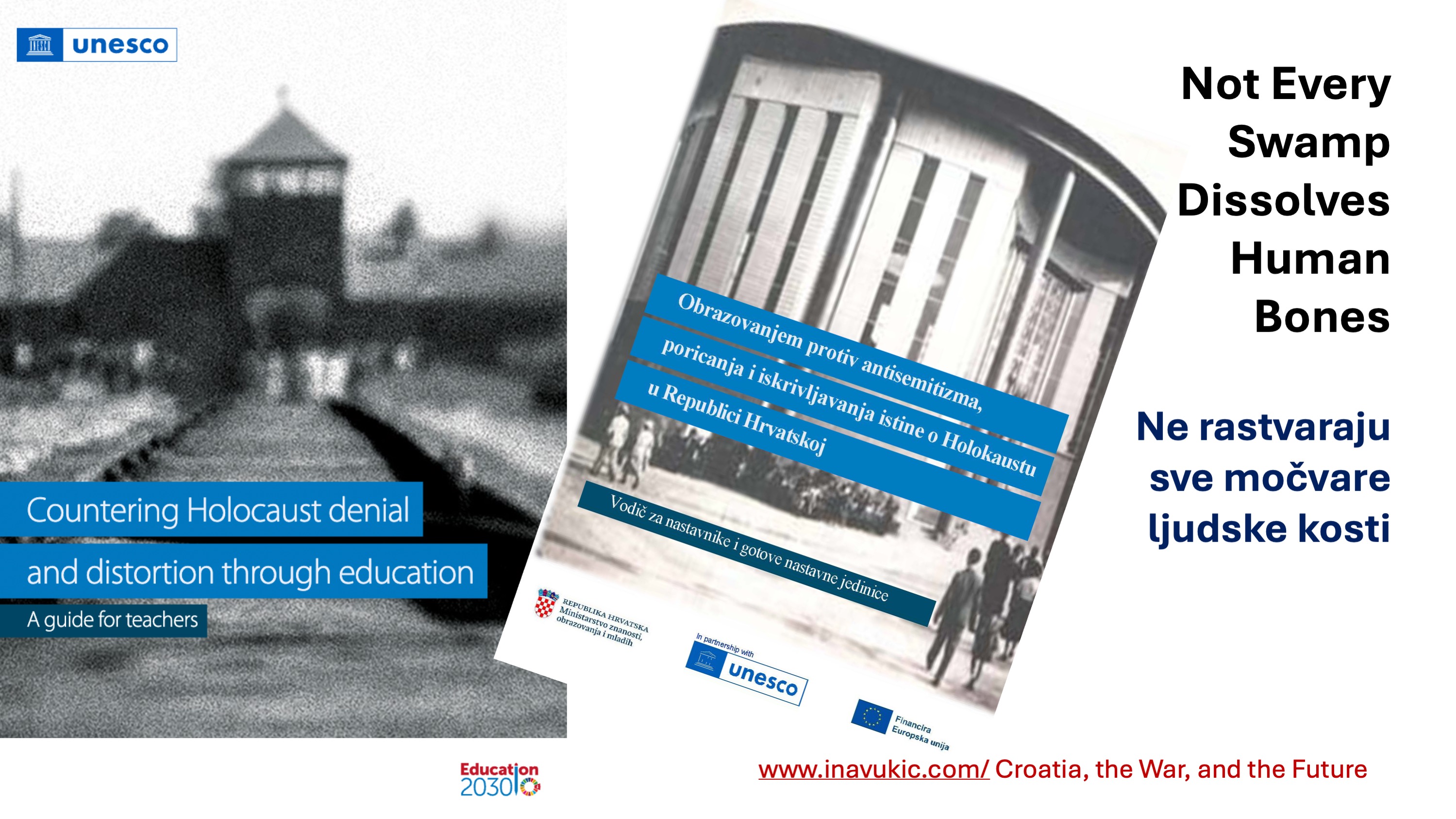
It is widely accepted that the Holocaust is weaponised when its history and symbols are manipulated to score political points, justify particular agendas, or suppress legitimate criticism and scholarly inquiry. Those seeking a contemporary example of such weaponisation may, in my considered opinion, find one in Teacher’s Guide, Education against Anti-Semitism, Holocaust Denial and Distortion in the Republic of Croatia, published by the Croatian Ministry of Science, Education and Youth, released on 18 May 2026.
The Croatian guide claims to have been composed in collaboration with UNESCO; however, it seems to me that the Croatian version is quite poor and damaging, and a poor reflection of UNESCO’s Guide for Teachers and a Set of Lesson Activities to Support Efforts to Counter Holocaust Denial and Distortion through Education, released in early 2026. Yet, when the two publications are compared, they share surprisingly little beyond their stated purpose.
Where the UNESCO guide emphasises critical thinking, evidence-based historical inquiry, and the careful identification of Holocaust denial and distortion, the Croatian publication, in my view, adopts a markedly different approach. Rather than encouraging open scholarly debate, it appears to dismiss, by name, several independent historians and researchers, portraying them as unreliable, amateur, or unworthy of credibility, despite their work being grounded in extensive archival documentation and established historical methodology.
What appears to bother the Croatian Government and its Education Ministry is that these researchers have, over the past decade, challenged long-established claims regarding the number of victims who perished at the Jasenovac camp, relying on documentary evidence and historical records rather than inherited narratives.
Viewed in that context, I believe it is justified to argue that the Teacher’s Guide itself contributes to the weaponisation of Holocaust history by discouraging legitimate scholarly examination of the historical narrative surrounding Jasenovac that was developed during the communist period of Yugoslavia. I understand that the historians and researchers named in the Guide have formally requested its withdrawal. Nevertheless, the publication remains available on the Government’s website without amendment, suggesting that this controversy is far from over.
Ironically, the UNESCO guide itself warns against precisely the kind of pseudo-scientific argumentation and false claims that can distort Holocaust history. In discussing fabricated evidence, it cites the example of the German Holocaust denier Ernst Zündel, who relied upon the so-called Leuchter Report to argue that the Auschwitz gas chambers showed no traces of Zyklon B. UNESCO notes that Fred Leuchter presented himself as an expert chemist despite possessing neither formal scientific qualifications nor recognised expertise in the field.
Against that backdrop, it is striking that the Croatian Teacher’s Guide presents the historian Ivo Goldstein as an authoritative source while omitting reference to one of the more alarmingly controversial aspects of his published claims concerning Jasenovac.
For several years, Goldstein asserted that a “bone-crushing machine” had been used at Jasenovac to destroy the remains of victims and conceal the scale of killings. This claim generated considerable public attention before later being abandoned. Subsequently, Goldstein admitted to his “mistake” and said words to the effect that “it was not a bone crusher but rather a roller” and still later argued instead that the Ustaše had exhumed mass graves and burned the bodies on large log fires at or near the Jasenovac site and dumped their bones into the swamp, in which, he claimed, bones disappear (without a trace).
Indeed, on page 20 the Croatian Teacher’s Guide states:
“The Ustashas dug up corpses from mass graves and burned them to cover their tracks (Goldstein, 2018).”
When publicly challenged only a few years ago with the scientific objection that human bones cannot be completely destroyed in ordinary log fires in the manner achieved by crematoria, Goldstein reportedly argued during a televised interview that the remaining bones had been discarded into nearby swampland, where they subsequently disappeared.
To me, this explanation resembles the imagination of someone constructing a fictional narrative rather than presenting a scientifically supported and verified historical conclusion. Moreover, these extraordinary efforts to devise ever-changing explanations for how the Ustaše supposedly destroyed—or attempted to destroy—evidence of their crimes have, for years, poisoned the social and intellectual climate in Croatia. Rather than encouraging rigorous, evidence-based historical inquiry, such speculative narratives have deepened public divisions, fostered mistrust, and discouraged open academic debate. In doing so, they have hindered rather than advanced a balanced understanding of one of the most sensitive chapters of Croatia’s twentieth-century history.
Forensic science demonstrates that whether human remains decompose or survive for centuries in swamp areas depends upon numerous environmental variables, including soil chemistry, acidity, groundwater conditions, and oxygen levels. Goldstein offered no detailed scientific explanation regarding these factors in the swamp at Jasenovac, he talks about, nor does the Teacher’s Guide appear to critically examine them.
Instead, the Croatian Education Ministry appears to have assumed the role of moral arbiter, identifying antisemitism where many observers would argue none exists, while simultaneously discouraging legitimate historical research by publicly discrediting scholars whose conclusions differ from officially endorsed interpretations.
Holocaust education rightly focuses on the systematic, state-sponsored genocide perpetrated against Europe’s Jews and other victim groups. Its educational purpose is to foster empathy, combat prejudice, and demonstrate the fragility of democratic institutions when hatred and totalitarianism prevail.
Education about communist crimes serves a different, though equally important, purpose. It examines political repression, ideological persecution, totalitarian rule, and mass violations of human rights committed under communist regimes. Both subjects offer essential lessons about the abuse of state power and deserve rigorous, evidence-based treatment in school curricula.
In Croatia, as throughout much of the former Yugoslavia, the past three decades have witnessed the discovery of hundreds of mass graves containing victims of communist crimes committed during and after the Second World War. These discoveries have been documented through archaeological investigations, forensic examinations, and historical research. Yet Croatian schools still devote remarkably little attention, if any, to these crimes compared with the extensive treatment afforded to the Holocaust.
More broadly, educational systems around the world increasingly examine the crimes committed under communist regimes such as the Soviet Union, Maoist China, Pol Pot’s Cambodia, and other totalitarian governments. The extent of such education varies considerably. Some jurisdictions, including the U.S. state of Florida, have introduced legislation requiring students to learn about the nature and evil consequences of communist regimes. Croatia, despite possessing abundant historical evidence within its own borders—including thousands of identified victims and continuing discoveries of mass graves—has yet to establish comparable educational emphasis.
It is in this broader context that I believe the Croatian Government, through its Ministry of Science, Education and Youth, risks weaponizing Holocaust education—not by teaching about the Holocaust itself, which is unquestionably essential, but by invoking it in a manner that discourages legitimate historical inquiry while diverting attention from the extensive and well-documented crimes committed under the communist regime during and immediately after the Second World War.
A mature democratic society should have sufficient confidence to encourage open, evidence-based historical research into all totalitarian crimes. Holocaust education and the study of communist crimes are not mutually exclusive. On the contrary, both are indispensable if future generations are to understand how ideology, political extremism, and unchecked state power can produce catastrophic violations of human dignity. Ina Vukic








Leave a Reply