
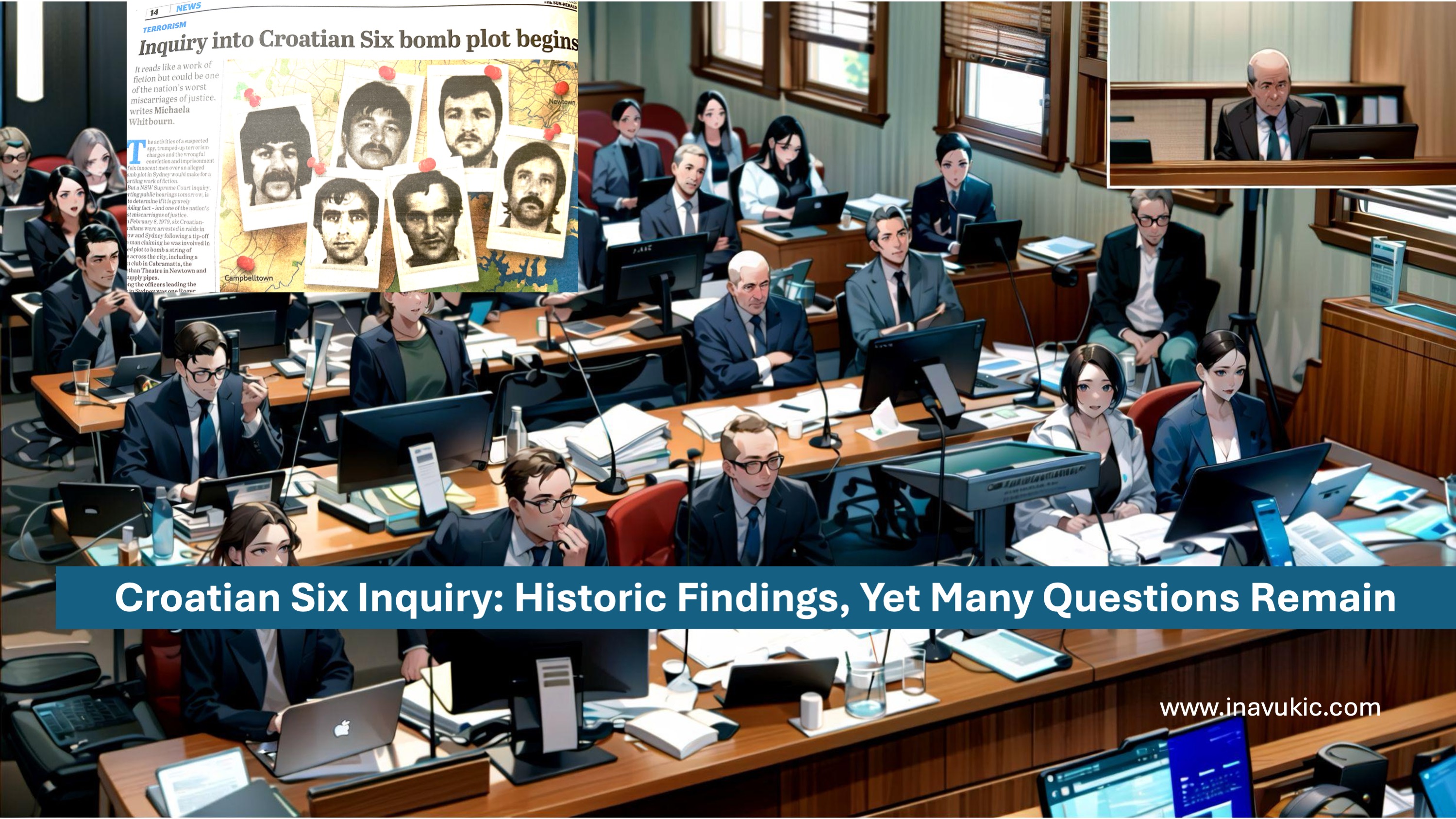
The Judicial Inquiry into the 1981 convictions of six Croatian-born men living in Australia for conspiracy to plant bombs at various Sydney locations has produced a landmark decision that is likely to shape debate about one of Australia’s most controversial criminal cases for years to come.
Released on 6 July 2026, the Inquiry’s report—spanning 856 pages across two volumes—found that there is reasonable doubt regarding the guilt of three of the six men: the late Mile Nekić and brothers Ilija and Joseph Kokotović. It concluded that their convictions represent a longstanding miscarriage of justice and recommended that the NSW Court of Criminal Appeal consider whether those convictions should be quashed.
The Inquiry, however, reached a different conclusion in relation to the remaining three men—Vjekoslav Brajković, Maksimilian Bebić and Anton Zvirotić—finding no reasonable doubt as to their guilt and leaving their convictions undisturbed.
That split decision has surprised many observers. For more than four decades, all six men maintained that they had been framed by the Yugoslav secret police (UDBA), acting through police informant Vico Virkez with the assistance of elements within Australian authorities. Yet the Inquiry accepted significant parts of that account while rejecting others.
One of its most important findings concerned Virkez himself. The Inquiry concluded that he deliberately lied when he denied his association with the Yugoslav Consulate and, by extension, Yugoslav intelligence services. It also found that information concerning those associations should have been disclosed to the defence, but was not.
At the same time, however, Justice Robert Allan Hulme concluded that Virkez’s evidence concerning the existence of the bombing conspiracy itself remained substantially reliable. In doing so, the Inquiry rejected the broader contention that the entire prosecution had been orchestrated by the UDBA in collaboration with Australian authorities.
It is this distinction that has left many readers puzzled.
After examining more than 52,000 pages of hearing transcripts and approximately 40,000 pages of additional documentary material, Justice Hulme appears to have carefully separated evidence that he regarded as demonstrably false from evidence he considered sufficiently corroborated to remain credible. Whether that distinction ultimately withstands public scrutiny—or the scrutiny of the Court of Criminal Appeal—remains to be seen.
The Inquiry’s principal findings and recommendations
That there is reasonable doubt as to the guilt of Joseph Kokotovic, Ilija Kokotovic and Mile Nekic.
That there is no reasonable doubt as to the guilt of Maksimilian Bebic, Vjekoslav Brajkovic and Anton Zvirotic.
The matter to be referred to the Criminal Court of Appeal for consideration of whether the three convictions in doubt should be quashed.
Recommendations of a law reform nature in respect of the Crimes (Appeal and Review) Act 2001 (NSW)
The Virkez controversy
Vice Virkez, the main witness for the police and the Crown Prosecution, lied to the police about who he was when he approached the police in Lithgow claiming to be part of a bombing plot, and lied about who he was during the trial and lied for ten years after until Australia’s leading investigative journalist Chris Masters exposed his fake identity in 1991. Virkez admitted for TV that he was a Serb (not a Croat, as he pretended to be) named Vitomir Misimović and that he had fabricated the whole case in collaboration with the Yugoslav Secret Police UDBa, which had, in fact, for decades spent a rather great deal of energy trying to blacken patriotic Croatians as extremist nationalists and terrorists.
The Judicial Inquiry finding has left many baffled. For forty-six years, all six had claimed innocence of the crime of conspiracy to plant bombs in public places, but the police and the state prosecution had insisted they acted in unison and that all six conspired to commit terrorist acts, which, of course, were never committed because, police claimed, Vico Virkez approached the Lithgow police station in 1979, before any damage was done, saying he was a part of the said conspiracy.
The Judicial Inquiry judge held that the allegation that Virkez “played or held a higher role within the UDBa network, such as an ‘agent provocateur’ either in the traditional or confined sense, cannot be sustained,” writes Hulme in his report. “In his role with the Yugoslav consulate, Virkez is best described as an ‘informant’ or ‘source.’ If he is to be considered any sort of ‘agent,’ the qualifying term used by Cavanagh of ‘low-level’ is apt.” Roger Cavanagh, Australian federal police intelligence official at the time of the original trial and appeals, had always played down the connection between Vico Virkez and the Yugoslav Intelligence Services UDBa, and it is obvious, whether purposefully or not, he failed to say whether a person, a civilian, he considers to be a mere informer or a source can still be considered a mere (benign) informant If he/she goes to the extraordinary efforts of taking on a new identity (name and nationality) in order to inform?
The Judicial Inquiry raised concerns about the veracity of the main Crown witness, Yugoslav “patriot” Vico Virkez, viz Vitomir Misimovic, who had pretended to be Croatian to befriend some of the six. And yet:
“The evidence does not support the contention that Virkez held considerable animus towards Ustaše Croatian organisations and activists and thereby had a motive to frame Croatian people, or to engineer a false flag style operation adverse to their interests,” Hulme found. Common sense would suggest that nobody tendentiously infiltrating a community (the Croatian community in this case), as Virkez did, would engage in any animus towards the very community they want to infiltrate. The judge did not, in his report, address the evidence that Virkez did indeed hold considerable animus towards Ustaše Croatian organisations, nor his animus towards one of the Croatian Six in particular, Vjekoslav Brajkovic. Furthermore, Judge Hulm omitted to address the extremely politically loaded term Uatase itself and whether it could have been used as a bona fide label for any patriotic Croatian organisation in Australia or elsewhere from the early 1980s onwards.
On 25 March 1980, while the Croatian Six criminal trial, instigation of which was Virkez’s spiel of conspiracy, Virkez himself was arraigned and pleaded guilty to a single charge of conspiracy to make dangerous things with intent to commit malicious injury to property and maliciously to cause damage to buildings by the explosion of explosive substances whereby the lives of persons would be endangered. He was sentenced on 11 April 1980 to a term of imprisonment of 2 years and 4 months. The charge of conspiracy to murder Tomo Mlinaric and Fabijan Lovokovic, two leading patriotic Croatians in Sydney, for which he had been committed for trial, was no-billed by the Attorney-General on the advice of the Crown Prosecutor. This in itself highly suggests that Virkez held considerable animus towards patriotic Croats or those desiring an independent Croatia from communist Yugoslavia.
The Inquiry argues that Virkez’s evidence is “not in any way tarnished by the claims made by Virkez many years later in interviews with Masters and McGeough, two highly respected journalists who tracked him down in his native country. While those claims provided support at a superficial level for the petitioners’ case, they are replete with inaccuracies and inconsistencies that deny them credibility.”
How a Judicial Inquiry can dismiss a filmed confession so lightly is concerning to me.
Police misconduct and disclosure failures.
The Judicial Inquiry report did find that a number of police officers ‘probably engaged in misconduct’, including the assault of one of the men in a police interview room, but did not give the evidence that clearly pointed to corruption much review or significance.
Justice Hulme did find several police officers involved in Brajkovic’s arrest had severely bashed him, one using a twisted towel to throttle him, and had then conspired to mislead an Internal Affairs Branch inquiry into Brajkovic’s complaint.
Further, the Inquiry did find that the police did not take proper precautions when sent to raid places where they were told they may find massive amounts of explosives. From the evidence or police testimonies at the Inquiry’s hearing, it was clear that the police involved in the raids and investigation of the alleged conspiracy to plant bombs made up their own rules as to how to proceed, ignoring the existing Police Procedures Manual for such situations of danger, evidently published to police around 1974, five years before the raids.
“Indeed, by today’s standards, the nonchalant way police acted on intelligence that there might be ‘30–50kg of explosives at an undisclosed location’ was rather extraordinary,” Hulme said. “However, the inquiry does not find the inadequate or complete lack of precautions to mean that police had formulated a conspiracy to falsely accuse the Croatian Six before any raids were carried out, knowing that there was no real bomb plot. Instead, more probable is the explanation that the lack of precautions was, in all likelihood, a product of a cavalier attitude that prevailed at the time and nothing more sinister,” Hulme further said. Even though the evidence before him included the procedures Manual, which the police blatantly ignored at the time.
The way I personally perceive this is that Justice Hulme has merely slapped the wrists, as in “naughty boys, don’t do it again”, of the police involved in serious misconduct, if not in planned or calculated for possible benefits of such disregard of rules they were required to follow as public servants.
The ASIO evidence and Hamish McDonald’s criticism
“It is when he turns to the main new evidence that led to the inquiry — the evidence of ASIO involvement — that Hulme leaves a huge gap in accountability.
ASIO records declassified in 2018 reveal that the security service was tapping telephones at the Yugoslav consulate and monitoring Virkez’s contacts with UDBa. Soon after the arrests in February 1979, a secret report was circulated by its head office in Canberra. Virkez, it said, had, for a period of at least six months prior to the arrests, acted as an informer on Croatian nationalist activities to a person suspected by ASIO of being an intelligence official attached to the Yugoslav Consulate-General.’ The plot revealed ‘the depth of the penetration of Croatian extremist groups by the Yugoslav Intelligence Service in Australia.
This report went to top NSW police and the Special Branch. In follow-up exchanges with ASIO, then assistant police commissioner Roy Whitelaw said ‘if the opposition [ie the six men’s defence team] became aware of this information it could blow a hole right through the police case.’ Later Whitelaw was advised he could tell his prosecutors about it as long as the source was not made public. Through the trial and appeal, defence subpoenas for relevant intelligence information about Virkez were rejected on national security and other grounds.
As a result, the crown prosecutor, the late David Shillington QC, was able to assert, unchallenged, that there was ‘not a skerrick of evidence to suggest that [Virkez] was some sort of undercover agent, an UDBa or Yugoslav representative.’
Hulme’s inquiry tried to find out whether ASIO’s information had got to Shillington. Various surviving police witness said he was fully informed about everything he should know. Hulme declines to accuse him of knowingly withholding evidence important to the defence: ‘[I]t would be neither fair to the late Mr Shillington QC, nor reasonably supported by the evidence before the inquiry, to conclude that he abdicated his responsibilities and acted in a manner inconsistent with his overarching duty.’
The judge noted that when the Croatian Six sought leave to appeal in the High Court in 1986, the then NSW crown counsel, Reg Blanch QC (later chief judge of the NSW District Court), admitted that if the prosecution had withheld vital evidence for the defence, ‘it would be almost automatic that there would be a miscarriage of justice.’”
Whether justice has been delivered by this Judicial Inquiry is a matter for individuals to ponder and decide. However, there seems little doubt that it has left many unanswered questions and, indeed, raised new and uncomfortable ones.
The most important question raised in my mind is why did the Judicial Inquiry, Judge Robert A. Hulme, dedicate relatively very little attention to the nature of the communist Yugoslavia Secret Police UDBa and the scenario in which the framing of six Croats for terrorist conspiracy is/was a very real possibility? Why did the Inquiry not entertain all the reasons as to why the police turned up at raids where they were told they may find dangerous explosives in regular clothes without even securing the safety of the premises for everyone who may be found in those houses and their neighbours, and their obvious and serious mishandling of explosives during transport and storage? Why did Hulme not take up the lawyers for the Croatian Six’s contention that the Wood Royal Commission’s 1994 finding that systemic “process corruption” existed in the Criminal Investigations Branch squads brought into question all the police evidence in this case, notably the alleged discovery of gelignite in Sydney homes?
The findings of this Judicial Inquiry have left many people who know how UDBa operated against patriotic Croats restless, but it has also brought some good news: the six-person conspiracy conviction in which the prosecution claimed all six Croats acted in unison has been blown asunder. Ina Vukic







Leave a Reply