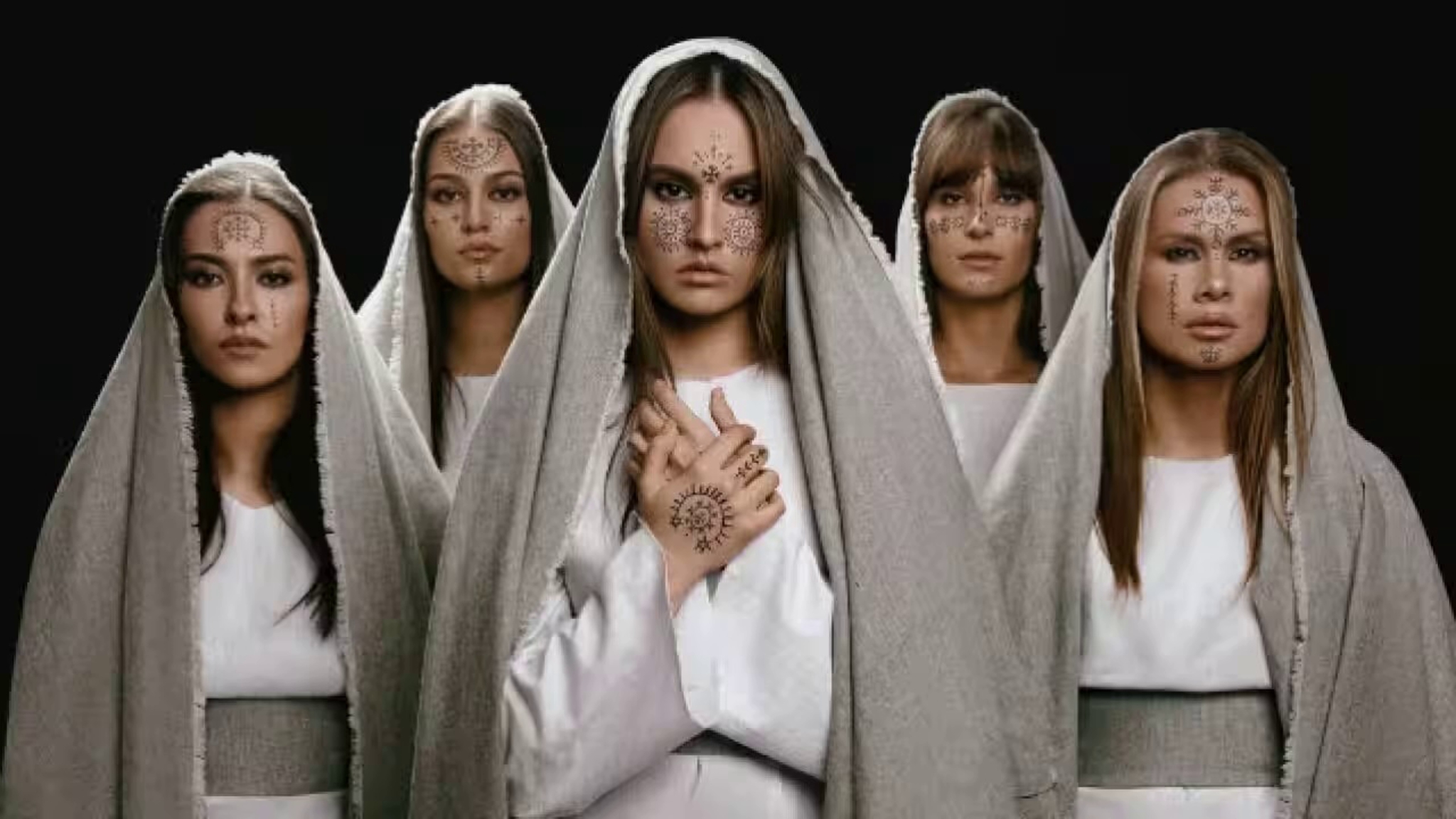

The catastrophic and utterly cruel 14th, 15th and 16th-century Ottoman invasion of Europe resulted in often drastic moves of the locals to preserve their Christian identity. In efforts to ward off, on a personal level, the cruel aggression of the Muslim invader, the now considered traditional tattooing spread among the Catholics in particular like wildfire. Tattooing of the cross motif, primarily among Croatian Catholic women and children in Bosnia and Herzegovina, had a clear religious and identity meaning and a unique protective function at the time of its origin. During the Ottoman period, it was a permanent sign of belonging: a cross on the arm, forehead or chest was a public and unambiguous message of belonging to the religion and community. It was most widespread in central Bosnia (Rama, Lasva Valley, the Travnik area, Jajce), and in some areas the custom persisted until the mid-20th century.
The basic motif of the Croatian traditional tattoo is the cross. Simple or stylised, sometimes with branches (fir trees) and geometric ornaments (fence). Its symbolism was multi-layered: faith, protection, belonging. Unlike many world tattooing traditions, which are aesthetic, tribal or initiatory, tattooing was a distinctly feminine and Christian practice, strongly linked to collective identity. It was not a decoration, but a living testimony of belonging to the Catholic Church and the Croatian people.
The song “Andromeda” by ethno-pop band Lelek (wailing) won on Sunday 15 February 2026, in Zagreb, Croatia, the Dora award and will represent Croatia in the Eurovision Song Contest in May in Vienna.
The members of the winning band are Inka Vecerina Perusic, Judita Storga, Korina Olivia Rogic, Lara Brtan and Marina Ramljak, and the group combines elements of Croatian traditional music with a modern pop sound, carrying the stylish traditional tattoos on their faces and arms just as Christian women did during the Ottoman invasion centuries ago.
Their winning song, “Andromeda”, was inspired by the custom of tattooing of Catholic women in Bosnia and Herzegovina and parts of Croatia under Ottoman rule. In this light, “Andromeda” is not just a pop song with attractive visuals. It functions as a contemporary translation of an old symbol. In a time when the body, through tattoos, fashion expression, and stage performance, is once again becoming a medium for personal non-verbal messages, Lelek has chosen a sign that carries a deep cultural memory, which is why their performance goes beyond aesthetic effect and crosses into the realm of cultural communication.
In these times of political unrest and fear from some real as well as perceived threats that illegal mass migration reportedly brings to Europe if the contemporary scene retains awareness of the historical dimension and its meaning for the modern fears, then popularisation becomes a value that will certainly contribute to strengthening identity of faith, tradition, patriotism, and if it is reduced to mere decoration and if it succumbs to the pressures of ideologies, trends, and media, it will most likely be reduced to a mere ornament.

The struggle for Croatian identity, or any national identity for that matter, has evidently not remained in the past. Ideological and political pressures, especially the so-called progressive ones, seem to pursue the erasure of national identities and the installation of globalism, which does not recognise individual national identities. Today, the same principle of preserving one’s own voice and right to exist is manifested through the political marginalisation, for example, of Croats in Bosnia and Herzegovina. The unitary system and decisions in institutions often ignore the legitimate rights of Croats, making their political position untenable and suppressing their voice. This is precisely why the idea of territorial, cultural, and political autonomy for Croats is presented as a practical and symbolic issue of survival in contemporary Bosnia and Herzegovina. The historical lesson is clear: a people that does not preserve its own identity quickly becomes voiceless in a society in which the decisive institutions are in the hands of others. The song “Andromeda” symbolises the above clearly and strongly. It reminds us that resistance and resilience are not luxuries but necessities, and that the courage to preserve identity must not be limited to past generations. Just as Croatians have preserved the sign of the cross as a symbol of resistance for centuries, so today Croats must preserve their political, cultural and territorial right to remain visible and relevant in their country.
Giving up or passivity means losing their voice and becoming weak, with that weakness spilling over into the future. Therefore, the group Lelek appears to send a clear message in this song: courage and resilience are not relics of the past; they are a prerequisite for survival today. Those who allow their identity to be extinguished or forgotten risk losing more than just their name. The song “Andromeda” serves as a wake-up call heard worldwide, not just in Europe: preserving one’s own identity requires determination, and history will not wait for those who give up. Andromeda, from the ancient Greek mythology. Does, after all, symbolise the ultimate “damsel in distress,” representing innocence, sacrifice, and passive beauty caught between divine wrath and heroic rescue.
This song translates oral memory, inherited fear, faith, and endurance into poetry. It gives a voice to generations who carried trauma quietly, without archives, without monuments. To experiences that were rarely written down but deeply lived and passed through generations. This “Andromeda” is not a fantasy nor a myth. It is an inherited memory! Ina Vukic
[English translation of “Andromeda” lyrics by Lelek]
[Verse 1]
As you light a candle, ask your grandmother
Why she gave birth to her daughter in fear
Why so many chose the grave
Our mothers did not give birth to slaves
[Verse 2]
So many tears have flowed like a river
Why is history written all over again
Our sons are not subjects
Are screams from the cradle waking you up at night
[Pre-Chorus]
Take me for yourself, Queen Earth
The soul is yours, to them I’m a body
[Chorus]
Lead me to the stars, to the shattered nests
There where, amid screams they send off soldiers
Lead me to the stars, far from all eyes
Andromeda
[Verse 3]
All the scars carved down to the bone
No mother will forgive you
On the table of shame, the gold from necklaces
While they wash their hands in the blood of our wounds
[Bridge]
Traitors
Traitors
Traitors
Traitors
[Pre-Chorus]
Take me for yourself, Queen Earth
The soul is yours, to them I’m a body
[Chorus]
Lead me to the stars, to the shattered nests
There where, amid screams they send off soldiers
Lead me to the stars far from all eyes
Andromeda
Lead me to the stars, to the shattered nests
There where, amid screams they send off soldiers
Lead me to the stars far from all eyes
Andromeda
[Outro]
Andromeda
Andromeda (Andromeda)
Andromeda
Andromeda (Andromeda)
Andromeda
Andromeda



Leave a Reply to preacher01704Cancel reply