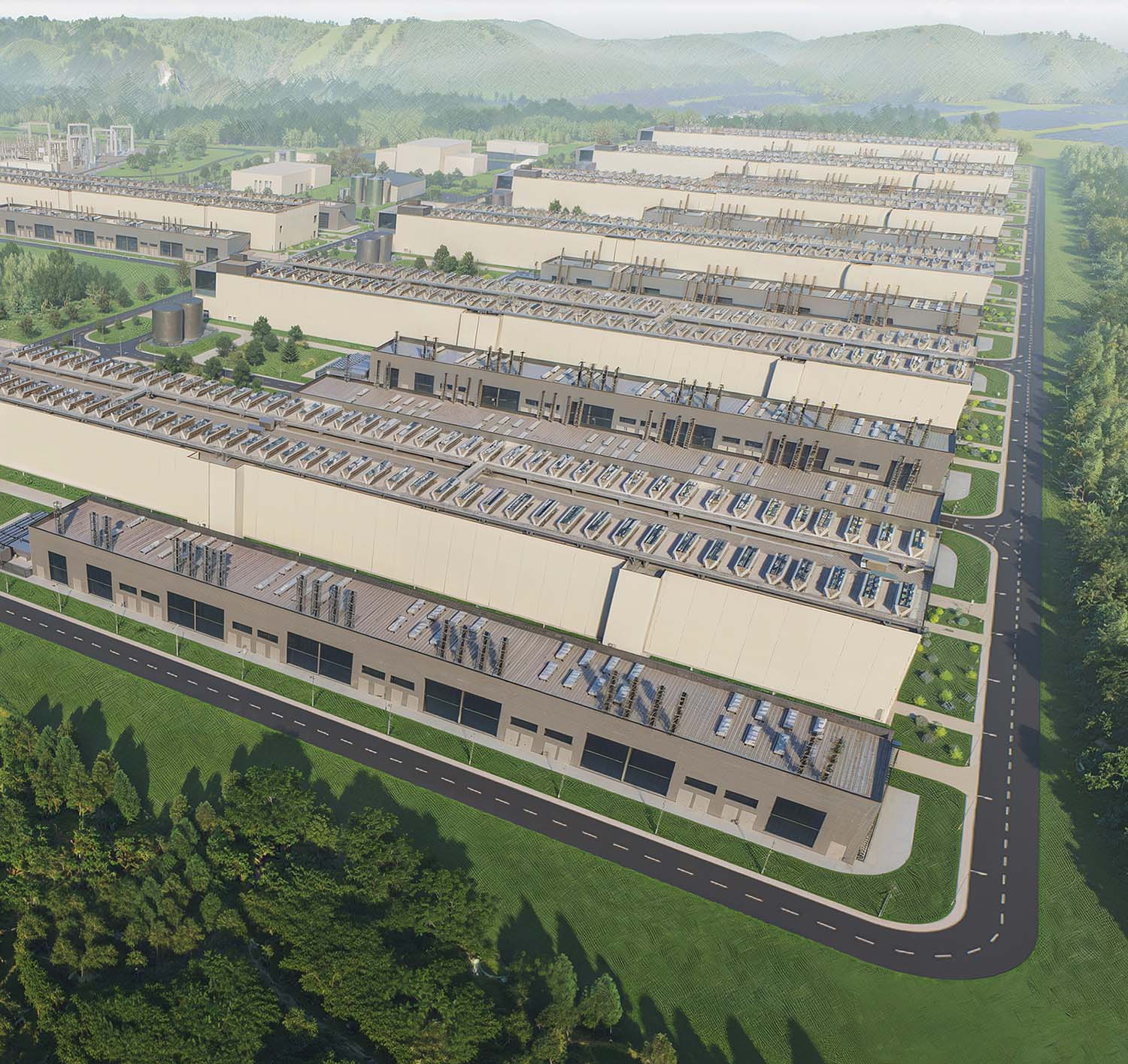

Croatia’s Pantheon data centre, announced in April of this year, will reportedly revolutionise the development of artificial intelligence in the European Union, ushering in a new era of economic prosperity, job creation, and renewable energy production.
This project is a powerful combination of U.S. capital with Croatian technical and regulatory expertise—and a model for what transatlantic digital infrastructure investment can look like.
Europe’s AI economy is growing faster than its infrastructure can support. While demand continues to rise, the continent’s primary data centre markets are running out of power and space.
Pantheon is built where the power is, where the fibre runs, and where capacity exists to meet the moment. Croatia offers electricity prices significantly below the European average, embedded access to three major EU fibre corridors, and low-latency connectivity to Italy, Austria, Hungary, Slovenia, and the broader CEE region—one of Europe’s fastest-growing markets for AI-native investment and one of its most underserved for hyperscale infrastructure. Construction begins in early 2027 with a streamlined permitting process supported by national and regional authorities.
A data centre is only as reliable as its power supply. Pantheon is built with that in mind.

Four dedicated 400kV transmission lines will connect the campus directly to Croatia’s national grid via the SS Topusko substation (400 /(220)/(110)/33 kV). The grid connections run in two directions: east-west toward Slovenia, Hungary, and Austria and north-south toward southern Croatia and Italy.
On site, a 500 MW solar plant will provide clean, locally generated power backed by large-scale battery storage.
Croatia’s transmission system operator HOPS has approved the technical blueprint for connecting the planned Pantheon AI data centre campus to the national electricity grid, clearing a major regulatory hurdle for what developers say will be the country’s largest-ever private investment, Pantheon Atlas said in a statement on July 23, 2026. “The HOPS approval confirms the technical and regulatory feasibility of supplying electricity to the project at scale,” the company said in the statement, adding that construction remains on track to begin in early 2027.
Developers say the project will help address Europe’s shortage of AI data centre capacity while positioning Croatia as a regional hub for digital infrastructure. The campus is also expected to support the expansion of renewable energy generation by financing upgrades to the country’s transmission network.
Pantheon Atlas has said the initial campus investment will total around € 12 billion, with overall investment exceeding €50 billion as technology tenants install computing equipment over time.
By all accounts, Pantheon AI will end up being a hyperscale data centre.
When ChatGPT launched in late 2022, for example, many of us watched something remarkable happen.
Within two months, it reportedly hit 100 million users, a growth rate that sent shockwaves through Silicon Valley. Today, it reportedly has over 900 million weekly active users. That launch sparked an explosion in AI development that has fundamentally changed how we build and operate the infrastructure powering our digital world.
That all happens in data centres… and more and more of them across the world every day, it seems. Data centres are economic engines and technical marvels, but they also come with real costs that communities are only beginning to feel, claims TechRepublic.
As with most things around us, there are pros and cons to their existence and introduction into our lives.
At this stage, the pros of data centres appear as:
1. They’re an economic catalyst (especially for rural areas)
2. They (mostly) create jobs
3. They can force infrastructure improvements (for better or worse)
At this stage, the cons of data centres appear as:
1. They are voracious, grid-straining energy hogs; A new AI hyperscale facility can demand as much as 100,000 homes or more.
2. They consume water at an alarming rate
3. They impose heavy burdens on local communities, such as constant noise, significant amounts of e-waste that often contain toxic materials and need to be handled and disposed of carefully.
But AI data centres are the infrastructure backbone of the AI era, transformative, necessary, and inevitable. While AI does fuel economic growth, its expansion is also triggering political battles over energy, water, jobs, and local communities. One thing we can be certain of is that AI is not going away. At the same time, it is having a tremendous impact on national and local economies. It touches upon everything from water rights and energy use to the environment.
US investment group Pantheon Atlas LLC has claimed that power for the planned 1GW hyperscale data centre campus in Croatia will be supplied entirely by renewables. Pantheon AI’s energy infrastructure will include a 500MW solar PV system paired with 8,000MWh of battery energy storage systems (BESS). A letter of intent has been signed with Greenvolt, a European renewables developer owned by US investment firm KKR, to build the behind-the-meter solar-plus-storage plant.
“The race to lead in artificial intelligence is global, and we are pleased to see American capital and investment expertise like Pantheon AI anchoring that leadership in allied, democratic nations,” US Department of Energy (DOE) special envoy for global energy integration Joshua Volz said.
In the global AI race, speed-to-power is among data centre developers’ biggest priorities and the combination of renewable energy with battery storage is seen as the fastest way to get there. It appears Croatia is well on its way in that race, and that is great news. Ina Vukic







Leave a Reply