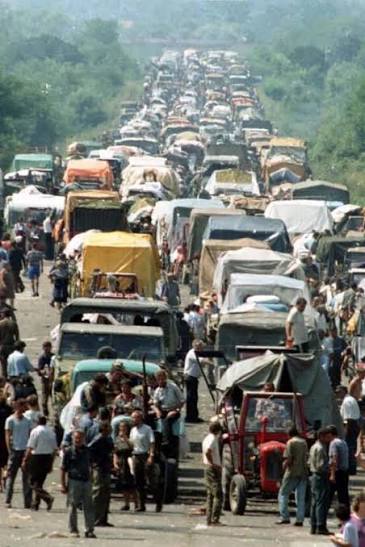

On 4 August 1995, Milan Martić, President of the self-proclaimed “Republic of Serbian Krajina” (RSK), signed an order initiating the planned evacuation of civilians considered unfit for combat from the municipalities of Knin, Benkovac, Obrovac, Drniš and Gračac. Amid the upheaval surrounding Croatia’s liberation campaign, Operation Storm, an estimated 200,000 Serbs subsequently left Croatia.
Thirty-one years later, neither Martić nor Serbian President Aleksandar Vučić—nor many of those who continue to defend or minimise the Greater Serbia project—has fully acknowledged the aggression, persecution and mass killings committed across Croatia and Bosnia and Herzegovina in pursuit of that expansionist goal. Instead, the departure of Croatia’s Serbs during Operation Storm continues to be presented in isolation, as though nothing had preceded it: no aggression, no occupation, no expulsion of Croats and other non-Serbs, and no evacuation order issued by the RSK leadership itself.
The claim that Croatia alone caused the entire exodus does not withstand scrutiny. The RSK evacuation order, years of fear and propaganda, military defeat and the unfolding Croatian military campaign to liberate its Serb-occupied regions all contributed to the departure. At the same time, historical accuracy requires acknowledging the International Court of Justice’s finding that a substantial part of the Krajina Serb population fled as a direct consequence of the military action and that crimes were committed against some Serbs during and after Operation Storm. The Court nevertheless rejected Serbia’s claim that Croatia had committed genocide. These findings do not erase the responsibility of the RSK and Serbian leadership for the war, occupation and displacement that preceded Operation Storm.
The continuing effort to isolate the Serb exodus from everything that came before it is propaganda by omission. It depends upon selective memory, the inversion of victim and aggressor, and the repetition of a carefully constructed narrative through sympathetic or state-aligned media. The victims of this historical revisionism are not only Croatia and Bosnia and Herzegovina, but the truth itself. The joint criminal enterprise to create a unified Serb territory through the forcible removal of non-Serbs was established in the ICTY judgment against Martić. Yet that finding continues to be denied or minimised, just as the Srebrenica genocide—repeatedly established by international judgments—continues to be denied by Serbian nationalist circles. ICTY findings on Srebrenica.
The case of Milan Martić provides a stark illustration of a convicted perpetrator’s continuing refusal to confront his responsibility.
In 2026, the International Residual Mechanism for Criminal Tribunals—the United Nations body that succeeded the ICTY—twice declined to grant Martić early release, first on 4 February and again on 13 July. In her July decision, Mechanism President Judge Graciela Gatti Santana acknowledged Martić’s good conduct while serving his sentence. She nevertheless concluded that he had failed to demonstrate sufficient rehabilitation: he had not accepted responsibility for his crimes, critically reflected upon his conduct or expressed sincere remorse for his victims. These considerations, together with the extreme gravity of his crimes, weighed against his release. IRMCT case record
Martić is serving a sentence of thirty-five years’ imprisonment for crimes committed against Croats and other non-Serbs in Croatia and Bosnia and Herzegovina between 1991 and 1995. On 12 June 2007, the ICTY Trial Chamber convicted him on sixteen counts—nine counts of crimes against humanity and seven counts of violations of the laws or customs of war. The offences included persecution, murder, imprisonment, torture, cruel treatment, inhumane acts, deportation, forcible transfer, attacks on civilians, wanton destruction of settlements and religious buildings, and the plunder of property.
The Trial Chamber found that Martić had participated in a joint criminal enterprise, involving Slobodan Milošević and other Serbian political and military leaders, whose objective was to create a unified Serbian state through a widespread and systematic campaign of crimes intended to remove Croats and other non-Serbs from large areas of Croatia and Bosnia and Herzegovina.
Martić was also convicted of ordering the indiscriminate rocket attacks on central Zagreb on 2 and 3 May 1995. Seven civilians were killed, and more than 200 were wounded. His convictions and thirty-five-year sentence were affirmed on appeal on 8 October 2008. ICTY Trial Judgment summary ICTY Appeals Judgment summary.
More than three decades after these crimes, Martić’s continued refusal to accept responsibility speaks volumes. So too does the refusal of political leaders and commentators who persist in portraying the consequences of Operation Storm while suppressing the aggression, occupation and persecution that made the operation necessary. Ina Vukic






Leave a Reply