
During the late nineteenth and early twentieth centuries, Amedeo Modigliani emerged as one of Italy’s most distinctive modern artists. His unmistakable portraits—with their elongated faces and figures, almond-shaped eyes and graceful, sculptural forms—created a visual language that remains instantly recognisable more than a century later.
Born in Livorno, Italy, in 1884, Modigliani eventually settled in Paris, where painting and sculpture shaped his brief but extraordinary artistic career. Among the people he repeatedly portrayed was his companion and fellow artist, Jeanne Hébuterne.
Modigliani’s prodigious talent was cut tragically short when he died in Paris on 24 January 1920, aged only thirty-five. Yet his influence endured. Today his works can be found in major international collections, including the Museum of Modern Art in New York, Tate in London and the Musée de l’Orangerie in Paris.
More than a century after his death, his name remains associated with the promotion and exploration of art through the Fondazione Amedeo Modigliani in Rome.
The Foundation describes its mission as promoting art through a subjective vision and fresh approach, continually questioning the purpose and relevance of cultural engagement in contemporary society. Through evolving projects, it seeks new ways of observing and understanding reality and its manifestations.
Above all, the Foundation has chosen art as an instrument of work, learning and free thought—a meeting place for both established and emerging artistic voices.
And in October 2026, that meeting place will include a Croatian voice.
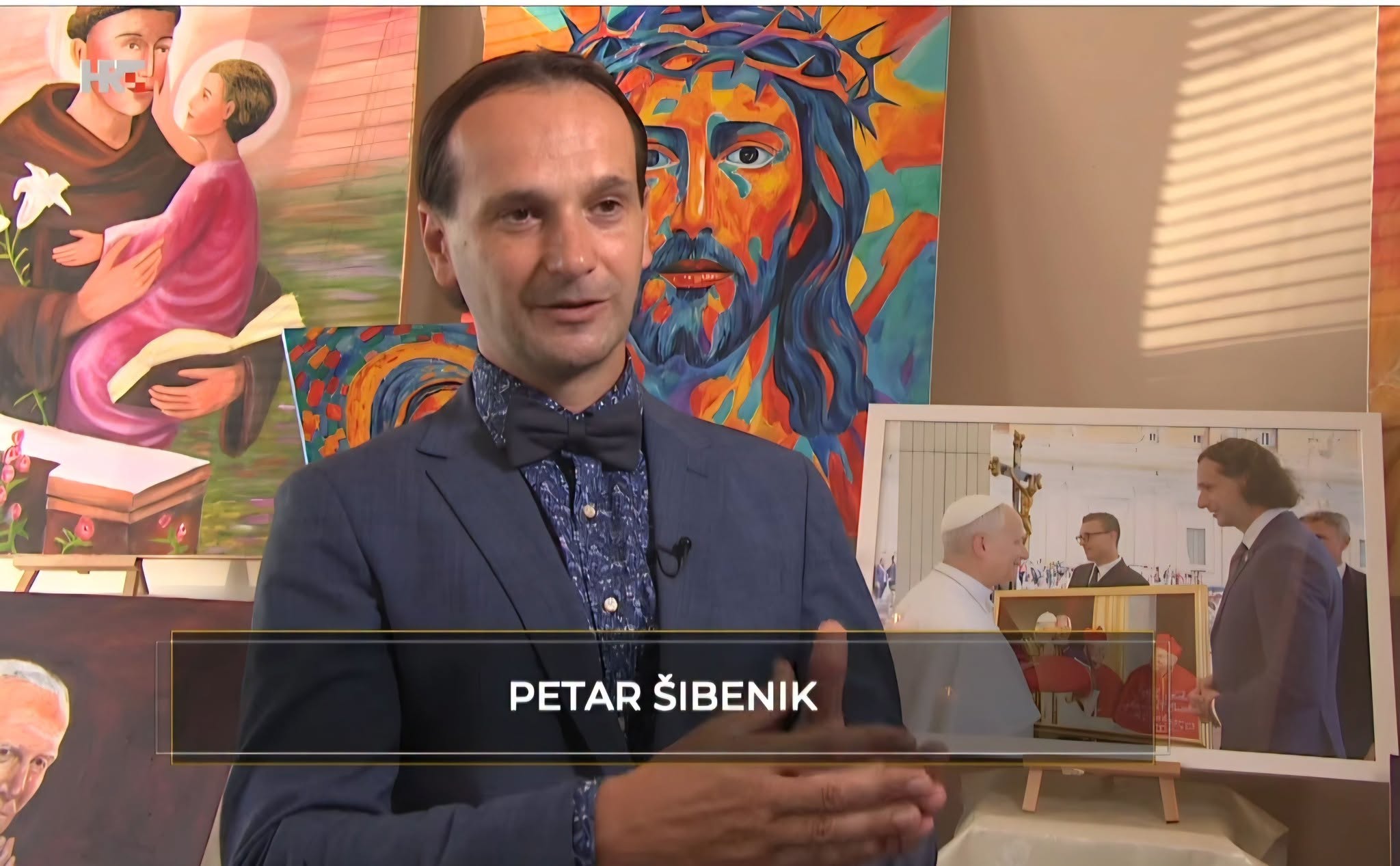
Petar Šibenik Among the Finalists
Croatian contemporary artist Petar Šibenik, whose work has been gaining increasing international attention, has achieved an important milestone: his work has been selected by the expert jury among the 50 jury finalists in the international painting competition I Colori della Mia Terra—The Colours of My Land.
The competition brings together artists from different countries and cultures around the theme of homeland, identity and belonging. Artists were invited to interpret not merely the physical appearance of the places from which they come, but also the memories, traditions, emotions and hopes those places inspire.
Colour becomes the language through which identity and homeland are expressed.
Ten finalists were selected through public voting, while another 50 works—including Šibenik’s—were chosen by an expert jury. The resulting 60 works will form the final exhibition at the Fondazione Amedeo Modigliani in Rome from 3 to 10 October 2026.
For Croatians, Šibenik’s selection carries particular significance.
His finalist painting is appropriately titled The Colours of My Homeland.
The work offers a striking contemporary interpretation of Christ the Saviour, bringing Christ into the world of people today with an almost effortless immediacy. Christ emerges as the central figure, wrapped in detail evocative of the Croatian flag and surrounded by imagery celebrating the mesmerising beauty of both coastal and continental Croatia.
It is a work in which faith, homeland and contemporary artistic expression converge.
And its selection by the international jury places a distinctly Croatian interpretation of identity before an international audience in Rome.
Šibenik’s achievement is all the more meaningful because the jury selection was based not simply on technique but also on the originality of interpretation, the strength of the message, and the work’s ability to evoke emotion.
His presence among the finalists has also been reported by Croatian media, which confirmed that the jury headed by Italian art critic Professor Vittorio Maria de Bonis selected Šibenik’s work for the final exhibition.

Croatia’s Colours in Rome
There is something especially fitting about a Croatian artist travelling to Rome with a painting called The Colours of My Homeland.
A homeland is, after all, much more than geography.
It is memory.
It is landscape and faith, history and identity, belonging and longing.
For artists, those things can become colour.
And for one week in October, Petar Šibenik’s colours of Croatia will have their place in Rome alongside those of artists representing other lands, cultures and experiences.
So, if you find yourself in Rome between 3 and 10 October 2026, consider visiting the final exhibition at the Fondazione Amedeo Modigliani and seeing the works for yourself.
For Petar Šibenik, being selected from an international field for the final exhibition is already a considerable achievement.
I wish him every success when the finalists gather in Rome.
And whatever the final decision of the jury, there is already something worth celebrating:
Croatia will be there—in the colours of his homeland.
Ina Vukic






Leave a Reply