
While United States President Donald Trump has turned to Russia’s Vladimir Putin for diesel supplies to ease soaring American fuel prices, European leaders are still searching for a common response to the energy crisis squeezing households, businesses and industries across the continent.
The contrast could hardly be more striking. Washington has announced an agreement to bring Russian diesel onto American and international markets, temporarily easing restrictions imposed in response to Russia’s invasion of Ukraine. The decision has attracted criticism from Ukraine and American lawmakers concerned that renewed energy revenues could strengthen Moscow’s capacity to continue its war.
The moral dilemma is unmistakable. Can a government claim to oppose Russian aggression while simultaneously pursuing commercial arrangements that may financially benefit the very state responsible for that aggression?
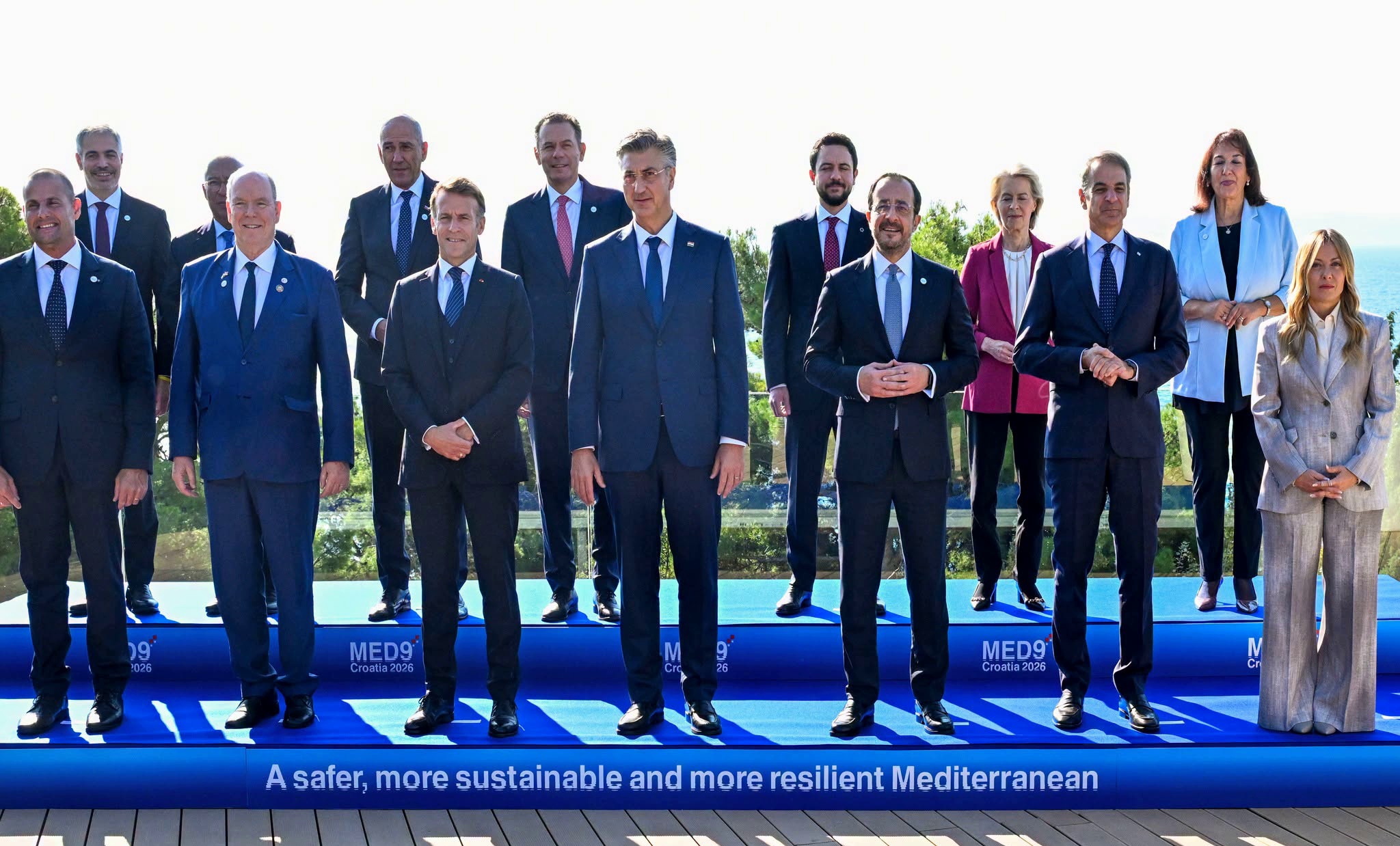
Meanwhile, at the 13th Summit of the Southern European Union countries, known as MED9, held in Split, Croatia, on 7 October 2026, European leaders discussed the need to contain energy prices, strengthen energy security and reduce dependence on imported fossil fuels.
They adopted the Split Declaration, affirming their commitment to a safer, more sustainable and more resilient Mediterranean.
These are commendable ambitions. But for European families struggling with energy bills, businesses confronting rising operating costs and industries losing competitiveness, declarations alone offer little immediate relief.
The question is no longer whether European leaders understand the seriousness of the crisis. Clearly, they do. The question is whether they possess the political determination to turn their shared concerns into sufficiently rapid and effective action.
The MED9 Summit: Unity Without Immediate Relief?
Hosted by Croatian Prime Minister Andrej Plenković, the Split Summit brought together representatives of Croatia, Cyprus, France, Greece, Italy, Malta, Portugal, Slovenia and Spain.
Among the participants were French President Emmanuel Macron, Italian Prime Minister Giorgia Meloni, Greek Prime Minister Kyriakos Mitsotakis and Slovenian Prime Minister Janez Janša. Spain was represented by State Secretary for the European Union Fernando Sampedro Marcos.
European Commission President Ursula von der Leyen and European Council President António Costa also attended, alongside European Commissioner Dubravka Šuica, Monaco’s Prince Albert II and Jordan’s Crown Prince Al Hussein bin Abdullah II.
The agenda was extensive: energy security, inflation, migration, environmental sustainability, European competitiveness, EU enlargement, Ukraine, the Middle East and the European Union’s financial framework for 2028–2034.
The Split Declaration acknowledged that Russia’s war against Ukraine and instability in the Middle East had exposed Europe’s vulnerability to disruptions in global energy supplies.
It called for targeted temporary relief, diversification of energy sources, improved infrastructure, expanded renewable and nuclear energy capacity, and measures to reduce dependence on imported fossil fuels.
These proposals cannot fairly be dismissed as meaningless. They identify important structural weaknesses in Europe’s energy system and possible ways to address them.
Yet much of their promise lies in the future.
What remains less clear is how quickly ordinary Europeans can expect meaningful relief from the financial pressures they are experiencing today.
Prime Minister Plenković acknowledged the common difficulties facing MED9 countries and stressed the need for coordinated European action to contain rising energy prices.
But agreement that something must be done is not the same as agreement on precisely what will be done, when it will happen and how its effectiveness will be measured.
For the citizens of Mediterranean Europe, those distinctions matter enormously.
The scale of Europe’s energy problem was laid bare by European Commission President Ursula von der Leyen in her address to the European Parliament in Strasbourg on 6 October.
She revealed that natural gas prices had risen by 140 per cent since the end of February, while diesel prices had doubled. Europe had consequently spent an additional €100 billion on imported fossil fuels without receiving any additional energy.
She warned that the pressure on households and industries could intensify as winter approached.
Those figures should alarm every European government.
Behind them are families forced to reconsider household spending, pensioners struggling with heating bills, transport operators facing escalating fuel costs and businesses wondering how much longer they can remain competitive.
Von der Leyen has outlined proposals for stronger joint European energy purchasing and cooperation with refineries, alongside efforts to address the structural causes of Europe’s energy vulnerability.
Such measures deserve serious consideration. However, their effectiveness will ultimately be judged by results, not announcements.
Migration, Security and the Mediterranean
Energy was not the only challenge confronting the MED9 leaders.
Irregular migration remained a major concern, particularly for Mediterranean countries situated along important migration routes.
Italian Prime Minister Giorgia Meloni emphasised that, despite international attention being concentrated on conflicts further east, Europe could not afford to neglect its southern neighbourhood.
Portuguese Prime Minister Luís Montenegro stressed the importance of shared responsibility for protecting the European Union’s external borders, cooperation with neighbouring countries and stronger action against migrant-smuggling networks.
The Summit also addressed Mediterranean biodiversity, marine resources, climate change, fisheries and the particular difficulties facing island communities.
These are legitimate concerns requiring international cooperation. Indeed, the Mediterranean’s strategic importance demands sustained attention.
But energy affordability cannot simply become another item in a lengthy catalogue of shared aspirations.
It requires urgency.
Two days after the MED9 Summit, Trump’s announcement of an arrangement for Russian diesel supplies introduced a troubling new dimension to the international energy debate.
The American administration’s argument is understandable from the standpoint of domestic economic pressure: fuel prices have risen sharply, and governments face demands to protect consumers. And from the standpoint of upcoming midterm elections.
Yet the implications extend far beyond American petrol stations.
According to reporting by Reuters and Associated Press, the agreement initially involves more than 300,000 metric tons of Russian diesel, with further deliveries envisaged. Analysts have questioned whether these supplies will produce significant or lasting price reductions.
What concerns me most is the possibility that an arrangement designed to ease economic pressure in the United States could simultaneously provide financial benefits to Russia while its war against Ukraine continues.
The precise financial consequences remain uncertain. Nevertheless, the contradiction deserves serious scrutiny.
Europe has repeatedly emphasised the need to reduce dependence on Russian fossil fuels and strengthen Ukraine’s ability to resist aggression. If economic convenience becomes sufficient justification for relaxing those principles, what message does that send to Moscow?
It is difficult to reconcile such a policy with a consistent commitment to isolating the economic resources available to Russia’s war effort.
The Split Declaration speaks of European resilience, security, solidarity and strategic independence.
Those are important principles, particularly for countries such as Croatia, whose modern history has demonstrated the enormous human cost of military aggression and the struggle to preserve national sovereignty.
But principles lose much of their force when governments fail to translate them into practical policies.
Europe needs energy measures that are economically effective, socially responsible and consistent with its stated opposition to Russia’s aggression against Ukraine.
The European Commission’s proposed measures offer a starting point. The next test will be whether member states can agree on their implementation quickly enough to make a difference.
As winter approaches, European households cannot afford endless political deliberation. Nor should Europe become so desperate for cheaper energy that it compromises the principles underpinning its support for Ukraine.
The MED9 Summit in Split demonstrated that southern European leaders recognise the seriousness of the challenge. It did not, however, provide an immediate solution to the energy crisis.
Perhaps the forthcoming European Council discussions will deliver the decisive measures that were not evident in Split.
I certainly hope so.
For Europe’s energy crisis is not merely a question of supply, prices or economic competitiveness. It is also a test of political consistency, international solidarity and moral responsibility.
Europe must find ways to ease the crushing burden of energy costs without strengthening the very forces whose aggression has contributed to its insecurity.
That is the challenge confronting Ursula von der Leyen and Europe’s national leaders.
And that, in my view, is where genuine European leadership must now be demonstrated. Ina Vukic





Leave a Reply