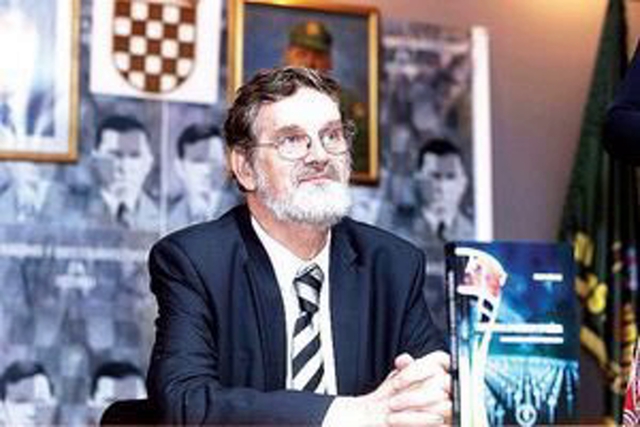

An Outstanding Mathematician, an Unwavering Croatian Patriot, and a Fearless Defender of Croatian National Identity and Historical Memory
3 September 1948 – 29 October 2026

With the passing of Academician Professor Dr. Josip Pečarić on 29 October 2026, Croatia has lost not only one of its most distinguished mathematicians and prolific scientific minds, but also a courageous intellectual whose profound love for his homeland shaped a lifetime of public engagement, patriotic commitment, and determined defence of Croatian national identity and historical memory.
Few individuals succeed in leaving such a substantial imprint upon two seemingly different worlds: the exacting discipline of mathematics and the passionate, frequently contentious arena of national history and public life. Josip Pečarić belonged to that exceptional category of intellectuals who regarded scientific achievement and responsibility towards one’s nation as complementary obligations rather than competing pursuits.
His life was distinguished by intellectual brilliance, extraordinary productivity, personal conviction, and an unyielding determination to defend what he believed to be historical truth. Whether pursuing mathematical discoveries, challenging prevailing interpretations of Croatian history, defending individuals he believed had been unjustly treated, or mobilising public support through petitions and publications, Pečarić demonstrated a remarkable unwillingness to surrender his principles for the sake of convenience or public approval.
He understood that intellectual independence carried responsibilities extending well beyond university lecture halls and scientific journals. For him, the pursuit of knowledge was inseparable from the courage to question established narratives, confront institutional authority, and defend the dignity of one’s people.
His passing marks the end of an extraordinary intellectual journey, but the influence of his scientific achievements and public interventions will undoubtedly endure.
A Brilliant Mathematical Mind of International Standing
Josip Pečarić was born on 3 September 1948 in Kotor, in the historic Bay of Kotor, a region whose Croatian cultural heritage would remain deeply embedded in his identity throughout his life.
After completing his early education in Kotor, he pursued higher studies in Belgrade, graduating in 1972 from the Faculty of Electrical Engineering with a thesis in nuclear physics. His intellectual interests subsequently developed towards mathematics, a discipline in which he would achieve international distinction.
He completed his master’s degree in 1975 and earned his doctorate in mathematical sciences in 1982, specialising in Jensen’s and related inequalities. This field became the foundation of an extraordinary scientific career.
Following research appointments at the Geomagnetic Institute in Grocka and the Faculty of Civil Engineering in Belgrade, Pečarić moved to Zagreb in 1987, where he continued his academic work at the University of Zagreb’s Faculty of Textile Technology.
He also directed the Seminar on Inequalities and Applications at the university’s Faculty of Science, contributing significantly to mathematical research, scholarly collaboration, and the development of younger generations of researchers.
His scientific productivity was nothing short of phenomenal.
Over his lifetime, Pečarić published more than 1,200 scientific papers, establishing himself as one of the world’s foremost authorities on mathematical inequalities. His publication record placed him in an exceptionally small international circle of mathematicians whose contributions to the scientific literature were of extraordinary magnitude.
His work appeared extensively in internationally recognised academic databases. MathSciNet recorded more than 500 indexed publications, Scopus listed 879, while Google Scholar and ResearchGate attributed considerably larger publication totals to his scholarly output.
Remarkably, even as his health deteriorated, his intellectual energy remained undiminished. During 2026 alone, he produced another nineteen scientific papers, demonstrating an extraordinary commitment to research until the final months of his life.
Such productivity would be exceptional for an entire research institution, let alone one individual.
As Editor-in-Chief of the international journal Mathematical Inequalities and Applications, he also played an influential role in advancing mathematical scholarship and fostering international scientific cooperation.
His achievements received prestigious institutional recognition. He became a corresponding member of the Croatian Academy of Sciences and Arts in 1992 and was elected a full member in 2000. His international affiliations included membership of the New York Academy of Sciences and corresponding membership of the Dukljan Academy of Sciences and Arts.
In 1996, he received the Croatian State Prize for Science in the natural sciences. Three years later, President Franjo Tuđman awarded him the Order of the Croatian Morning Star with the image of Ruđer Bošković.
Among mathematical colleagues, Pečarić earned the affectionate and admiring description “King of Inequalities”, a fitting acknowledgement of his exceptional contributions to the field.
Yet mathematical inequalities were not the only inequalities that commanded his attention. Beyond academia, he devoted immense energy to challenging what he regarded as injustices directed against Croatia, its history, and its people.
Patriotism as a Lifelong Moral Responsibility
For Josip Pečarić, patriotism was never merely a sentimental attachment to his birthplace or a ceremonial expression of national pride. It was a deeply held moral obligation demanding intellectual honesty, personal courage, and active participation in public life.
He believed that Croatia’s national identity, its struggle for independence, and the sacrifices of those who defended its sovereignty deserved protection against political manipulation, historical distortion, and unjust accusations.
The Croatian War of Independence, commonly known as the Homeland War, occupied a particularly important place in his public engagement.
He regarded the restoration of Croatian statehood as one of the defining achievements of modern Croatian history and believed that the sacrifices involved imposed an enduring responsibility upon future generations.
This conviction frequently brought him into confrontation with political institutions, influential commentators, and interpretations of history that he considered damaging to Croatia’s national dignity.
Rather than retreating into the relative security of academic prestige, he willingly entered public controversies, often at considerable personal cost.
Through more than 200 books, brochures, and open letters, together with petitions, essays, and public statements, Pečarić established himself as one of Croatia’s most prolific patriotic publicists.
His writings addressed historical personalities, political controversies, national sovereignty, cultural identity, and the treatment of individuals whose contributions to Croatian history he believed were being misrepresented.
He was not content merely to observe public debates. He sought to influence them through argument, documentation, organisation, and the mobilisation of like-minded citizens.
For Pečarić, silence in the face of perceived injustice was itself a form of acquiescence.
Defending the Croatian Generals and the Homeland War
Among his most determined public campaigns was his defence of Croatian military commanders prosecuted before the International Criminal Tribunal for the Former Yugoslavia in The Hague.
Pečarić strongly opposed interpretations that, in his assessment, threatened to portray Croatia’s military liberation of occupied territory as the implementation of a criminal national policy.
He regarded such interpretations as an affront to the legitimacy of Croatia’s struggle for independence and to the sacrifices of those who had defended the country.
His opposition was neither passive nor confined to occasional public commentary.
He initiated and supported petitions demanding what he considered fair treatment of Croatian generals and greater accountability from Croatian political institutions.
One particularly significant initiative called for postponement of Croatia’s referendum on European Union membership until a decision concerning the generals had been reached.
The appeal attracted nearly 1,200 signatories, including more than 120 bishops, archbishops, academicians, university professors, and scientists.
Another initiative addressed to the United Nations Security Council gathered more than 2,300 signatures.
These campaigns demonstrated Pečarić’s considerable ability to bring together individuals from different professional and social backgrounds around causes he considered essential to Croatian national dignity.
He believed that the defence of historical truth and national sovereignty should not be left exclusively to politicians. Scientists, religious leaders, intellectuals, and ordinary citizens, he argued, shared responsibility for the moral direction of their society.
His support for Dario Kordić, convicted by the international tribunal and sentenced to twenty-five years’ imprisonment, reflected the same determination.
Pečarić questioned the reliability of evidence and testimony presented against Kordić and publicly challenged the judicial conclusions, which he regarded as unjust. Kordić maintained his innocence and rejected a proposed plea agreement, circumstances that Pečarić considered significant in his advocacy.
His interventions reflected his conviction that judicial judgments, particularly those carrying profound historical and political consequences, should remain open to critical examination.
Challenging Historical Narratives
Pečarić’s engagement with Croatian history extended beyond the Homeland War into the deeply contested legacy of the Second World War and its aftermath.
He became associated with efforts to re-examine prevailing interpretations of the Jasenovac concentration camp, supporting publications and arguments that challenged established historical accounts.
His interventions in this field were controversial and attracted criticism, particularly because the history of Jasenovac involves documented mass atrocities committed under the Ustaša regime.
Nevertheless, Pečarić regarded the questioning of accepted historical interpretations as an essential element of intellectual freedom and believed that historical claims should remain subject to scholarly scrutiny.
His approach reflected a broader conviction that no interpretation of national history should be considered beyond examination simply because it enjoyed institutional or political support.
Whether his conclusions were accepted or rejected, his willingness to enter highly sensitive historical debates became a defining feature of his public identity.
He believed that a nation could face its future confidently only when its citizens were prepared to examine its past, defend its legitimate achievements, and challenge what they considered historical injustice.
Defending Croatia’s Cultural, Political, and Religious Figures
Three prominent Croatian personalities occupied a particularly important place in Pečarić’s patriotic writings: Marko Perković Thompson, Franjo Tuđman, and Cardinal Alojzije Stepinac.
Although representing different spheres of national life, each embodied values and historical experiences that Pečarić considered essential to Croatian identity.
For him, Marko Perković Thompson represented more than popular music. Thompson’s songs evoked the Homeland War, remembrance of fallen defenders, patriotic attachment, and the emotional experiences of a generation shaped by Croatia’s struggle for independence.
When the singer faced public criticism, controversy, and demands for restrictions on his concerts, Pečarić became one of his most outspoken defenders.
Through publications including Hajka na Thompsona and Thompson pjesmom za Hrvatsku (The Campaign Against Thompson, and Thompson with a Song for Croatia), he challenged what he regarded as campaigns of political and cultural exclusion.
His defence reflected a broader concern about freedom of artistic expression and the place of patriotic cultural traditions within Croatian public life.
Franjo Tuđman, Croatia’s first president, occupied an equally significant position in Pečarić’s understanding of modern national history.
He regarded Tuđman as the decisive political architect of Croatia’s restored independence and one of the most consequential Croatian historical figures of the twentieth century.
Pečarić repeatedly defended Tuđman’s achievements against interpretations he believed diminished his role in establishing and defending the modern Croatian state.
His commitment extended into academic institutional affairs, where he opposed candidates whose public positions, he considered hostile to Tuđman’s historical legacy. According to accounts of his activities, his interventions contributed on two occasions to preventing such candidates from entering the Croatian Academy of Sciences and Arts.
Cardinal Alojzije Stepinac represented another dimension of Pečarić’s historical and moral commitments.
He regarded Stepinac as a symbol of religious conscience, personal courage, and resistance to political coercion.
Pečarić advocated for the defence and rehabilitation of Stepinac’s reputation, challenging portrayals he considered ideologically motivated or historically unjust.
For him, Stepinac’s legacy was inseparable from the broader experience of Croatia under totalitarian rule and the struggle to preserve moral independence amid political oppression.
Together, Thompson, Tuđman, and Stepinac represented cultural remembrance, political statehood, and spiritual conscience.
Pečarić’s defence of these figures reflected his belief that national identity survives not only through institutions and territorial sovereignty, but also through the preservation of historical memory and the recognition of individuals who have shaped a people’s collective experience.
A Fearless Voice in Public Controversy
Josip Pečarić was not an intellectual who preferred comfortable neutrality.
His public interventions were frequently provocative, his convictions uncompromising, and his readiness to confront prevailing opinion unmistakable.
He organised petitions, circulated open letters, encouraged public debate, and assembled networks of academics, clergy, writers, artists, and citizens willing to support causes he considered important.
One of his most controversial initiatives came in 2015, when he advocated introducing the greeting “Za dom spremni” (For Homeland Ready) as an official greeting of the Croatian Armed Forces.
The proposal attracted more than 4,300 supporters but also substantial opposition because of the greeting’s historical association with the Ustaša regime.
Pečarić defended the initiative through his own interpretation of Croatian history, illustrating his willingness to advocate positions that remained deeply divisive within Croatian society.
His historical and political views were frequently challenged, and many generated sharp disagreement.
Yet controversy rarely deterred him.
He regarded freedom of expression as indispensable to a democratic society and believed that intellectuals had a particular responsibility to defend the right to question powerful institutions and prevailing orthodoxies.
In this sense, he increasingly saw himself as a dissident within contemporary Croatian public life.
Those close to him witnessed the personal burdens of his activism, including the pressures on his family.
Nevertheless, he remained steadfast, approaching opposition with the same persistence that characterised his scientific research.
His patriotism was expressed not simply through words, but through sustained intellectual labour, organisational effort, and an extraordinary willingness to defend unpopular convictions.
Boka Kotorska: The Homeland Within His Homeland
Despite spending much of his professional life in Zagreb, Pečarić never relinquished his profound attachment to Boka Kotorska, the Bay of Kotor, and its Croatian cultural heritage.
His birthplace remained an enduring source of personal identity, historical interest, and emotional belonging.
He devoted numerous publications to the Croatian community of the region, its historical personalities, cultural achievements, and contributions to the broader Croatian national experience.
For Pečarić, preserving this heritage was not merely an exercise in regional nostalgia. It was an important responsibility towards a community whose history and identity he believed deserved greater recognition.
His attachment to Boka Kotorska demonstrated that national identity could transcend contemporary political borders while remaining deeply rooted in local traditions, historical continuity, and cultural memory.
It was a connection he carried throughout his life, linking his earliest experiences in Kotor with his later achievements and public commitments in Zagreb.
A Legacy Beyond Scientific Achievement
The legacy of Academician Josip Pečarić cannot be measured by publication statistics alone, however extraordinary those figures may be.
His contributions to mathematical inequalities secured him a lasting place in international scientific scholarship. His academic leadership helped strengthen research collaboration and encouraged the development of mathematical knowledge.
His extensive public writings created a substantial record of Croatian political and historical debate across several decades.
His petitions and initiatives demonstrated the influence that a determined individual could exercise through intellectual engagement and collective action.
His positions were not universally shared, nor were they free from controversy. Yet even those who disagreed with him could recognise the extraordinary consistency, energy, and determination with which he pursued his convictions.
He refused to separate the privileges of intellectual achievement from what he understood to be the obligations of citizenship.
His life reminds us that scientific brilliance does not necessarily demand withdrawal from the social and political concerns of one’s nation. In Pečarić’s case, scholarly distinction strengthened his determination to participate in those concerns.
Beyond his public achievements, however, there remains the immeasurable personal loss experienced by those closest to him.
His three daughters, sons-in-law, and grandchildren have lost a beloved father, father-in-law, and grandfather.
His friends, colleagues, fellow patriots, and admirers have lost a remarkable individual whose intellectual vitality, generosity of effort, and devotion to his convictions enriched their lives.
To them, his passing represents far more than the conclusion of an illustrious academic career.
It is the loss of a familiar voice, a steadfast ally, and a man whose determination seemed capable of overcoming even the limitations imposed by declining health.
Farewell to an Extraordinary Croatian
With the death of Josip Pečarić, Croatia bids farewell to a scholar of exceptional international standing, an extraordinarily productive author, a courageous public intellectual, and a patriot whose devotion to his homeland remained unwavering until the end.
His life united the precision of mathematics with the passionate uncertainties of history and politics.
In one sphere, he pursued demonstrable truths through rigorous scientific reasoning. In the other, he challenged prevailing interpretations and defended convictions grounded in his understanding of Croatian history, sovereignty, and national dignity.
He leaves behind a remarkable scientific inheritance, an extensive body of patriotic writing, and the memory of a man who refused to let intellectual achievement serve as an excuse for public silence.
Future generations will continue to encounter his mathematical discoveries, examine his publications, and debate his historical and political positions.
That, too, is part of the legacy of an individual who believed that ideas mattered, that history mattered, and that the dignity of one’s homeland deserved lifelong commitment.
For those of us privileged to know him, admire his achievements, and share his concerns for Croatia, gratitude now accompanies profound sadness.
Josip Pečarić devoted his extraordinary mind to science and his passionate voice to Croatia.
His scientific achievements deserve lasting recognition, his intellectual independence deserves remembrance, and his contribution to Croatian public life deserves thoughtful historical consideration.
May the Croatian soil rest lightly upon him.
Rest in the peace of God, dear Josip.
Josip Stjepandić, President
Ina Vukić, Vice-President
Croatian Academy of Sciences and Arts in Diaspora and Homeland (HAZUDD)






Leave a Reply