
The profound impact that Ken Kesey’s 1962 novel One Flew Over the Cuckoo’s Nest and its celebrated 1975 film adaptation had on my generation is difficult to put into words. More than fifty years later, its disturbing portrayal of institutional cruelty, authoritarian control, and the crushing of the human spirit continues to haunt me. Beneath its tragic narrative lay a powerful confrontation between oppression and the irrepressible human desire for dignity, freedom, and self-determination.
The cold, authoritarian, and at times sadistic conduct of psychiatric hospital staff depicted in the film left an indelible impression on me. Particularly horrifying were the scenes involving the use of lobotomy as an instrument of punishment and submission, stripping a human being of his personality, independence, and very essence. Those images unsettled me deeply, and their moral implications have remained with me ever since.
A few years after watching the film, I found myself serving on a government professional steering committee in Sydney, advocating for fundamental reforms to psychiatric care. Our work supported the closure of large psychiatric institutions and the transition towards mainstream hospital services and community-based mental health care. At the heart of those reforms was the conviction that people experiencing mental illness were entitled to the same dignity, protection, and human rights as every other member of society.
I believed that the days when psychiatric patients could be subjected to such degrading and potentially fatal treatment at the hands of those entrusted with their care were being consigned to history.
How terribly mistaken that belief now seems.
The shocking news emerging from Croatia in recent days has brought those haunting memories rushing back, accompanied by disbelief, anger, and profound sorrow.
According to Croatian media reports, four medical technicians employed at the Jankomir Psychiatric Hospital, also known as St John Psychiatric Hospital, in Zagreb have been arrested on suspicion of aggravated murder following the death of 32-year-old Croatian sportsman Kristian Josip Periš on 21 October 2026.
The circumstances surrounding his death, as reported and depicted in disturbing surveillance footage made public in early November, have sent shockwaves through Croatian society. They raise questions not only about the conduct of individual hospital employees but also about institutional accountability, professional ethics, and the protection of some of society’s most vulnerable people.
Kristian Josip Periš was no stranger to achievement or discipline. His background included athletics, education in kinesiology, and involvement in parasports. Yet, on 21 October 2026, he became a patient in a psychiatric institution from which he would never emerge alive.
According to media accounts, his family had called emergency medical services and the police out of concern for his altered mental state and his need for medical assistance. Reports indicated that he was not behaving aggressively.
As police escorted him towards the locked entrance of the hospital ward, Periš reportedly protested in words that now seem almost unbearably prophetic:
“I don’t want to go in there. Last time you brought me here I was beaten and tied up.”
Those words should trouble the conscience of every person who hears them.
They suggest a man who feared the very institution to which he was being taken for help. Whether his earlier reported experiences were formally investigated, documented, or addressed remains an important question.
What is known is that Kristian Josip Periš died in that hospital the same night.
The Croatian public did not learn of the disturbing circumstances surrounding his death until early November, when police investigations and media reporting brought the matter into the open. Around 8–11 November, accounts of the incident, together with deeply disturbing surveillance footage, began circulating publicly.
Questions have since arisen about the hospital administration’s handling of the death, the timing of notifications to the competent authorities, and whether the circumstances were accurately and promptly reported.
These questions demand transparent and independent answers. Any attempt to conceal, minimise, or misrepresent the circumstances of a patient’s death would represent a grave betrayal of public trust.
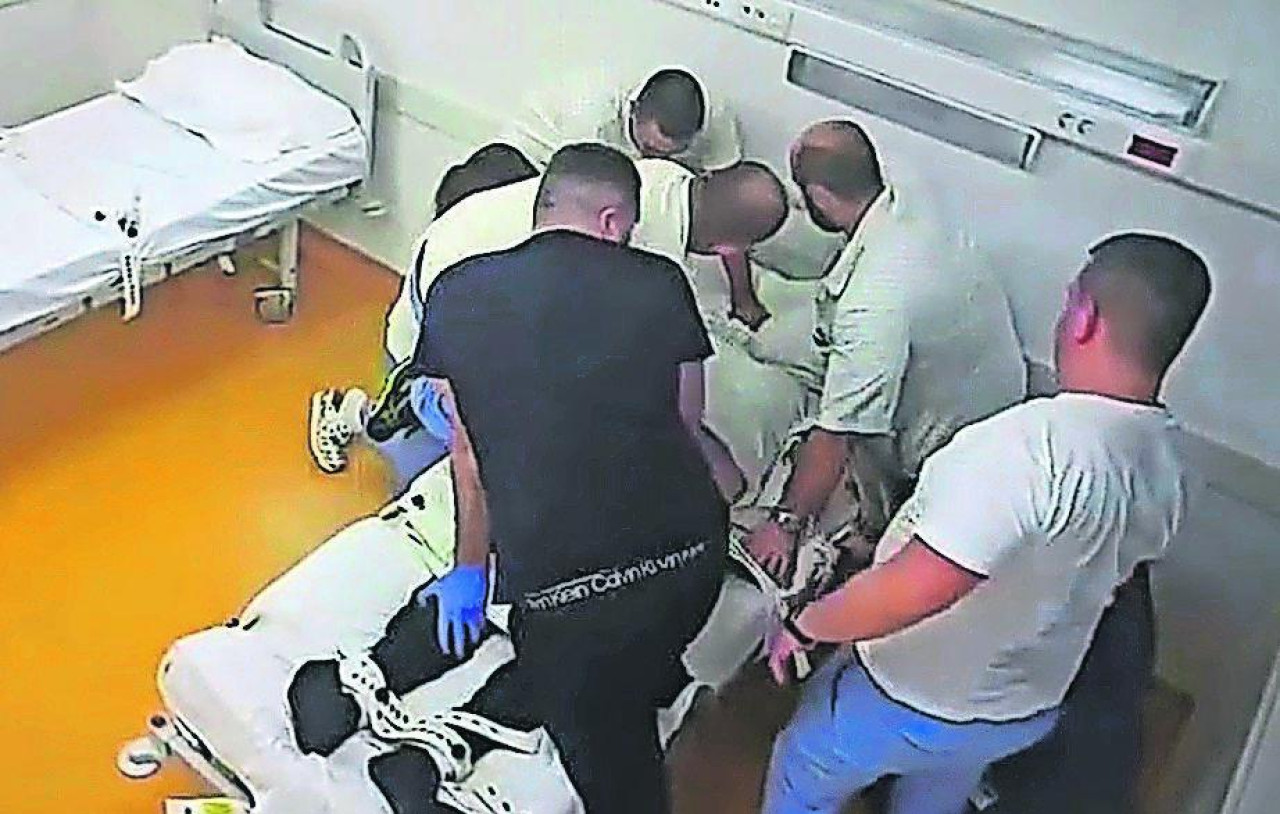
The surveillance footage reportedly shows Periš restrained on a hospital bed while several members of staff subjected him to an intervention of extraordinary physical force.
According to published accounts, his head was pressed down with a pillow over his face, while pressure was applied to his neck and chest with knees. Reports have described multiple fractured ribs, repeated blows and scratches, and the development of brain and pulmonary oedema.
The footage appears to show four male medical technicians directly involved in the forceful intervention, while three other men assisted in holding Periš’s arms and legs against the bed, despite his already being secured by heavy mechanical restraints.
Perhaps one of the most disturbing aspects of the reported footage is the presence of a female doctor standing beside the bed, apparently observing the intervention as it unfolded.
The entire episode reportedly lasted between eight and ten minutes.
Eight to ten minutes.

An agonisingly long time when a human being is struggling beneath the weight and force of several people, unable to move freely, unable to escape, and dependent entirely upon those restraining him to recognise the limits of his physical endurance.
When Periš reportedly became unresponsive and lost consciousness, staff attempted resuscitation. Their efforts were unsuccessful.
A 32-year-old man who had entered a hospital in need of medical care was dead.
The precise medical cause of his death, the individual actions of those present, and their criminal responsibility must ultimately be established through forensic evidence and the judicial process. Nevertheless, the reported circumstances are so appalling that they demand far more than routine expressions of regret.
I struggle to imagine even the most inventive Hollywood makers of sadistic horror films devising a scene more disturbing than the one described and seen in these reports and video footage.
Yet this was not fiction. It was not a theatrical depiction of institutional brutality intended to provoke audiences into moral reflection.
It was a real man, in a real hospital, whose life ended in circumstances that should be unthinkable in a modern healthcare institution.
And that is what makes this tragedy so profoundly disturbing.
The death of Kristian Josip Periš has understandably provoked public outrage throughout Croatia. As the criminal investigation proceeds, attention has turned to the hospital administration, its supervisory structures, the Ministry of Health, and the City of Zagreb’s responsibilities regarding the institution.
Political accusations and counteraccusations have erupted, with various public figures seemingly more concerned with assigning political blame than confronting the deeper institutional failures that may have allowed such a tragedy to occur.
Some professionals have reportedly defended the staff involved, suggesting they were merely “doing their job”.
Such a defence, without careful examination of the facts, is deeply troubling.
Physical restraint is not a licence to inflict suffering. Nor does a patient’s psychiatric condition diminish the duty of care owed to that person.
The use of restraint in psychiatric settings is governed by legal, clinical, and ethical obligations. Such interventions must be justified, proportionate, carefully supervised, and employed only in accordance with applicable procedures.
The fundamental purpose of restraint is to prevent immediate harm, not to punish, humiliate, intimidate, or overpower a patient through unnecessary force.
Whether the staff involved complied with these requirements is a matter that investigators must establish. But the mere assertion that employees were performing their duties cannot excuse conduct that may have exceeded lawful and medically justified limits.
Deaths associated with restraint in mental health facilities are a recognised and serious patient-safety concern. Physical restraint may involve staff holding a patient, mechanical devices restricting movement, or medications administered specifically to control behaviour.
Whatever the method, the obligation to protect the patient’s life remains paramount.
Close and continuous monitoring is essential because restraint can interfere with breathing, compromise circulation, cause traumatic injuries, or precipitate a medical emergency. The possibility that a patient may become distressed, physically exhausted, or unresponsive must never be overlooked.
The greater the force used, the greater the responsibility to ensure that the intervention does not become a threat to the very life it is supposedly intended to protect.
The tragedy in Zagreb therefore raises a question that goes far beyond the actions of those immediately involved: How could a patient in a psychiatric hospital allegedly be subjected to such force, in the presence of several healthcare workers, without effective intervention to prevent his death?
The criminal investigation is continuing, and further evidence may clarify the precise sequence of events, the actions of each participant, and the responsibilities of those who supervised the incident or subsequently reported it.
Meanwhile, public anger is mounting. Protests have reportedly been announced, and accounts of other alleged incidents involving excessive physical restraint and mistreatment in Croatian psychiatric institutions are beginning to emerge.
Such allegations must be investigated individually and fairly. They must neither be dismissed for being uncomfortable nor accepted without proper examination.
But their emergence should compel the Croatian authorities to undertake a much broader review of psychiatric care, restraint practices, complaint procedures, staff training, clinical supervision, and independent oversight.
A criminal prosecution, however necessary, cannot by itself answer every question raised by this tragedy.
Punishing individuals found guilty of wrongdoing is one matter. Ensuring that the institutional conditions which may have permitted such wrongdoing are identified and corrected is another.
Both are essential.
For me, the death of Kristian Josip Periš has reopened memories of the psychiatric institutions and practices that reformers in Australia worked so determinedly to change decades ago. It has also stirred a deeply uncomfortable recognition of patterns of institutional behaviour that I remember from communist Yugoslavia.
The apparent reluctance to accept responsibility. The shifting of blame from one authority to another. The questions surrounding the accuracy and timing of official reports. The suspicion that institutional reputation may be receiving greater protection than the dignity and rights of the individual.
These are troubling echoes of a political and administrative culture in which protecting those in authority too often took precedence over exposing wrongdoing and securing justice.
I am not suggesting that every unanswered question constitutes proof of a cover-up. That must be established through evidence. But the possibility of institutional concealment, and the apparent delays and inconsistencies reported in this case, demand the closest scrutiny.
What concerns me most is how little of the public debate, at least so far, appears to be directed towards the urgent need for a comprehensive examination of Croatia’s mental health services and the practices that govern them.
If this tragedy results only in political finger-pointing, administrative reshuffling, and the prosecution of a handful of individuals, an opportunity to confront potentially systemic failures will have been lost.
The Croatian public deserves to know whether existing safeguards are adequate, whether restraint procedures are properly enforced, whether patients’ complaints are taken seriously, and whether hospital staff are held accountable when those safeguards fail.
Above all, psychiatric patients and their families deserve the assurance that seeking medical help will not expose them to degrading treatment, avoidable injury, or death.
More than half a century after One Flew Over the Cuckoo’s Nest exposed the terrifying consequences of unchecked institutional power, I find myself confronting the same fundamental question that troubled me when I first watched that film:
What happens to human dignity when the people entrusted with protecting the vulnerable are themselves permitted to become instruments of fear?
Kristian Josip Periš entered a psychiatric hospital because his family believed he needed help. He did not enter it to be punished. He did not surrender his human rights at its locked doors. And he certainly did not deserve to lose his life there.
His death must not become merely another scandal swallowed by political controversy and eventually forgotten.
It must become a demand for truth, justice, accountability, and meaningful reform.
For a society that calls itself democratic and civilised, the measure of its humanity lies not merely in the rights it proclaims, but in how faithfully it protects those who are least able to defend themselves. Ina Vukic







Leave a Reply