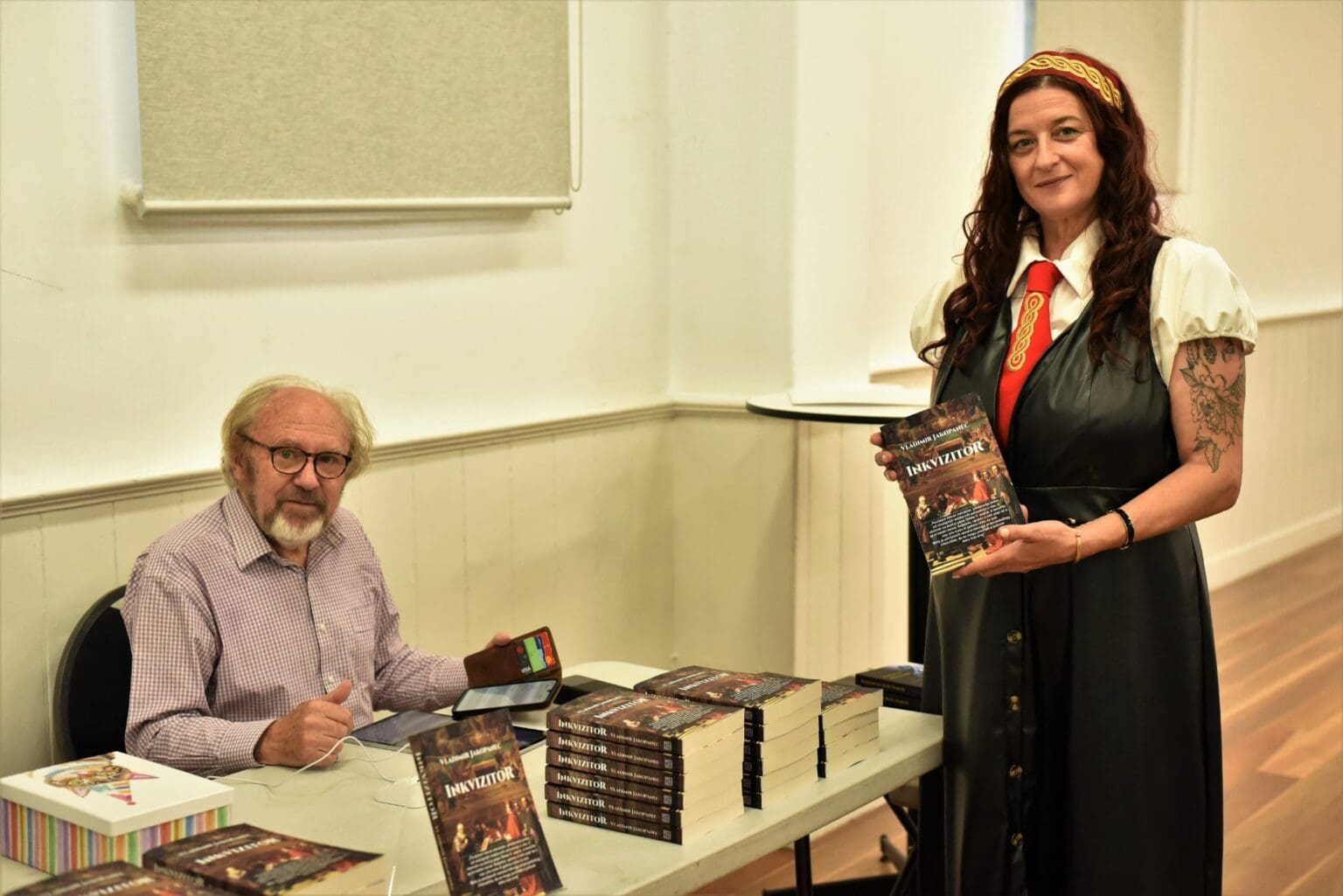

One of the leading Australian-Croatian, Melbourne-based authors, Vladimir Jakopanec (Jakopanetz), brings sixteenth-century Europe vividly to life in his historical novel, exploring the extraordinary legacy of Pope Sixtus V, who was of Croatian origin, and the timeless conflict between religious devotion and the desires of the human heart.
“The Inquisitor”, a novel by Melbourne-based author Vladimir Jakopanec, is a brilliantly crafted and deeply immersive work of historical fiction that transports readers into the turbulent religious, political and social world of sixteenth-century Rome and Europe. Masterfully blending historical fact with imaginative storytelling, Jakopanec creates a compelling narrative that captivates the reader from beginning to end.
Written in Croatian language (for now) and launched in Melbourne on 25 October 2026, the novel brings to life the extraordinary story of Pope Sixtus V, a pontiff of Croatian ancestry whose remarkable achievements have largely faded from popular historical memory. Through the eyes of his determined biographer, Bishop Alfonso Rugierri, who travels across the land in search of little-known details about the Pope’s life and legacy, readers are drawn into a fascinating world of ecclesiastical power, political ambition, religious upheaval and deeply human struggles.

Jakopanec’s meticulous attention to historical detail gives the novel an exceptional sense of authenticity. The splendour of Renaissance Rome stands in striking contrast to the harsh poverty and suffering of ordinary people, while the Catholic Church emerges as an institution grappling with religious schisms, challenges to its authority, internal rivalries and the moral complexities of its own teachings.
The novel, published by Aspectum, vividly captures the political intrigues that shaped sixteenth-century Europe, as well as the tensions arising from the Protestant Reformation and the Catholic Church’s efforts to preserve its influence and authority. Yet beneath this richly textured historical narrative lies something even more compelling: an intimate exploration of faith, forbidden love, human vulnerability and the profound moral dilemmas surrounding clerical celibacy, earthly happiness and the promise of life after death.
At the heart of the story is Bishop Alfonso Rugierri, a man whose intellectual ambitions and spiritual devotion are increasingly challenged by the desires of his own heart.
Rugierri is determined to write a definitive biography of Pope Sixtus V, a remarkable figure whom he believes history has neither adequately recognised nor treated with the generosity his accomplishments deserve. During a papacy lasting only five years, Sixtus V undertook an extraordinary programme of architectural and urban transformation, contributing to the completion of the dome of St Peter’s Basilica, the construction and restoration of churches and aqueducts, and the reorganisation of Rome’s infrastructure. His vigorous efforts to suppress criminal gangs and enforce ecclesiastical discipline further distinguished his pontificate.
In many circles, he became known as the “Builder of Rome”, a title reflecting achievements that, in Rugierri’s estimation, surpassed those of other pontiffs over several decades.

But Rugierri’s quest to restore the Pope’s rightful place in history gradually becomes intertwined with a far more intimate and dangerous struggle.
Although bound by his priestly vows and regarded by influential Church figures as a man destined for greater ecclesiastical responsibilities, Rugierri is, above all, a man of flesh and blood. His spiritual convictions are deeply rooted, yet his humanity refuses to be confined by the rigid boundaries imposed by his calling.
His life takes a dramatic turn when he falls passionately in love with the Marquise Giulia, a woman whose beauty, warmth, and companionship awaken emotions he can neither suppress nor reconcile easily with his religious obligations.
When Giulia becomes pregnant with his child, Rugierri confronts the most profound crisis of his life.
His love for her is no fleeting indulgence. It becomes the very foundation upon which he begins to question the Church’s insistence upon celibacy and the apparent contradiction between devotion to God and the natural human longing for intimacy, companionship and family.
It is precisely this conflict between his priestly identity and his manhood that gives rise to some of the novel’s most compelling reflections. Rugierri’s desires provoke questions that gradually evolve into convictions, justifications and deeply personal interpretations of what constitutes sin.
In one particularly moving passage, Jakopanec lays bare the bishop’s emotional turmoil:
“…Suddenly, lying there in bed beside her—sensing the scent of her body and her freshly washed hair, watching her still-firm breasts rise as she spoke and tremble so charmingly when she laughed—he felt helpless. No, he could not do it. He could not leave her, at least not now. Some other solution had to be found; for surely, this—whatever was happening with her—could not be a sin. They were both alone, both yearning for life; she knew where she stood with him, and he was well aware of his own position—no one was deceiving anyone—so how could there possibly be any sin in this? In any case, it seemed to him that celibacy was not a commandment from God… After all, he had never in his life experienced anything more beautiful or more sacred. It was not merely a matter of lust when he beheld her, so lovely and alluring. He loved her—he truly loved her—and how could that possibly be a sin? Granted, they could not marry and live as husband and wife, but they could still see each other—perhaps once every two weeks. Life would be easier for both of them, and it would carry far more meaning. They simply had to agree to keep their sacred bond a secret. They would have to arrange it carefully, ensuring that not a single soul ever learned what was truly transpiring between them. It would all simply appear to be a beautiful, unusual friendship.”
This passage captures the extraordinary emotional and spiritual complexity that makes Rugierri such a memorable character. His internal struggle is not simply between lust and religious duty, but between two forms of love that he cannot bring himself to believe must necessarily be incompatible.
Why, he wonders, should a life devoted to serving God demand the rejection of the beauty, tenderness and physical pleasures of God’s own creation? Why should the genuine love of two people, freely given and deeply felt, be regarded as sinful merely because it exists outside the boundaries prescribed by ecclesiastical law?
These are not abstract theological questions for Rugierri. They arise from the very depths of his being, from the conflict between the vows he has taken and the life he suddenly realises he longs to live.
He is prepared to abandon his ecclesiastical position, marry Giulia and become a father to their unborn child. Yet the powerful forces operating within the Church are unwilling to accommodate his personal desires, however sincere or deeply felt.
His longing for love and family is rendered almost insignificant against the institutional ambitions, expectations and calculations of those who wield ecclesiastical authority.
Jakopanec develops this conflict with remarkable narrative skill, weaving together romance, religious conviction, secrecy and political intrigue in ways that sustain both emotional engagement and an ever-present sense of danger.
The consequences for Rugierri and Giulia, should their intimate relationship be exposed, could be catastrophic. Their love unfolds under the constant shadow of discovery, making even the most tender moments between them resonate with apprehension.
What makes the novel particularly absorbing is the author’s ability to introduce intrigue and high stakes into seemingly tranquil settings. Conversations over dinner at the bishopric, encounters among influential Church figures and moments of apparently harmless social interaction become charged with hidden motives, unspoken threats and the possibility of betrayal.
The reader is drawn into an atmosphere where outward civility can conceal ruthless ambition, where spiritual authority and political power are inseparably entwined, and where the smallest indiscretion can have devastating consequences.
Yet Jakopanec never allows the historical setting or ecclesiastical intrigue to overwhelm the humanity of his characters.
Indeed, one of the novel’s greatest achievements is its portrayal of men of the Church not merely as representatives of religious authority, but as complex individuals shaped by ambition, conviction, fear, affection, weakness and desire.
Rugierri’s faith is genuine and profound. His connection to God permeates his existence, even as he struggles with the restrictions his religious calling imposes on his life. He does not cease to believe because he loves Giulia. Rather, his love forces him to confront the possibility that the institutional interpretation of religious duty may not always reflect the fullness of human experience or divine intention.
His body becomes the meeting place of these seemingly irreconcilable forces: profound faith and physical longing, spiritual discipline and emotional vulnerability, religious obedience and the yearning for personal freedom.
Giulia, the forbidden fruit of his earthly existence, becomes at once his greatest joy and his deepest torment. And he, to her.
Through this beautifully rendered conflict, Jakopanec invites readers to consider whether the sacred and the sensual must always stand in opposition, and whether genuine love can ever be entirely separated from spiritual truth.
The novel also raises fascinating questions about the relationship between earthly life and the promise of eternity. What meaning should be attached to the pleasures, sacrifices and sufferings of human existence when measured against the Church’s teachings about salvation and life after death? And how does an individual reconcile personal conscience with the demands of an institution that claims spiritual authority over that conscience?
These questions give “The Inquisitor” an intellectual and philosophical depth that extends well beyond the conventions of historical fiction.
At the same time, Jakopanec never loses sight of the historical figure whose life provides the original impetus for Rugierri’s journey.
Pope Sixtus V emerges as a formidable and fascinating presence, a man whose extraordinary achievements, uncompromising exercise of authority and lasting contribution to Rome’s physical and institutional transformation deserve renewed attention.
Through Rugierri’s determination to uncover the neglected details of the pontiff’s life, the novel becomes an exploration of historical memory itself: how reputations are constructed, how achievements are forgotten, and how the passage of time can obscure even those individuals who profoundly shaped the world in which they lived.
For me, however, the novel’s most enduring strength lies in its extraordinary understanding of human nature.
Rugierri is neither an idealised servant of God nor a simple rebel against religious convention. He is a deeply human figure whose contradictions make him all the more believable. His faith does not extinguish his desires, and his desires do not erase his faith. Instead, the two exist within him in a state of painful, sometimes beautiful, tension.
The same humanity emerges in the other ecclesiastical characters who populate the novel. Beneath their robes, titles and positions of authority are individuals subject to the same weaknesses, ambitions, affections and moral uncertainties as everyone else.
This is what makes “The Inquisitor” so special to me.
Jakopanec succeeds in stripping away the distance that centuries of history and layers of religious ceremony can place between readers and the people who inhabited that world. He allows us to see them not as remote figures preserved in historical records, but as living, breathing human beings whose hopes, fears, desires and struggles are remarkably familiar.
In doing so, he reminds us that history is not made solely through great political decisions, religious decrees or monumental architectural achievements. It is also shaped by the private struggles of individuals whose hearts and consciences are caught between personal longing and the demands of their times.
“The Inquisitor” is therefore much more than a historical novel about sixteenth-century Rome, the Catholic Church or the remarkable Pope Sixtus V. It is a deeply engaging meditation on love, faith, conscience, sacrifice and the enduring complexity of being human.
Rich in historical atmosphere, compelling in its characterisation and thought-provoking in its exploration of moral and spiritual conflict, Vladimir Jakopane’s novel offers readers a literary journey that is as emotionally rewarding as it is intellectually stimulating.
It is a novel that brings history to life while reminding us that, across the centuries, the human heart has remained remarkably unchanged.
Ina Vukic
Book purchase inquiries to vjakopanetz@gmail.com.







Leave a Reply